Question of the day

By Buddhadeb Bhattacharjee to Kerala Communists

Buddhadeb Bhattacharjee took a swipe at the hardline fringe of the Kerala unit which has yet to come to terms with the reforms within. ”Why should we oppose foreign companies if they bring in jobs? Why should we oppose shopping malls from MNCs if they provide employment to our jobless youth?” he said. [Why are you afraid of foreign firms if they give jobs]

Jobless youth are required to destroy public property and bring life to standstill depending on if Achyutanandan or Pinarayi Vijayan got out on the wrong side of the bed. Giving such lectures will not change anything and so we need to follow the tactics in HOWTO: Develop Kerala document.

What Aryan Invasion – II

“The perennial concept of people, language and agriculture arriving in India together through the northwest corridor does not hold up to close scrutiny,”

The proponents of the Aryan Invasion/Migration theory believe that Central Asian people bought agriculture to India. Also since we Indians descended from them, there should be some evidence for this in our genetic makeup.
May such theories are being put to rest now. Newly surfaced evidence shows that agriculture developed in Middle Ganga Valley much before Europe. Research by Oppenheimer, Michael Petraglia and Hannah James show that Europeans are descendents of people from India. Two recent genetic studies done in India dispute the European parenthood theory.

A study by scientists at the Central Forensic Science Laboratory in Calcutta has revealed that most present-day Indians are the descendants of early humans who began to arrive in India about 60,000 years ago. It suggests that modern Indians do not owe much genetic makeup to central Asians who arrived much later.

The findings do lend support to the migration of people from central Asia into India.

“Although we did find genetic signatures from central Asian populations in Indian communities, there are not enough (signatures) to prove large-scale mixture with local populations,” research team leader Vijendra Kashyap told The Telegraph.

“The perennial concept of people, language and agriculture arriving in India together through the northwest corridor does not hold up to close scrutiny,” Kashyap and his colleagues at the University of Oxford and the Estonian Biocentre said in their research paper.[Aryan impact myth crumbles]

A separate study by Partha Mazumder at ISI Calcutta also proves that genetic signatures of Indian men are older than 10,000 years and this predates the arrival of Europeans in India.

The First Farmer: From India?

The findings indicate that people residing in this area too started farming 10,000 years back

Recent discoveries in archaeology are pushing back the dates of many civilizations. The discovery of murals and writing in a Mayan site in San Bartolo in the lowlands of northeastern Guatemala pushed the dates for Mayan art and writing to 250 – 100 B.C. Now a single grain of rice is showing that developed civilization may have existed in India about 7000 years back, much before the Harappan civilization.
The Archaeological Survey of India had started excavating many sites across the country looking for evidence of cultures that pre-dated the Indus Valley Civilization and the main sites are Virana (Haryana) and Lahudadev (UP)

“This would mean that there were pockets were urbanisation would have started before the well-developed urban civilisation of the Harappans,” said Mani.
But now we have studied a variety of rice that was obtained from the Lahura-Deva site, which revealed that there were regular farming and cultivation activities going on in 6th century BC,” he said.
Mani also said that revelation of developed cultures should not be misunderstood as a separate civilisation.
“We have also received pieces of pottery and other evidence from sites like Lahura-Deva and they have created a lot of curiosity as they can themselves become a tool to trace the evolution of Harappan civilisation,” he added. [Grain of rice points to pre-Harappan culture]

The discoveries in Lahuradeva site also indicate that Middle Ganga Valley would have been the home of the first farmer. Previously it was believed that agriculture began in West Asia in a region known as the Fertile Crescent with the domestication of barley and wheat. Later a new Fertile Crescent was discovered in China where rice cultivation began much before agriculture in West Asia. In the Indian subcontinent wheat and barley cultivation began in Kachi Plain in Baluchistan(Pakistan) in the seventh millennium B.C.
Now recent excavations show that people in this region took to farming and domestication of animals much earlier.

Lahuradeva has now provided the answer. The archaeologists here have found remains of carbonised material containing grains of cultivated rice along with wild grass. There are several layers of ancient civilization buried under the mound â?? as the archaeologists found out when they dug deeper..
The findings indicate that people residing in this area too started farming 10,000 years back. Talking to Hindustan Times, director State Archaeological Department Rakesh Tiwari said the habitation deposits had been divided into a five-fold tentative culture sequence, including Early Farming Phase, Copper Age, Early Iron Age, NBPW and Early Centuries BC/ AD.
The cultural remains of Early Farming Phase, including potsherds, charred and un-charred bones, scattered small pieces of charcoal, small burnt chunks of clay, a small piece of stone and tortoise shell, were found here. Ceramic industries of the period consisted of hand made red ware, black and red ware, he said. [The â??first farmerâ?? belonged to (UP) India, says ASI]

Agreement and Disagreement on Larry Page's Keynote

Larry Page’s keynote at the CES in Las Vegas was one sold out show. Few things he mentioned made sense, while a major annoucement, Google Pack, did not impress that much.

Now shifting to talk about electrical power. Shows photo of power adapter clutter. “Why can’t we just standardize the power with a really nice power supply? (shot of happy power supply) We really needs standards in these areas.
“Most devices can be connected through adapters. You can basically adapt anything to USB for like $20. Do you really need all these ports running around? I don’t think it’s really necessary. Phones have been a really positive example. You can connect any bluetooth headset to any blue [Live coverage of Google Keynote with Robin Williams]

The shot he gave of various power supplies is nothing compared to what most people have under their desks. With cameras, camcorders, cell phones, printers, iPod, speakers and other peripherals having their own style of power supply, it has become scary to put the foot under the desk. Now to disconnect a device you have to venture down the desk and trace the cable from the mess without getting electrocuted. Though most people wish that this problem would be solved, the clutter may never disappear as there is no incentive for manufacturers to make it happen.
Though there were rumors that Google would unveil a cheap PC running the Google OS, noting of that sort happened. Instead Google announced a video store as well as Google Pack. Google Pack makes it convenient to install various pieces of software easily as well as manage the updates. The pack includes software from Google like Earth, Picassa, Desktop and Desktop Toolbar as well as third party software like Real Player, Firefox, Norton Antivirus, Ad Aware, and Adobe Reader.
Google decided to do the pack to make it easy for users to manage the installed set of programs. They also like software which comply with their list of software principles and one of the items mentioned in the list is Upfront Disclosure.

When an application is installed or enabled, it should inform you of its principal and significant functions. And if the application makes money by showing you advertising, it should clearly and conspicuously explain this. This information should be presented in a way that a typical user will see and understand — not buried in small print that requires you to scroll. For example, if the application is paid for by serving pop-up ads or sending your personal data to a third party, that should be made clear to you.[Software Principles]

When you start Real Player for the first time, it takes you through a wizard driven registration screen. In one of the E-mail subscription screens, the user is expected to select those mailing lists which he is interested in. While the ones visible are unchecked, as you scroll down, you see that the ones not visible have been checked for your convenience. This is sneaking past the user and does not comply with the Upfront Disclosure policy of Google.
The second point is against the Norton Antivirus which is also included in the Pack. The installed version comes with a six month subscription of updates, and after that you have to purchase. Since Google’s policy seems to be to buy companies and make their software available for free (Picassa, Earth), it goes against that trend to sell subscriptions of Norton Antivirus.
While some think that Google Pack is directed against Microsoft, there is nothing in the pack which reduces Microsoft’s revenue or attacks their cash cows. It would have been useful if the Pack contained Open Office. With user having to give their first born to buy a version of Microsoft Office, this would have been a direct hit on Microsoft.
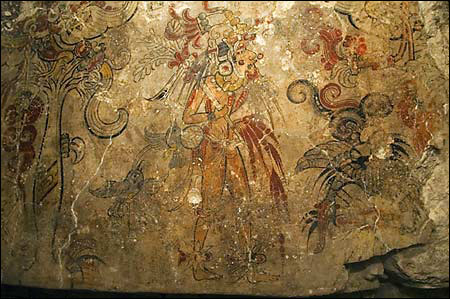
Earlier date for Mayan Art and Writing

Mayan Murals dated 100 B.C, San Bartolo, Guatemala

New archaeological evidence is shifting the timeline of Mayan history. In 2005, archaeologists revealed the final section of the earliest known Mayan mural in the city of San Bartolo in Guatemala. This mural shown above tells the story of creation and the mythology of kinships. This mural has been dated to 100 B.C and thus establishing that Mayans used art and writing centuries earlier than believed.

“There are kings, they have art, they have writing,” Saturno said. “All these things we attribute to the Classic [Maya period] are all in existence in the Preclassic. Now if we want to talk about origins, we need to be going back further in time.”
The Classic period dates from about A.D. 250 to 1000. The Preclassic period dates from about 2000 B.C. to A.D. 250.
Prior to this find, researchers believed sophisticated Maya painting and writing wasn’t firmly established until the seventh century A.D. [Oldest Known Maya Mural, Tomb Reveal Story of Ancient King]

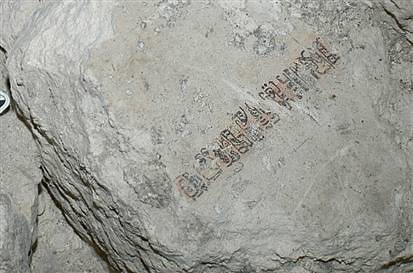
Now the same archaeologist, WIlliam Saturno has found ten bold hieroglyphs painted on plaster and stone from the same site and radiocarbon tests prove that the writing is 100 years older than the murals. This information pushes back the date of Mayan writing to some time between 300 to 200 B.C, around the time the Mauryan empire was in the full bloom in India.

Mayan Hieroglyphs dated 300 – 200 B.C, San Bartolo, Guatemala

For example, glyph 7 is an early version of “AJAW,” a symbol ubiquitously used with kings’ names that means “lord, noble or ruler.” Glyph 2 has vague pictorial qualities and may suggest a hand holding a brush or a sharp knifelike object.
A common problem with dating Mayan writing is that it is often on stone, which scientists can’t accurately date using radiocarbon dating. Instead, they must use stylistic changes to date materials.
However, Saturno and his team found these writings in a pyramid made in part with wood, which is carbon-based and can be dated with radiocarbon techniques. [Earliest Maya Writings Found]

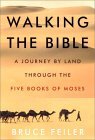
PBS: Walking the Bible

Part adventure, part archaeological detective work and part spiritual exploration, this three-part series follows storyteller Bruce Feiler on his inspiring 10,000-mile odyssey as he searches for traces of the great biblical heroes. Feiler travels by foot, four-wheel, camel and boat to re-create the journey he recounts in his best-seller, Walking the Bible. The series wanders through 10 countries on three continents, including volatile areas of the Middle East. Accompanying Feiler is Avner Green, one of the world’s leading biblical archaeologists. Dramatic scripture readings are interspersed throughout the three programs, bringing viewers closer to these Biblical settings. [PBS]

To understand the Bible better, Bruce Feiler traveled from Egypt to Jerusalem along the path taken by Moses with an archaeologist. As he passes the locations mentioned in the book, he talks about the stories, about the people currently living there and archaeological discoveries. One of the best travelogues I have read is now coming as PBS series on KQED TV. Here are the timings.

What Aryan Invasion?

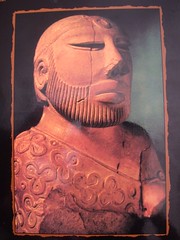
Steatite statue of a high priest
or official; circa 3000 B.C.,
found at Mohenjo-Daro

Stephen Oppenheimer concluded by genetic studies that people moved into India from Africa initially and rest of the world population were descendents of this group. University of Cambridge researchers Michael Petraglia and Hannah James came to the similar conclusion by analyzing fossils, artifacts, and genetic data. So if there was a migration, it was from India to Europe and not the other way. Does this prove that there was no Aryan Invasion/Migration?
While the above migrations happened about 85,000 years back, the theory of Aryan Invasion/Migration talks about what happened around 4000 years back. This is what Dr. Jonathan Mark Kenoyer, who has been excavating in the Indus city of Harappa has to say

The transition from one culture to the next was gradual as seen at Harappa, and there is no evidence for invasions by outside communities such as the so-called Indo-Aryans.
Although some scattered skeletons were discovered in the later levels, they do not represent warfare or raiding, and there is no evidence that the site came to a violent end. [Decline and Transformation]

Now the BBC has updated their page on the history of Hinduism to reflect this. So why are some people still holding onto the invasion theory? A good answer comes from Suhag A Shukla, who was the legal counsel for the Hindu American Foundation in the recent California textbook controversy.

There is no evidence of any invasion or any war. Honestly, the people who have held onto the Aryan invasion theory, probably based their entire careers on that particular theory and have expounded that through their research, they have a vested interest in not seeing it disappear.[‘I am not for rewriting Hinduism’]

Subhash Bose: Waiting for the report

Recently Anita Pfaff was in India and when asked about the disappearance of her father Subhash Chandra Bose she said that he could have perished in the air crash of 1945.

Anita Pfaff, 63, who is on a visit here, told IANS: “I don’t think he survived. Unless some fantastically new evidence comes up, if I look at the data available to me, he did not survive.
“I have been present at the interview of some of the survivors of the plane crash, including some Japanese officers, more than 20 years ago, and their story sounded quite consistent, credible and reasonable.”
She says: “Some speculation was also in the reports that the doctor who treated Netaji after the crash when interviewed this time had confusion about what he said earlier. He is 90 years old now and you can’t expect much from an interview unless it is done very carefully of a person of that age.
“Ultimately what he said many years ago made a lot more sense. You certainly have lapses in memory when you become old. Even if his new interview sort of raked up some controversy I would not place too much emphasis on it.” [My father did not survive the air crash: Netaji’s daughter]

She also seems to believe the statement of Brigadier Habib-ur-Rehman who was in the plane with Bose. If there was no plane crash in 1945, then where did the survivors come from? Why did Habib-ur-Rehman fabricate this story?
The Justice Mukherjee Commission of Inquiry has submitted the report to the Parliament and it is supposed to be tabled along with an action taken report by the end of February. Already leaked news has provided some fascinating twists like the fact that there was no air crash and the ashes kept in Japan were not that of Subhash Bose. There is also some evidence that Nehru knew the truth and kept quiet.
Justice Mukherjee was unhappy with the way his visits to Russia and Japan were handled by the Govt. and Anita Pfaff has said that she does not expect anything terribly new to come out of the Mukherjee report. We need to wait till the end of February to see if she is right.

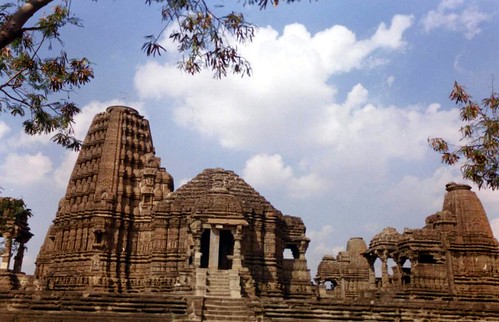
The Gondeshwar Temple, Nasik

Gondeshwar Temple, Sinnar, Nasik (Photo by Amol N. Banker)

The Gondeshwar temple is a very beautiful temple built in the Hemadpanthi style of Architechture. During the Adilshahi rule in Maharastra, Ahmednagar was the capital. One of the pradhans (minister) of Ahmednagar was Hemadpanth who popularised a typical style of construction using locally available black stone and lime. This style became very popular and came to be known as the Hemadpanthi style. The Gondeshwar temple is one of the few structures of this style still in good shape. [Nasik City Guide]

More Gondeshwar photos

Firefox extensions

Firefox is one sleek browser and comes with features like Tabbed Browsing, Pop-up Blocking and integrated search. But most of us like browsers with <insert your favourite feature> feature. We also like bloatware. Firefox lets you decide how obese you want your browser to be through extensions. By installing extensions, you can choose those features without which your life would be meaningless.
Continue reading “Firefox extensions”