Firefox is one sleek browser and comes with features like Tabbed Browsing, Pop-up Blocking and integrated search. But most of us like browsers with <insert your favourite feature> feature. We also like bloatware. Firefox lets you decide how obese you want your browser to be through extensions. By installing extensions, you can choose those features without which your life would be meaningless.
Continue reading “Firefox extensions”
Author: जयकृष्णः | ജയകൃഷ്ണൻ
The legend of Charumati maybe true
“This will surely open a new horizon in the history of the Kathmandu Valleyâ??â??
When it comes to Emperor Asoka’s children, the standard line in most textbooks is about how Mahinda and Sanghamitta were sent to Ceylon to spread Buddhism. There is not much mention about his other children and what they did.
He had other sons named Kunala and Tivara[14]. Apparently he also had a daughter named Charumati, and recently one stupa constructed by her was found in the Kathmandu Valley.
Archaeologists at the Department of Archaeology, a government institution to conserve and protect ancient monuments of the country, said this is the first time something has been found in the Kathmandu Valley written in Brahmi script, which was prevalent in 300 BC.
Only two inscriptions have been found so far in Brahmi script in Nepal â?? one in Lumbini and the other in Lignihawa, both erected by emperor Ashoka.
â??We were just enlightened. We could not believe when we found bricks with a word in Brahmi script. This will surely open a new horizon in the history of the Kathmandu Valley,â?said senior archaeologist Prakash Darnal.
The brick has a Dharma-Chakra emblem, two Swastikas, a word â??Cha-ru-wa-tiâ?in Brahmi script and also two other words in the most ancient form of Nepalbhasa script, Bhujimol.
â??Till date, historians believe that the sixth century AD inscription of Mandeva at the Changu Narayan is the oldest inscription found in the Valley and a statue of Jaya Barma, found at Mali Gaon, is regarded as made in the second century ADâ?, he said.
â??What we have found in Chabahil may prove that Kathmandu has a 2,300-year-old written history,â?Darnal said. But he also added that the evidence is not yet scientifically tested and the word could have been written later in Brahmi script that was extinct by the second century in Nepal.
â??The word â??Charuwatiâ?proves the legend of Charumati, said to be Ashokaâ??s daughter, and this has some grounds in the historyâ?, he said.[2300-year-old inscription found in Chabahil]
2005 In Review
At the end of 2005 here is a look at the topics that were covered in varnam and some of the important posts, in blogmela style.
India: We discussed the story of how Natwar Singh was found with his hands covered with oil and lamented on the demise of the argumentative Indian. The ban on showing cigarettes in movies irritated us
There was some talk about the hypocrisy of the Communists in these posts: Man bites dog: DYFI opposes CPI(M), Your’s are small too, Not for the family, The Communist “U” turn, More Catholic than the Pope
How could we miss Praful Bidwai?. We analyzed some of his thoughts in Praful Bidwai: New Theorems and Praful Bidwai: In defence of Maoists
We also covered the mystery behind the death of Subash Bose in the following posts. Subhash Bose: Was not in Russia, Subhash Bose: The Investigations – II, Subhash Bose: The investigations, How did Subhash Bose die ?
Foreign Affairs: We talked about the Pakistani apologists and wondered about the stability of China. It’s been only few years and people seem to have forgotten the Taliban.
What does Musharraf want from the peace process?. He might get it since we are so flexible. We also find out how Chachaji messed up Nepal
Economy & Globalization: A Time Magazine article talked about the expatriate economy and we had some comments on how it applied to Kerala. India was a globalized country from historic times and so Why Fear Globalization?. Also if America was in control of globalization as portrayed, then why are American car manufacturers in trouble?
History: An Indus valley skeleton was discovered near Delhi. Cheraman Perumal’s trip to Mecca seems to be a myth. We also talk about the various manuscripts that were translated into other languages. We dispel another myth that Indian historical writing started with the arrival of Muslims.
We also found some uncanny similarities among various mythologies
Book and Movie Reviews: Engaging India, The Motorcycle Diaries, Blink, Lankaparvam (Malayalam), Massacre at the Palace, Maximum City, A Short History of Nearly Everything, State of Fear
We participated in the Book Tag meme and listed few of our favourite books.
Photos: Sunset, Thalikkulam Beach, Kerala, Temple Pond, Harippad, Kerala, Water Lily, Golden Gate Park, San Francisco, Butchart Gardens, Victoria, Canada
Humor: Kerala does not have many industries thanks to many world class factors. But now there is a way to make it the hub of development. For that you need to read HOWTO: Develop Kerala. We also thanked Microsoft for not entering the desktop widget race.
What is similar between Musharraf and HTTP?
Announcements: The history section of this blog was spun off into a separate blog called The Palm Leaf. It is expected to go IPO in 2007.
Quiz – I
Question: Who wrote ‘Om Jai Jagdish Hare’?
Hint: He also wrote the first Hindi Novel in 1888
Answer: is here.
Raja Ravi Varma's Lithographs
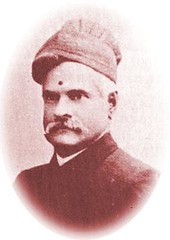
Raja Ravi Varma (1848-1906)
Raja Ravi Varma lived for a while in Maharashtra and painted many Maharashtrian women. He also ran a press in the town of Malavli. Two Italian curators Enrico Castelli and Giovanni Aprille visited the press few years back and found it in very bad condition.
“When we visited the press, we found rare paintings infested by moth and the owner was planning to sell it off. Even the Archaeological Survey of India did not want to do anything. So we decided to restore them,’’ says Castelli, who owns the Tamburo Parlante museum of African heritage. [Stoned for posterity]
These lithographs (engraving on stone), can be seen in at the exhibition titled Divine Lithography, organised at the Indira Gandhi National Centre for Culture and Arts in Delhi. The exhibition is also traveling to Trivandrum and Pune.
India, populated before Europe
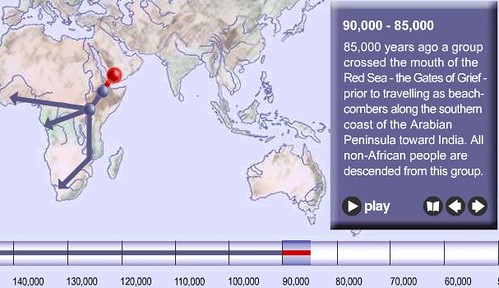
Journey of Mankind (The Bradshaw Foundation)
The Bradshaw Foundation and Professor Stephen Oppenheimer have a new theory on the migration of human beings from Africa over 160,000 years. Based on DNA analysis, the conclusion by Oppenheimer is that about 85,000 years ago, humans migrated from Africa to the mouth of the Red Sea. From there they reached India, traveling through Yemen, Oman, Iran and Pakistan.
74,000 years back, there was an eruption of Mt. Toba in Sumatra and the volcanic ash covered India and Pakistan and causing population crash. Following that incident, the Indian peninsula was re-populated. One of the statements by Stephen Oppenheimer is that all non-African people in the world are descended from this group which migrated to India and India was populated much before Europe, Americas and Australia.
While Oppenheimer’s study was based on DNA evidence, there is another archaeological study which confirms this theory. University of Cambridge researchers Michael Petraglia and Hannah James by analyzing fossils, artifacts, and genetic data.
According to them, a human ancestor Homo heidelbergensis, arrived in India about 250,000 years ago from Africa. Modern humans arrived in India about 70,000 years ago and wiped out the Homo heidelbergensis.
The new theory posits that as much as 70,000 years ago, a group of these modern humans migrated east, arriving in India with technology comparable to that developed by Homo heidelbergensis.
“The tools were not so different,” Petraglia says. “The technology that the moderns had wasn’t of a great advantage over what [Homo heidelbergensis] were using.”
But modern humans outcompeted the natives, slowly but inexorably driving them to extinction, Petraglia says. “It’s just like the story in Western Europe, where [modern humans] drove Neandertals to extinction,” he says.
The modern humans who colonized India may also have been responsible for the disappearance of the so-called Hobbits, whose fossilized bones were discovered recently on the Indonesian island of Flores. [Early Humans Settled India Before Europe, Study Suggests]
Like Oppenheimer’s research, Petraglia and James’ research too concludes that modern humans arrived in India tens of thousands of years before their arrival in Europe. So next time someone tries to pull the Aryan Invasion/Migration/Tourist theory on you, ask them, in which direction the migration happened?
Related Links: Indian History Timeline
HOWTO: Develop Kerala
Finally we have a fool proof plan for making Kerala the hub of IT development. This plan is so perfect that once implemented, investors will be running to the state with the same enthusiasm with which Karunakaran is running towards the Communists.
Previously, some management types working for investors did some research on places to invest in India and came up with Kochi, Kerala. The person had used factors like educated workforce, access to airport, roads etc and Kochi was the perfect match like the hammer to the sickle or Prakash to a Karat.
A bunch of VC’s came with bag loads of money, made the decision to setup shop, and while trying to enjoy the trip were are stuck in a houseboat in middle on a lake in Kumarakom due to an instant hartal called by the Communists, protesting the lack of hartal for a month. The oarsman who was a Communist had deserted the boat.
After living on fresh fish for two days, the realization stuck them that they need to add more parameters into their Excel spreadsheet while choosing places to invest. Since then Kochi was blacklisted among all VCs and they instructed their travel departments never to book a ticket to God’s own country, even if an actual God ordered them. So no one invests in Kerala anymore.
If you have been reading news, you know that politicians have changed the name of Bangalore to its ancient name Bengaluru to more accurately reflect the 16th century infrastructure there. As a result, the name Bangalore is up for grabs.
Our plan consists of instantly renaming Kochi to Bangalore. Now when a VC wants to invest in Bangalore and books a ticket guess where he is going to land? I mean who calls his travel agent and says, book a ticket to Bengaluru? Before you know investors will be landing in the Kerala and creating startups. IBM, Microsoft and Google will be having offices in coconut groves and employees will be getting free Ayurvedic massages as perks.
By the time the Comrades return back from their conclave in Kolkatta, the palce would have changed like anything. Internet cafes would have changed to dotcoms. Old dilapidated shops which used to sell bananas, cigarettes and Ma magazines would be having a BPO operation on the side. DYFI members would be speaking Malayalam with an American accent and SFI activists would be enthusiastically discussing BitComet’s non-honoring of BitTorrent private flag.
Looking at this, the Comrades would be wondering if a coconut fell on their heads. They would take out their Nokia phones and dial each other to protest this invasion of globalization. Wouldn’t that be a sight to see.
Scientific Evidence = Hindu Conspiracy
According to Harvard Professor Michael Witzel, scientific evidence against the creationism based Aryan Invasion Theory is a Hindu conspiracy!
A few months back, Science magazine published a paper that disproves the Aryan Invasion Theory. You can read about that paper here.
The research shows that there was only a single dispersal from Africa, via a southern coastal route, across the mouth of the red Sea, through India and onward into Southeast Asia and Australasia. There was subsequently a northern offshoot from the Gulf region, leading ultimately to the settlement of the Near East and Europe, but this only occurred much later.
However, this turns out to be wrong. According to the Harvard Professor who supports theories based on Biblical creationism, this is nothing but a conspiracy hatched by Hindus!
Witzel claimed the changes were motivated by “Hindutva” forces and would “lead without fail to an international educational scandal if they are accepted by the California’s State Board of Education.”
Hindus had suggested changes in textbooks based on this paper to California’s State Board of Education. According to another “scholar” named James Heitzman who was on the “Super Review Team” to assess the facts placed by Hindus, the “undecayed body of Saint Francis Xavier” is actually a miracle! And Islam began when “Muhammad received visions in which the Archangel Gabriel revealed the word of God to him.” Heitzman also states that Hinduism is based on speculations.
The activists led by Michael Witzel were also planning to contact BBC and make them take off the section on Hinduism that stated that the Aryan Invasion Theory “was not just wrong, it included unacceptably racist ideas.” Apparently, they temporarily succeeded in their efforts to foil the Hindu conspiracy to plant DNA evidence when BBC pulled down the page for two days, but the page was restored after BBC received complaints from people who believed in DNA evidence. [SABHA 4M Report]
For more on the text book issue in California, read this post by Sibin, who asks who the experts are.
Define Irony – II
Leftists in West Bengal on Thursday took up cudgels against the axing of Sourav Ganguly from the Indian team for the third Test against Sri Lanka, with CPI leader Gurudas Dasgupta sending a protest letter to BCCI chief Sharad Pawar urging him to protect Indian cricket from politics. [Left flays axing of Sourav Ganguly]
In the same letter the CPI MP asked that Ganguly be included in the third test match, thus interfering in Indian cricket politically.
Understanding HTTP
The protocol you use to browse the web, called HTTP is a stateless protocol. This means that once a request is served, the connection between the browser and the webserver is terminated and for a new request to the same server, another connection is established.
For example, when you type https://varnam.org in your browser, an http connection is made from your browser to the server hosting this site. Now after visiting the site, you find that there is an anti-communist article of your liking and click on it. For this request, a new connection is made, even though it is to the same server. What this means is that, there is no memory of the previous connection.
To understand this concept better, let’s take the help of P. Musharraf, the man running the country next door. Today he issued a statement that Pakistan should have increased cultural ties with India as it would lead to ‘speedy resolution of disputes’.
Currently India is on the receiving end of the explosive Pakistani culture spread by organizations like the Lashkar-e-Toiba and there should be some way for us to reciprocate, by exporting some movies of Uday Chopra, Suneil Shetty and Bobby Deol. This call for increased cultural ties comes at a time when Pakistan has banned the import of Indian movies and Musharraf, the friendly culture-vulture, seems to have forgotten it. If this export cannot happen, how can any ‘dispute’ be solved?
For the sake of the media, Musharraf produces these sound bites one after the other without any memory of the previous transactions, just like the HTTP protocol.