If America is the place from where globalization is radiating outward, then all American industries would be secure and only rest of the world would be in trouble, but it not so. Few American industries are in dire straits and the reason for it is globalization.
Ford, America’s second largest auto maker announced yesterday that it would shutdown fourteen facilities and fire a quarter of its work force (about 30,000 people). This comes as no surprise to anyone living here. It was obvious when they started giving employee discounts to entice people to buy their cars that disaster was on its way. Employee discount which means customers can buy a Ford car for the same discounted price as employees was one of the master plans that the management came up to boost sales. Also they could not afford to stay away from the race since the other American car makers, GM and Chrysler were also offering it.
It is not just Ford which is in trouble. Chrysler which saw a dip in sales started offering free gasoline and maintenance for two years. Other are extending the warranty and soon American car makers might pay you money if you agree to take one vehicle from the showroom.
All the while the CEOs of these companies never even paused for a moment to wonder why their sales are dipping. Getting to the root cause of the problem never seems to taught in management classes here. The problem was that American car makers were making cars which the consumer did not want while Japanese car makers Toyota and Honda were successully selling cars and increasing their market share. Toyota which will soon beat GM as the world’s largest automaker outsold Chrysler in December.
In this whole episode, just having capitalism did not help the consumer, for the local capitalists did not want to build fuel efficient cars or ones with hybrid technology. The manufacturers from Japan understood the customer needs and are killing the players who could not adapt. Thanks to globalization, the American consumers are getting the vehicles they want.
Some management consultants are going to take millions of dollars and educate the American car makers something which commonsense and globalization should have taught them – listen to the customers.
Related Stories: The Toyota Story
Author: जयकृष्णः | ജയകൃഷ്ണൻ
HOWTO: Read blogs more efficiently
Looking at the log files of varnam.org, I find that a lot of visitors do not use any feed readers, instead come to the site via a bookmark or by typing varnam.org/blog in the address bar. This means that you are visiting this site daily, to see if there are any words of wisdom from me and believe me, it is the most inefficient way to read blogs.
If you read news from about three hundred sources daily, imagine how much time would be wasted if you had to manually check each site for updates. Some folks like The Acorn have many posts each day, while Seriously Sandeep and The Palm Leaf are not updated daily. Now there is software available which can keep track of blogs, let you know which have been updated, all for free. This is how I read about three hundred blogs daily and efficiently.
Continue reading “HOWTO: Read blogs more efficiently”
Found: A missing State
Usually archaeologists find artifcats like terracota idols, amphorae or the first labelled portaiture of Emperor Asoka. They also find old temples, forts, boats, and sometimes even skeletons. But it is only once in a blue moon that they find an entire state and this is what happened in China.
The existence of this 3000 year old state, Peng, was never recorded in any historical documents, but only in some inscriptions in bronzeware excavated from two Western Zhou Dynasty tombs
Li Boqian, director of the archaeological research center of the prestigious Beijing University, said at an archaeological forum recently in Beijing that the discovery of the Western Zhou graves in Hengshui is the most important archaeological discovery since the excavation of the graves of the Marquis of Jin, another state of the Western Zhou Dynasty, in Quwo County of Shanxi Province.
The newly found ancient state will help archaeologists and historians better understand the history of the Western Zhou Dynasty and its jurisdiction, Li said.
More than 80 tombs have been excavated at the site in Hengshui, with the tombs of Pengbo and his wife the largest ones. The couple were buried side by side with lots of funeral objects such as bronze ware, carriages and jade, said Song Jianzhong, deputy director of the Institute of Archaeology of Shanxi Province.
One of the most important findings in the graves is the remains of a pall covering the coffins. The remains of the pall, already blended with earth after several thousand years, are still a vivid red color. Phoenix patterns can be seen on the pall, said Song.[3,000-year-old ancient state found in Shanxi]
Tags: archaeology china peng Zhou Dynasty Hengshui
Stegodons in India
The stegodon was a elephant like animal that lived in Asia about 5.3 million to 1.8 million years before present. These animals were about 13 feet high, 26 feet long and had 10 feet long tusks. Stegodons were earlier considered to the ancestor of elephants and mammoths, but now they are considered to be the sister group of the mammoth and the Indian and African elephant. Recently archaeologists from the ASI (where else?) found some tools in Jharkhand’s East Singhbhum which resemble the stegodon.
The deep elephant-shapped furrows stunningly resembled ‘stegodon’, the first of the true elephants that had probably roamed in this part of the world during the ‘pleistocene’ period, the official said. Chauhan said the length of the ‘elongated’ truck is very long and the about four-inch imprint point to a primitive species. “This unusual figure of an elephant on the stone at Basadera takes one back to a primitive period,” he said.
“The technique ‘block-on-anvil’ and ‘block-on-block’ adopted to shape and size the tools found by us and their striking similarity with the tools discovered in the river valley indicate the age of human habitation which could be older than the one discovered near Jamshola by the anthropologists from Kolkata,” he said. The discoveries should be enough pointer to the perception that East Singhbhum might have seen transformation of primitive men, he said. [Vital clues about primitive human beings]
Tags: stegodon archaeology Jharkhand
Adichanallur skeletons spill beans
In 2004, there was a spectacular archaeological discovery in Adichanallur, near Tirunelveli when 2800 years old human skeletons were found in urns. These urns also contained writing resembing early Tamil Brahmi. Later a three-tier burrial system was discovered in which earlier generations were burried in urns at 10 ft depth and recent ones above them. Soon the habitational site of the people who were burried was also discovered.
Analyzing the habitational site, it was understood that people lived in a fortified town and it had a separate potters quarters. There was also evidence of industrial activity and archaeologists think that it was a crowded busy town. The analysis of these skeletons have revealed some new facts.
- These people were tall, contradicting an earlier hypothesis that pre-historic Indians were short
- People consumed refined food, though there is no description of what constitutes refined food
- They had Southern Mongoloid features indicating sea trade between east coast of India and south east Asia in 800 B.C.
Tags: Tamil Brahmi Adichanallur
Oh God, Where art thou?
Ray Nagin, Mayor of New Orleans:
New Orleans Mayor Ray Nagin (NAY’-gin) is suggesting that Hurricanes Katrina and Rita and other storms were a sign that “God is mad at America” and at black communities too
Pat Robertson, Conservative Christian evangelical broadcaster
Pat Robertson on Thursday linked Prime Minister Ariel Sharon’s stroke to God’s “Enmity against those ‘who divide my land.’” “He was dividing God’s land and I would say woe unto any prime minister of Israel who takes a similar course to appease the EU, the United Nations, or the United States of America,” Robertson said on his television program, “The 700 Club,” Broadcast from his Christian Broadcasting Network in Virginia Beach. “God says ‘this land belongs to me. You better leave it alone.’”
Before this God was seen talking to George Bush and Mahmoud Ahmadinejad also. This is why when I call Him, he is not around.
Entry of Non-Hindus in Guruvayoor
Recently there was a controversy in Kerala over Sri Lankan President Mahinda Rajapakse’s visit to Guruvayoor temple. It seems his wife entered the temple and the issue was if she was a Christian or a Buddhist. In Guruvayoor temple only Hindus are allowed to enter and there is a strict dress code. Men have to remove their shirt and wear a mundu. Women are allowed to wear only sarees and girls have to wear a skirt and blouse.
This is one busy temple and there is a guard at the door checking to see if you confirm to the dress code and I am not sure if he checks the religion also. If so, it would be an amazing skill, for there is no easy way to find the religion of an Indian, unless he is wearing a symbol, like the cross. Due to this it is possible for people of any religion to enter the temple, but only famous people are stopped.
So when Congress leader, Vayalar Ravi’s son’s marriage was conducted in Guruvayoor, the authorities had to clean the temple because Vayalar Ravi’s wife was a Christian. If it were two ordinary folks, no one would have questioned this nor cleaned the temple. Other famous people who have been denied entry are singer Yesudas, who is a devotee of Guruvayoorappan and poet Yusuf Ali Kecheri, who lives close to the temple and has written many devotional songs.
But then how can we assume that all Hindus too are devotees? Communists are known to be atheists and what is the logic in allowing them to enter the temple. Recently in a statement, the temple authorities said that people of Buddhist and Jain faiths are allowed entry, since they are treated on par with Hinduism. This even more odd since both these religions do not recognize God as Hindus do. In Jainism, there is no creator god and a person is responsible for his actions. Buddha claimed that his enlightenment was not due to any divine intervention. It seems illogical that when followers of such agnostic religions are allowed entry, people who believe in Guruvayoorappan are not.
Related Links: Anand writes on the reforms initiated by his father at Guruvayoor. Bhavane rolls his eyes as he reads about the marxist temple minister. Rajeev Srinivasan makes the counterpoint.
Oldest fort in Kerala?
Before the Cheras established themselves as a major force in Kerala, it was ruled by the Ay dynasty sometime between 7th to 11th century AD with Vizhinjam as the capital.The Ay dynasty ruled the land between Nagercoil and Thiruvalla. In A History of South India, Nilakanta Sastry writes that the Ay kingdom lay around the Podiya hill, the southernmost section of the Western Ghats. He also writes that the Greek geographer Ptolemy wrote about one ‘Aioi’ was ruling the country at that time which included Cape Comorin and Mount Bettigo.
Last year there was news that a 9th century Vishnu temple was being rebuilt due to the initiative of the local people. This temple is unique since it is one of those which have a circular sanctum santorum. Much before this, when the kings of the Ay dynasty shifted their capital to Vizhinjam, they built a fort which is now considered to be the oldest fort in Kerala dating to the eighth or ninth century.
A preliminary investigation by the team has revealed the fort might have originally been 800 sq. m in area. The fort’s wall can be found on the northern and western (seaside) parts and has been constructed using large boulders set in mud mortar. The wide base of the wall tapers on its way up. According to Dr. Ajit, one important clue in dating the fort is that the walls have no battlements or `loop holes’ (holes to place cannons in). This is typical of early forts, he says.
The team was also able to trace literary and epigraphical references – of 9 AD to 12 AD vintage – to a fort and port at Vizhinjam. Sangam literature such as `Pandikkovai’, `Iraiyanar Ahapporul Urai’, `Kalingattup-parani’, of Jayamkondar, and `Vikrama-solan-ula’ are said to have numerous references to the existence of a fort, port and a mansion at Vizhinjam.
Moreover, the Srivaramangalam copper plate s of Pandyan King Nedum Chadayan ( 8 AD) have clear reference to Vizhinjam and its fort. “Here, the fort is described as surrounded by waters of three seas, protected by a wide moat, high walls which the sun’s rays do not touch and so on. Leaving aside the hyperbole typical of such inscriptions, the ground evidence at Vizhinjam that we got fits this description of the old fort. In fact the port at Vizhinjam has been mentioned in the work `The Periplus of the Erythraean Sea’, a work of the first century AD. Here Vizhinjam has been called as Balita,” said Dr. Ajit. [Ninth century fort discovered at Vizhinjam]
Tags: Ay Dynasty kerala vizhinjam ptolemy archaeology
history
Quick Intro to Indian history
Do you want to know about Indian history and how European Aryans came to India? Take a look at the SABHA version, assembled from the works of “scholars”.
Stanley Wolpert explains lucidly in his book, The New History of India, the fate of the inhabitants of this civilization.
Around 2000 B.C. the original Indo-European speaking, seminomadic barbarians, who most probably lived in the region between the Caspian and the Black seas, were driven by some natural disaster, possibly drought, prolonged frost, or plague. Elaborating on the type of natural disaster, he writes,
Whatever the cause of their dispersion – it may even have been a series of Mongol invasions from Central Asia – the ancestors . . . were forced to flee from Southern Russia to survive.
We chose “whatever” as the cause (since we haven’t yet figured out how a series of Mongol invasions falls under the category of natural disasters), and were in luck when we found the actual explanation buried in an article by Michael Witzel! Apparently, civilizations developed on pond sides! A tsunami from the pond must have drowned the entire civilization. Well, not quite the entire civilization. The male members and horse chariots survived! [SABHA 4M Report]
More and more evidence is surfacing which is disproving the Aryan Tourist TheoryTM. Archaeological and genetic evidence do not show that there was a massive migration of Europeans to India. They did not teach us agriculture also.
Kadakkarapally Boat
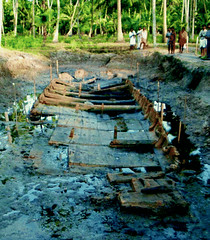
The Thaikkal-Kadakkarappally Boat, Kerala
Last year we had some posts about an ancient boat discovered in in Kadakkarappally, Kerala. This boat was considered to be somewhere between 600 to a 1000 years old and the 72 foot boat, according to initial reports was built using anjili, a wood found in Kerala. The boat according to report was built by foreign seafarers
According to a new research paper we have more details on this boat, which was apparently used to transport people or commodities between coastal ports and interior backwaters. Traditionally boats built in Kerala never used iron and it was assumed that such practice started with the arrival of Europeans in Kerala, starting with Vasco da Gama in 1498.
This boat which has been dated between 13 and 15th centuries, provides proof that shipmakers in Kerala were using iron fastners before the arrival of Europeans. The authors suggest that since Kerala was a main port in the Indian Ocean trade network, it is possible that local shipmakers would have encountered ships using iron fastners and got â??inspiredâ?.
What about the theory that it was built by foreigners?
The Thaikkal-Kadakkarappally boat, therefore, has features in common with several different traditions of boatbuilding. The form of the boat appears to mirror one strand of Chinese boatbuilding and the lashed lugs are a feature commonly found in South-East Asian shipbuilding. The use of lap joints between adjacent planks is typically Indian while nails clenched over a rove are normally only identified with north European building traditions. The boat itself, however, was clearly built locally. All three species of wood identified in the remains are indigenous to Kerala. Anjily, in particular, is used for almost all of the plank-built craft in Kerala today as it is strong, resilient, fairly cheap and widely available. It is possible that the boat was constructed by foreign shipbuilders settled in Kerala, but there is no reason to conclude that the Thaikkal-Kadakkarappally boat is not an Indian vessel, built in India by Indian shipbuilders.[The Thaikkal-Kadakkarappally Boat]
It was expected that the climate of Kerala would not allow for the preservation of of archaeological material, especially in waterlogged areas. But this boat somehow survived.