
In 1621, an Angolan named Antonio was captured by an enemy tribe and sold to an Arab merchant who eventually sold him to the Virginia Company. The company was chartered in 1606 by King James to grab land in Virginia and propagate Christianity and it was the Virginia Company that established the Jamestown colony. It was during the initial settlement of Jamestown that the myth of John Smith and Pocahontas was created. After the initial hiccups, where they had to resort to cannibalism, the colony had survived.
In Virginia, Antonio worked as an indentured laborer and after a period of time — after he had paid off his dues — he was freed. His wife, Mary, too was freed and as was normal for free indentured people, granted land. Thus, 20 years after he arrived in Virginia, he took the name Anthony Johnson and became the owner of a 250 acre farm with his own servants. Thus an African man becoming a landlord himself may look unusual, it was not odd because slavery was not codified during this period. Though African slaves were present in Jamestown few years at least a decade after its founding, people like Anthony Johnson could buy their freedom and become property owners.
During this period, there was not much of a difference between the White indentured servants and Africans; the difference between slavery and indentured servitude was fuzzy. The slaves and servants would revolt and run away together. Initially the colonies had more indentured servants consisting of poor English folks who were willing to risk everything for a prosperous life. Though the Africans formed less than 5% of the population in Virginia, they were more balanced in gender and age while the indentured Whites were mostly male. The Africans had families and since there was no ban on interracial marriage, free blacks even married Englishwomen. They were also able to court to settle disputes. In this early phase, Virginia was a society built by slaves and servants, but it was not a slave society.

By the 1660s, there was a demographic shift. There was a decline in servant population. The mortality rate began to drop and the White population started increasing and more African slaves were required. According to the Slave Trade voyages database, while Virginia imported a hundred slaves from Africa in the period 1628 – 1650, that number increased to 4754 in the fifty year period after that. To concentrate the powers among the landowners, only the landed were allowed to vote. In one instance, one governor even banned general elections for 15 years.
There were two events that happened which caused a dramatic shift in how the slaves and servants were viewed. The first was passing of the Enactment of Hereditary Slavery Law Virginia in 1662 and the second, the Bacon rebellion of 1676.
 Under English law, a child received his or her status from the father. The new colonial law of 1662 made the child of an enslaved mother also a slave for life. Thus this race making piece of legislation ensured that reproductive capacity of the African women was used to feed into the slave system. Slavery was thus codified on the woman’s body. This also made sure that even if the father was one of the English slave owners, their child would still be a slave.
The rebellion of Nathaniel Bacon started when he wanted a commission to fight the native Americans to kill them and drive them off the land. The governor declared him a rebel, but Bacon was resourceful. He built an army with slaves and servants and plundered the region. They took control over Jamestown and burned it to the ground. The rebellion had a surprise ending when Bacon died of dysentery and the armed vessels returned regaining control. This incident showed Virginia’s elite that the slaves were a politically unstable and a dangerous force.
Soon the slave code was enforced by singling out people of African descent from the Christian white servants. Free blacks were stripped off their rights and the rights to marriage. A master had the right to “correct” a slave, and if the slave died during the “correction” process, he would be acquitted. A similar experiment was carried in the English colony of Barbados earlier and the concept of Whiteness and Blackness had been introduced. Due to similar changes, the slave category was codified into law and by the first quarter of the 18th century, Virginia had become a society of slaves.
(Based on the lectures of Prof Stephanie McCurry, University of Pennsylvania for the course History of the Slave South at Coursera)
Author: जयकृष्णः | ജയകൃഷ്ണൻ
.jpg "Anthony Johnson")
In the Reading List: Pope And Mussolini
So far it was believed that the Catholic Church was against fascism during the 20s and 30s, when Mussolini came to power in Italy. Newly revealed documents state otherwise. NPR had an interview with David Kertzer, the author of the new book The Pope and Mussolini: The Secret History of Pius XI and the Rise of Fascism in Europe
On the pope’s interest in allying with Mussolini
On what the church got out of this alliance
The church got financial benefits, considerable payments by the state to the Catholic clergy. … They got, for example, as the fascists were forming fascist youth groups, which millions of youth in Italy were a part of in those years, the church was given chaplains to all the local chapters of the fascist youth groups so that they were able to influence the youth, which was very important to them. They also got as part of the Concordat, the fascist imposition of teaching religion in elementary schools, which was one of the first things Mussolini did to ingratiate himself when he came to power — to extend that to secondary schools as well so that all the school children in Italy were taught Catholic religion in their school.

The Conversion of Pocahontas

The Virginia Company was chartered by James I in 1606 for settling in North America and one of the goals mentioned in the charter was the following:
We, greatly commending, and graciously accepting of, their Desires for the Furtherance of so noble a Work, which may, by the Providence of Almighty God, hereafter tend to the Glory of his Divine Majesty, in propagating of Christian Religion to such People, as yet live in Darkness and miserable Ignorance of the true Knowledge and Worship of God, and may in time bring the Infidels and Savages, living in those parts, to human Civility, and to a settled and quiet Government: DO, by these our Letters Patents, graciously accept of, and agree to, their humble and well-intended Desires;[The First Charter of Virginia; April 10, 1606]
In the Terrence Malick movie, The New World (2005), which portrays the arrival of Virginia Company people in America, the conversion goal is downplayed and the English are portrayed as people who had come to trade. In the Disney movie Pocahontas(1995) which is based the same voyage, the intentions of the invaders are not diluted. They sing:
What can you expect From filthy little heathens?
Their whole disgusting race is like a curse
Their skin’s a hellish red
They’re only good when dead
They’re vermin, as I said
And worse
[Savages (Part 1)]
There were few reasons why the English wanted to come to North America and convert the heathens. By the 17th century, the Spanish becoming fabulously wealthy through imperialism and were converting the natives to Catholicism. As I wrote in a previous post
But with the discovery of the Americas, the Spaniards ended up with a mother-lode of wealth. The image on the side shows a 1553 CE map of the city of Potosí in Bolivia. This was one of the sites of a major silver mine which the Spaniards reached after they had done looting the native coffers. Between 1560 and 1685 CE, Spanish America sent between 25,000 to 35, 000 tons of silver to Spain and in the century following that the amount doubled. In fact around 85% of the world’s silver supplies came from the Americas. This was extracted from 30 such mines.To compare it to modern times, it was like Saudi Arabia discovering oil.[Impact of the Columbian Exchange on the world]

The initial settlement in Jamestown did not go very well; a previous settlement in Roanoke had vanished without trace. They had to face harsh winters without food and eventually had to resort to cannibalism. The Jamestown colony was surrounded by 15,000 native Americans under the leadership of the Powhatan tribe who followed a matrilineal system, like the Nairs and some sort of agreement had to be reached with them for food.

According to a discussion in BBC’s In Our Time, this incident never happened. Pocahontas, who lived nearby, visited the colony often and her age at that time was around 10 which makes it unlikely that she threw herself to save a 30 year old Smith. Also, in a narrative written by James Smith in 1608, this incident is never mentioned. In another version written in 1624, seven years after Pocahontas died, this incident appears. Not just that, in his voyages, there seems to be a pattern; James Smith is saved by maidens three other times as well.

Even though that tale was doubtful, even a movie made a decade back, never cast any doubt on it. One reason could be that the affair between a Native American and a White settler makes for a powerful national narrative in which the imperialism gets a smooth human face. From the Captain Smith and Princess Pocahontas (1805) by John Davis to The Indian Princess by James Barker in 1808 to Pocahontas; or, The Settlers of Virginia (1830) by GW Custis to the modern day movies, this narrative has been repeated again and again without any care for historical accuracy.
Once James Smith went back to England and Pocahontas was on her way to her husband’s house, she was kidnapped by the English under Captain Samuel Argall. The Virginia Company had instructed their men to kidnap children of leaders so that they could be instructed in Christianity. During her captivity in Virginia, the 15 year old was converted and took the name Rebecca. This was a big coup for the company and she was taken to London as a sample of one who was eager to receive the gospel. London did not suit her well; she caught one of the numerous diseases and died at the age of 21.


Indian History Carnival–72: Aryan Invasion Theory, Buddha, Ramayyan Dalawa

- Koenraad Elst writes about the Vedic Conference that happened in Kozhikode in January and how the Aryan Invasion Theory still lives on
Having spent time in the real world, interacting with real scholars, I know the real situation, which is that the AIT is still taught from all the important platforms. People who tell you diferently, live in a fantasy world and only interact with village bumpkins who accept their word for it; so as feedback they ultimately only hear their own opinions. Fortunately, we can ignore recent history including these Hindu will-o-the-wisps, and start work on the really available testimonies to ancient history.
- GeoCurrents has the third part of the series of posts on the Vexatious History of Indo-European Studies. The latest one has a section on how it is dealt in India.
Meanwhile, the legacy of Müller and his peers have came under increasing attack from another quarter altogether, that of Indian nationalism. This school is epitomized in D. N. Tripathi’s edited collection of 2005 entitled A Discourse on Indo-European Languages and Cultures. The various contributors to this volume understandably object to the old narrative of the Aryan invasion of the sub-continent, a story that emerged in the 19th century from a combination of philological inquiry and racial science. According to this account, superior Aryans invaded South Asia in the Bronze Age, conquering and ruling over the indigenous dark-skinned people and then creating the caste system to ensure that the two groups remained distinct and unequal. Support for this theory was supposedly found in the Rigveda, one of humankind’s oldest text. Yet as Trautmann shows, this neat and simplistic narrative of Aryan invasion had actually been opposed by most of the leading European Sanskritologists of the 19th century. It has also been rejected by modern mainstream scholars, who deny stark racial divisions and tend to posit plodding infiltrations of Indo-European speakers into the Indian subcontinent, along with a gradual and complex development of caste ideology. And regardless of the seemingly clear division of South Asia into an Indo-European north and Dravidian south, it has long been recognized that the entire region shares numerous linguistic features, making it a Sprachbund or linguistic convergence zone.
- Few months back, there was a popular news article which claimed that new clues from Lumbini pushed back the date of Buddha. Jayarava, after reading the original paper, writes
There is no doubt whatever that the find at Lumbini is significant and fascinating. But Coningham et al (and Coningham himself) have overstated the claims for what this find signifies. In particular it tells us nothing whatever about the dates of the Buddha. What it tells us about is the dates of human occupation and use of the site at Lumbini. This is intrinsically interesting, but is only an outline that requires considerable filling in. Specifically it tells us nothing about who the occupants were. The authors of the article seem to have been carried away by the minutiae of the discovery and the assumption that all archaeology on an Asokan site is ipso facto Buddhist.
- A while back I did a post on the origins of Aviyal. Maddy writes that in Travancore it was also known as Ramayyar kootu and has a post on Ramayyan Dalawa, who was Chanakya and Shakuni rolled into one.
If you were to study the successful reign of Marthanda Varma, you will quickly notice that there was one person who faithfully tended to him and guided him through those hectic days. In fact that person had been around even before MV took the throne, rightly or wrongly, from his uncle Rama Varma. The shrewd man was not only a Shakuni and Chanakya rolled in one, but also a very able administrator. Krishnan Raman or Ramayyan, that was his name, of Tamil Brahmin stock, was a good cook and a person of stern behavior, great logical outlook and acute intellect. Well, if you were to look at his story, you would be surprised at the involvement he had with the illustrious king, and not only that but you will also come across a large number of anecdotes attributed to him and retold even today. He is also considered to be the inventor of the Malayali dish Aviyal or what is sometimes termed as Ramayyar kootu in Travancore.
That’s the 6th anniversary of the carnival. If you have any links that are to be featured, please send them by any of these channels. The next carnival will be up on Feb 15th.
Volcanoes: Mount Sinabung, Toba, Hasan Dağı, Pompeii

The above picture shows Mount Sinabung in Indonesia’s North Sumatra province which has been erupting since last September. The Atlantic has 30 stunning photos of the January eruptions which show in detail the damage a volcano can cause and how it impacts human and animal life. Around 74,000 years back, there was a major volcanic explosion in Indonesia which caused a nuclear winter and a massive reduction in population. Though the destruction it caused was significant, people in Jwalapuram in Andhra Pradesh survived.
Though no one drew pictures of that eruption, one has been found of another one which happened in 6900 BCE, in the Hasan Dağı twin-peaks volcano located 130 km northeast of Çatalhöyük. A contemporary site to Mehrgarh, Çatalhöyük is one of the best preserved Neolithic settlements.

Though the interpretation that this was a depiction of a volcanic eruption was controversial, new studies have shown that the the painting was drawn during the time of the eruption and the artists may have witnessed the event.
Now if you want to experience a volcanic eruption in 3D, all you need is wait for the upcoming disaster-adventure movie, Pompeii
A Course on Mathematics in India (From Vedic Period to Modern Times)
In 662 CE, a Syrian bishop named Severus Sebokht wrote

When Ibn Sina (980 – 1037 CE) was about ten years old, a group of missionaries belonging to an Islamic sect came to Bukhara from Egypt and he writes that it is from them that he learned Indian arithmetic. This, George Gheverghese Joseph, writes in The Crest of the Peacock: Non-European Roots of Mathematics
Though there is a such a rich history, we rarely learn about the greatness of Indian mathematicians in schools. Even our intellectuals are careful to glorify the West and ignore the great traditions of India. A prime example of that was an article by P. Govindapillai, the Communist Party ideologue, in which he lamented that the world did not know about the contributions of the Arab scientist al-Hassan. In response, I wrote an Op-Ed in Mail Today in 2009.
Thus it is indeed great to see that NPTEL ran a course on Mathematics in India – From Vedic Period to Modern Times. The entire series of around 40 lectures is available online. It is there on YouTube as well. It starts with Mathematics in ancient India with the Śulbasūtras and goes past the period of Ramanujam. It goes through various regional scientists including the members of the Kerala School of Astronomy and covers the difference between the Greco-Roman system of proofs and how Indian mathematicians did it. Kudos to Prof. M. D. Srinivas, Prof. M. S. Sriram and Prof.K. Ramasubramanian for making this available to the general public.
PS: @sundeeprao points to this course on Ayurvedic Inhertance of India
Kon-Tiki (2012)
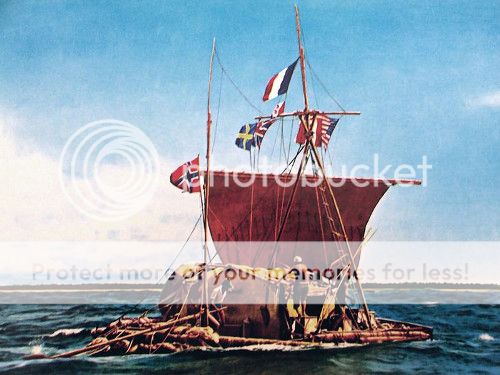

Five years after Zamperini’s unplanned voyage across the Pacific, a Norwegian explorer and writer named Thor Heyerdahl, set off on a voyage from Peru to Polynesia. Heyerdahl had a theory that Polynesia was populated not from Asia, but from South America. The early explorers to Polynesia had found pineapple, which was indigenous to South America. Also, certain sculptures found in Polynesia resembled the ones in pre-Columbian Peru. Though his theory was dismissed by academics and the National Geographic Society, because people at that time did not have boats required for such long distance travel, Heyerdahl believed that the rafts they had were sufficient and the ocean current would have favored such a travel; he believed that ancient Peruvians did not see water as a barrier.

There was the possibility that a storm would wash them back into South America or taken them into Galapagos. They survive few storms and soon encounter giant sharks which swim below the raft; there is some stunning photography at his point as the camera goes below the waves. They survive the shark attacks, even going as far as harpooning one and bringing it on board. While there were concerns that the wood was absorbing water and becoming heavy, they eventually figure that they are along the right path. Soon they spot land, and just few days before India got independence, they land at Raroia.
Though Heyerdahl proved that you could travel 5000 miles in the open ocean in a balsa wood raft the his theory that Polynesia was populated by South Americans never found acceptance. The dominant theory seems to be that Polynesia was populated from South-East Asia.
Six ways to follow varnam

If you have been following this blog regularly by visiting this website, you may not know that there other ways of following varnam using various social networks. Here are few ways by which you can follow the blog
- By e-mail. This link takes you to Feedburner which manages the e-mail subscription. Every time a post is made, you get the contents via mail.
- If you use Feedly, this link will take you to the page to add the feed.
- If you use any other RSS reader, this is the feed link
- If you are a Facebook user, here is the page to follow
- If you are a Google+ user, here is the profile page
- Finally, here is the twitter feed.
You can find the widgets for all these subscriptions on the sidebar under “Subscribe”. Please connect and share the posts.
In Pragati: Where is the Indo-European homeland these days?

(This article was originally published in Pragati)
The discovery of the relation between Sanskrit and European languages by Sir William Jones resulted not only in the birth of comparative philology, but it also initiated the search for the Indo-European homeland. There was no consensus on homeland location. In The Quest for the Origins of Vedic Culture: The Indo-Aryan Migration Debate, Edwin Bryant writes, “The Indo-European homeland has been located and relocated everywhere from the North Pole to South Pole, to China. It has been placed in South India, Central India, North India, Tibet, Bactria, Iran, the Aral Sea, the Caspian Sea, the Black Sea, Lithuania, the Caucasus, the Urals, the Volga Mountains, South Rusia, the steppes of Central Asia, Asia Minor, Anatolia, Scandinavia, Finland, Sweden, the Baltic, western Europe, northern Europe, central Europe and eastern Europe.”
During the time of William Jones, scholarship was focussed on reconciling Indian history with theBible. In 1790, Jones reaffirmed the “sanctity of the venerable books (of Genesis)” and put the origins of Indian empire within the safe confines of Bishop Usher’s creation date of 4004 BCE. Under Max Muller, who claimed that Genesis was historical, the biblical heritage survived with the narrative that superior civilisations of Europe, Persia and India had one language family. Though India was initially considered as the homeland, by the 19th century that was no longer the case. Bryant writes, “The Indomania of the early British Orientalists did not die of natural causes; it was killed off and replaced by an Indophobia initiated by Evangelism and Utilitarianism epitomised by Charles Grant and James Mill respectively.”
The 19th century was also a period of racial science and it was encouraged by Orientalists in Madras who discovered that South Indian languages were not derived from Sanskrit. Following this discovery, Vedic texts were interpreted to read that white-skinned Aryans subdued dark-skinned and snub-nosed dasas. The similarity of Indo-European languages along with such heroic conquests led the search for the mysterious homeland from where these aristocrats set forth. With this the British could explain their presence in India as yet another wave of Aryan invasion, similar to the many waves that happened before. Once scholars started searching for the homeland, it turned out that you could throw a dart at a world map and there was a theory of origin from that place.
As of 2013, there are three homeland theories that are prominent. The first one — the Anatolian-Neolithic — proposes that Indo-European originated in Anatolia and spread through Europe along with the spread of farming. The spread of the language towards India was explained using two models. The first one proposed that the language spread eastward from Anatolia to India and the second one suggested that it was a later southward migration from Central Asia that bought the language to India. After going back and forth between these two models, the present version argues that Indo-European spread symmetrically westward to Europe and eastward to India. The second theory suggests that the homeland was not in Anatolia, but to the south of the Caucasus. The spread of the language did not happen with the spread of farming, but at a much later date. This theory also posits a secondary homeland located north of the Black and Caspian seas. The third one suggests that the homeland was located between the Volga and Dnieper (The Pontic-Caspian) during 4500–3000 BCE.
In a 2013 paper titled Twenty-first century clouds over Indo-European homelands, J P Mallory used the common notion that Anatolian was one of the first languages to split away in the proto-Indo-European framework to evaluate the three homeland theories. In the Pontic-Caspian model, the ancestors of Anatolians leave the region north of the Black Sea and move to Anatolia. Indo-European develops later in the Pontic-Caspian region and the speakers disperse both east and west in the Bronze age. The Near Eastern model presents crazy travel plans. First the Anatolians move out of Anatolia into the Balkans and Indo-European develops in that space. Before the Anatolians move back to their homeland, the Indo-Europeans move out requiring carefully choreographed movements of peoples. In the Anatolian Neolithic model, the Anatolians do not travel back and forth to the Balkans, but stay put. Instead the Indo-Europeans disperse around the world.
For each of the homeland theories and their paths of dispersal there are sufficient counter arguments that make it untenable or look ridiculous. To give an example, a theory presented in 2012, required two linguistic groups, and separated geographically for 2500 years to have similar linguistic changes. Mallroy writes, “the statisticians who devised this model seem to require some form of mutual contact at a distance, one of the stranger aspects of quantum theory that Einstein once dismissed as Spukhaftige Fernwirkung (“spooky action at a distance”) ”
A second problem with all these migration theories is this: If agriculture was the source of language expansion, did the region from Anatolia to the Indus speak the same language at some point? Very often historians tell us that the invading/migrating Aryans changed the linguistic landscape of North-West India. If the agricultural spread theory is true, then it was not just the Indus languages that were changed. In the 2500 km distance from Anatolia to the farming community of Mehrgarh in Balochistan, there were four other non-Indo-European speaking regions (Hurrian, Semitic, Sumerian and Elamite) and the migration model requires major language shift in all these areas. Mallroy writes, “In any event, all three models require some form of major language shift despite there being no credible archaeological evidence to demonstrate, through elite dominance or any other mechanism, the type of language shift required to explain, for example, the arrival and dominance of the Indo-Aryans in India.”
One possibility is that the language did not spread through invasion or the current favourite — migration — or due to elite dominance, but due to demic diffusion. Peter Bellwood looked at the farming hypothesis and coupled it with new archaeological discoveries in the Gangetic plains, and proposed last year that Indo-European speakers arrived in North-West two millenia earlier than expected. This gave possibility to the development of Vedic language in the region and not in Central Asia. It also provided the ability for the language to spread slowly rather than suddenly. Later in his life Max Müller questioned the concept of a single Proto-Indo-European language. Martin Lewis, a historical geographer at Stanford University, writes, “He [ Müller] further contended that speakers of these dialects might have spread their tongues not by way of massive invasions but rather through the gradual infiltration of relatively small numbers of people out of their Asian homeland.”
To paraphrase an Indo-European scholar, the right question to ask these days is not where the Indo-European homeland is, but rather, where do they put it now? Since Indian history has been deeply tied to the movement of Indo-European people, it is important to understand the debate that is going on. If one has to be cynical of the whole enterprise, it has to come from an understanding of the complexity and not through a simplistic denial of the theory. In her book History of Ancient and Early Medeival India: From the Stone Age to the 12th Century Upinder Singh wrote that most historians have
abandoned the idea of an Aryan invasion for a ‘several waves of migration’ theory. Though no one knows where they came from or which path they followed, Indian history is still firmly rooted in these external origins.
The problems with two centuries of linguistics do not end with diverse homelands or inconclusive paths of migration. There are fundamental issues on what languages belong to the Indo-European tree. Where does Graeco-Armenian or Italo-Celtic belong? Is Tokharian an orphan or should it be associated with the German branch? A debate which is going on this year is if Basque, the ancestral language spoken by people living in the region spanning northeastern Spain and southwestern France, is an Indo-European language or not. These doubts, (See An earlier date for Indo-Europeans in Northwest India) which exist in Indo-European linguistics, is absent in Indian history narratives. There is not an iota of scepticism and a simplistic model still seems to be the norm.
Tipu Sultan- The Tyrant of Mysore by Sandeep Balakrishna

Fortunately Menon does not call him a freedom fighter, but many many historians and politicians and literary types like Girish Karnad and Bhagwan Gidwani consider him so. They also consider him to be a great warrior, a humanist, the son of Kannada and a tolerant ruler. Sandeep, by going through copious amounts of primary sources on Tipu finds that a fictional narrative has been constructed regarding every aspect of Tipu’s life and the tale which was spread by bards who relied on bakshish, now is spread by modern bards for various nefarious reasons.
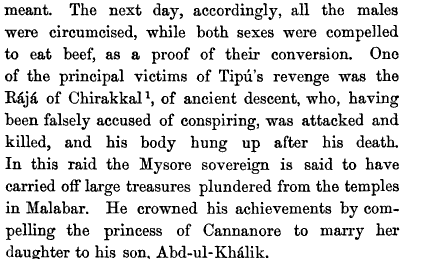
The part that Sreedhara Menon whitewashed s expanded by Sandeep and that is not for the faint of heart. Tipu hunted down the Nairs who rebelled against him and forced them to surrender. Here is the what happened next:
.
Another account of Tipu’s march through Calicut records that both men, women and children were hanged; churches and temples were desecrated; women were forced to marry Muslim men. Proud of his accomplishments in Calicut, he wrote a letter gloating about this massive conversion. He also congratulated his commanding officer for circumcising the captives and converting the others. As he marched to Travancore, burning towns and villages, he was halted by the Nairs and extreme cruelty by Tipu caused an exodus of people from Malabar. This is the level of progressiveness that is attributed to Tipu by a writer who had a good idea of what really happened as he was the former editor of the Gazetteer of Kerala. The trend seems to be to not let facts get in the way of a progressive interpretation.
Another myth that prevails is that Tipu was a freedom fighter because he fought against the British. Less mentioned is the fact that he working on replacing one colonial power for the other for his own personal gain. In various letters written to the French,he conveyed the notion that he was friends with the local Muslim rulers and with the combined French army, they could rout the British. To entice the French, he promised half the territory that would be taken away from the British and he had correspondence with Napoleon himself. Napoleon was not the only foreigner with whom he bargained. He wrote letters to the Caliph, to Zaman Shah of Afghanistan, and to other foreign Muslim rulers, inviting them to wage the battle against the infidels.
Besides revealing such less mentioned facts, the book begins with the crux of the problem which is the problem with historiography in India. These narratives are not written with a focus on revealing the truth, but for subverting certain truths. There is a revealing conversation between S L Bhyrappa and G. Parthasarathy, a Nehru-Gandhi family acolyte, who lead a committee to foster national integration through education. Parthasarathy tells Bhyrappa, who at that time was a philosophy lecturer, that teaching about the iconoclasm of Aurangzeb and Mahmud of Ghazni would poison the minds of the students, offend the minorities and “cleave the society”. Hence it was important to use “maturity and discrimination” in selecting the narrative.
In 2009, I wrote a piece for Pragati about these biases and one of the solutions was for us not to leave the history to historians.

Lawsuits, protests, activism—these can be an effective tools, but there is also a need to popularise the discourse. Stephen Ambrose, David McCullough are masters of the popular history genre in the West. Barring a few honourable exceptions, in the Indian context this genre consists of writing more biographies of Nehru and Gandhi. There is a need to add more voices to this discourse—to explain how the invasion theory evolved to migration theory to Aryan trickle down theory—because this Aryan-Dravidian race theory still has serious social and political implications in India.[Op-Ed in Pragati: Getting Objective about it]
Sandeep’s book is a good step in that direction.
Tipu Sultan – Tyrant of Mysore, Rare Publications; 1st Edition 2013 edition (November 30, 2013), 186 pages [Kindle Edition | Flipkart| Amazon India]