
In his memoirs, published in 1881, ex-Confederate President Jefferson Davis cast secession as a wholly constitutional move designed to restore government to what the founding fathers had intended. The goal of secession, the late President wrote, was to protect the rights of “sovereign states” from “tremendous and sweeping usurpation” by the federal government. “The truth remains intact and incontrovertible, that the existence of African servitude was in no wise the cause of the conflict, but only an incident.” The problem is that Davis’s interpretation was not consistent with case for secession made by southern politicians in the 1850s.
 On June 10, 1850, the people of Georgia passed the Georgia Platform and it contained five grievances of the state. One of the main points of contention between Georgia and the Federal Government was related to slavery and its future. For the Georgians, the “ the establishment of a boundary between the latter and the State of Texas, the suppression of the slave trade in the District of Columbia, and the extradition of fugitive slaves, the rejection of propositions to exclude slavery from the Mexican territories and to abolish it in the District of Columbia (“Georgia Platform”) ” were all controversial. The fourth clause in the Platform made it clear that when it came to the subject of slavery, there would be no compromise. It clearly stated that it would oppose any action, “upon the subject of slavery in the District of Columbia, or in any places subject to the jurisdiction of Congress incompatible with the safety, domestic tranquility, the rights and honor of the slaveholding States, or any refusal to admit as a State any territory hereafter, applying, because of the existence of slavery therein, or any act prohibiting the introduction of slaves into the territories of New Mexico and Utah, or any act repealing or materially modifying the laws now in force for the recovery of fugitive slaves. ” Thus, they were clear about what they were fighting for.
Mississippi too was clear about why were seceding from the Union in A Declaration of the Immediate Causes which Induce and Justify the Secession of the State of Mississippi from the Federal Union. “Our position is thoroughly identified with the institution of slavery– the greatest material interest of the world. Its labor supplies the product which constitutes by far the largest and most important portions of commerce of the earth,” they stated. Mississippi too was incensed by the dangers to the institution, the refusal of admission of new slaves states to the Union, the nullification of the Fugitive State Law and the proposal for slave equality. They felt that, it was worth seceding from the Union rather than face the loss of four billions dollars of money

.The same spirit about slavery was echoed in the Cotton is King speech of James Henry Hammond in 1858. According to Mr. Hammond, though people claimed that slavery had been abolished, it was in name only and “all the powers of the earth cannot abolish that. God only can do it when he repeals the fiat.” Unlike the Northerners who had kept White men as wage earners, the Southerners, he felt, had “a race inferior to her own, but eminently qualified in temper, in vigor, in docility, in capacity to stand the climate, to answer all her purposes.” Every society, he argued required a class of people, “do the menial duties, to perform the drudgery of life” with a “ low order of intellect” and with such people, they were able to produce massive amount of wealth. The new developments, he thought were threatening the business and if required, the South was ready to go to war for it.
The Southerners knew that the admission of a large number of free states would change the balance of power in the Congress. As they struggled to the secure the future of slavery, the edifice on which their wealth was created, they realized that the slavery could soon be abolished. The admission of new states into the Union always resulted in a debate over slavery and they often resulted in a compromise. For the Southerners it was evident that the tide was not going their way and secession was the only option available to preserve their wealth.
The important point to note is that the statement from Jefferson Davis was written in 1881, much after the South lost the war and thus a post-justification for the war they lost. As you read the statements from Mississippi, Georgia and from James Henry Hammond, it is clear that slavery and not the state rights were the cause of secession.
(This was one of the writing assignments for the course History of the Slave South at Coursera)
Author: जयकृष्णः | ജയകൃഷ്ണൻ
Indian History Carnival–74: Puranas, Mughals, Orissa, Anandi Gopal Joshi, Selden Map
- Dr. Sunil Deepak writes about ancient Indian history based on the Puranas. His post is based on the book Pracheen Brahmin Kahaniyan by Rangey Raghav
Ancient Indians used logic and had the capacity to categorize and analyse knowledge. Thus, Panini could work on Sanskrit grammar in a way that is understandable to linguistic experts even today. Or Vatsyayan could work on the theme of sexuality, that can be understood scientifically even today. Even esoteric subjects like meditation, yoga and the nature of human soul, were looked at in logical terms, analysed and discussed. Then, why those ancient Indians, did not use that kind of logic for writing history? Why did they make a mish-mash of actual events with mythological stories? Perhaps for ancient Indians, the worlds of gods and spirits were as real as their daily physical world, because that was the only way they could make a sense out of the events? Thus their ideas of history were impossible to separate from these fantasy worlds? Perhaps it had something to do with Indian concept of time as being cyclical (and not linear), where worlds were created and destroyed in cycles,and thus history was understood differently?
- Saptarshi Dutta writes in WSJ India about a Mughal Art collection which depicts life before the British arrived. The post has few paintings from that collection.
Ghulam Ali Khan, one of the most accomplished Indian painters from that era, drew some of the paintings. He was the last royal Mughal artist and was employed in the courts of Mughal rulers Akbar II and Bahadur Shah Zafar. Other works are believed to have been drawn by some of Khan’s family members. One of Khan’s paintings featuring in the sale on April 8, captures what life was like for many workers during the Mughal era. It shows a man, his mouth covered with a cloth, working with a string to fluff up cotton
- We know very little about Orissa, says Fëanor
Five hundred years earlier, Orissa was ruled by a Hindu raja. Orissa was a Shaivite state – the God Shiva was supposed to be its lord, and the kingdom was dotted with grandly ornamented Shiva temples. One particularly magnificent sculpture – of Shiva and Parvati – likely stood at the entrance to one of the great temples. It found its way to Stuart and thence to the British Museum. This was a life-size sculpture, and originally would have been brightly painted. Shiva would have been white, signifying the ash with which the ascetic God adorned himself, with a blue throat, from the poison he swallowed during the churning of the ocean for amrit. Observe the tenderness and devotion between him and his consort – this was no impersonal deity thundering abstinence and damnation upon his followers. Ganesha, their son, appears at the bottom, while figures representing the donor of the sculpture and his wife appear to the left and right of the Gods.
- Jai Virdi writes about Dr. Anandi Gopal Joshi, a Brahmin, who went to United States in the 1880s to study medicine.
Born in 1865 in Kaylan, a small town near Bombay (Mumbai), she was married off at 9 years old to 229 year old postmaster Gopalro (Gopal Vinayak Joshi), a widower. Gopal renamed Joshi, shifting her birth name from Yamuna to Anandi (“the happy one”). He was also a supporter of women’s education and started teaching his young wife shortly after they got married. She eventually learned Sanskrit and English. The marriage completely ideal; there’s sources indicating that Gopal often abused his young wife in order to keep her focused on her education. In the 1880s, with the help of a Philadelphia missionary, Joshi was sent to the United States to receive an education in medicine, a decision made after the tragic death of her son when she was 14. She enrolled in the Women’s Medical College of Pennsylvania, then the first hospital for women; her thesis was titled Obstetrics among Aryan Hindoos.
- The rediscovered Selden map shows Calicut in what would be Rangoon. Maddy explains the story behind the map.
The map itself was constructed towards the end of the Ming period, i.e. early 1600’s. Calicut though still important had slipped out of the early prominence and the Arabian seas were mostly in the control of first the Portuguese and later the Dutch. The English were waiting to slip in at an opportune time. The Moplah, Marakkar and Arab sailors still plied the waters of the Arabian Sea and the Western powers i.e. Dutch, English and Portuguese ran their own shipping vessels through these waters carrying tons of spices and other goods back and forth to red sea ports. The Ming Chinese voyages had ceased in the 15th century, a full 100 years or more before the Selden map was created. The junk trade was mostly restricted to the SE Asian areas (the area depicted in the map). So why place Gu Li at the corner or even mention it? It is not possible to discuss this topic without covering the Chinese trade with Malabar through the ages, albeit briefly.
If you have any links that are to be featured, please send them by any of these channels. The next carnival will be up on April 15th.
New date for Chauvet Cave

If you have seen the the Bavarian film maker Werner Herzog’s 3-D documentary, The Cave of Forgotten Dreams(2010) about the Chauvet caves, you would be wonderstruck by the amazing paintings on the walls. The paintings were dated to around 30,000 years back, when the Neanderthal man roamed alongside humans. Now new data says, these caves were old, but not that old.
But its study – when one places it in its natural regional, cultural and thematic framework – makes it impossible to see it as an isolated entity of astonishing precocity. This needs to be reconsidered, and the affinities that our research has brought to light are clearly incompatible with the very early age which has been attributed to it. And if one extends this examination to the whole of the Franco-Cantabrian domain, the conclusion is inescapable: although Chauvet cave displays some unique characteristics (like every decorated cave), it belongs to an evolved phase of parietal art that is far removed from the motifs of its origins (known from art on blocks and on shelter walls dated by stratigraphy to the Aurignacian, in France and Cantabrian Spain). The majority of its works are therefore to be placed, quite normally, within the framework of the well-defined artistic creations of the Gravettian and Solutrean. Moreover, this phase of the Middle Upper Palaeolithic (26,000–18,000) coincides with a particularly intensive and diversified local human occupation, unknown in earlier periods and far less dense afterwards in the Magdalenian. A detailed critique of the treatment of the samples subjected to AMS radiocarbon dating makes it impossible to retain the very early age (36,000 cal BP) attributed by some authors to the painted and engraved figures of Chauvet cave.[New investigations into the cultural and stylistic identity of the Chauvet cave and its radiocarbon dating]
Slaves Refuting Pro-Slavery Arguments

James Henry Hammond was a politician and planter from South Carolina who served as a United States Representative, the Governor of South Carolina and as a United States Senator. He owned several plantations, about 300 slaves and was one of the outspoken supporters of slavery before the American Civil War. In Letter to an English Abolitionist written in 1845, he argued that slavery was more humane than wage labor.
“You think it is a great ‘crime’ that we do not pay our slaves ‘wages,’ and on this account pronounce us ‘robbers.’ In my former letter I showed that the labor of our slaves was not without great cost to us and that in fact they themselves receive more in return for it than your hirelings do for theirs. . . It is altogether praiseworthy to pay the laborer a shilling a day and let him starve on it. To supply all his wants abundantly, and at all times, yet withhold from his money, is among ‘the most reprobated crimes.”
This outrageous claim was challenged by narratives written by the slaves, published with the help of anti-slavery and abolitionist allies. A perfect rebuttal is this passage from Twelve Years a Slave by Solomon Northrup.
“The existence of slavery in its most cruel form among them has a tendency to brutalize the humane and finer feelings of their nature. Daily witnesses of human suffering—listening to the agonizing screeches of the slave—beholding him writhing beneath the merciless lash—bitten and torn by dogs—dying without attention, and buried without shroud or coffin—it cannot otherwise be expected, than that they should become brutified and reckless of human life.”

When an impurity was found in the picked cotton or a branch was broken, the penalty was twenty five lashes. For crimes above this, they got fifty lashes. If you stood idle, the penalty was a hundred lashes and two hundred, if you fought with other slaves. Runaway slaves got five hundred lashes and Northrup mentions an incident where a slave named Patsy was almost flogged to death. For some incidents, they were put down like animals or hanged. Northrup writes that for some slave owners “…. whose chief delight was in dancing with his “niggers,” or lashing them about the yard with his long whip, just for the pleasure of hearing them screech and scream“ were not paternalistic as Hammond claimed, but just sadistic.

While daily laborers sold their labor and not themselves, that was not the case with the slaves. Since they had no ability to read, write or swim, they had to endure the torture. Floggings were the not cruelty they had to endure. Overseers, whose sole motive was to ensure the maximum crop without any concern for the suffering went around with dogs to overhaul fleeing fugitives and even used the gun sometimes. If a slave fell down, tired from his cotton picking, he was dragged to the shade and buckets of water poured on him to wake him up. Once he woke up, he was sent back to labor.
In the quoted passage, Northrup mentions the “ tendency to brutalize the humane and finer feelings of their nature.” Slaves were treated like animals. In the slave market, customers would examine their body, look at their teeth, ask about their skills, like how “a jockey examines a horse.” In some cases, they were stripped and examined more carefully. Once a purchase was finalized, the purchasers did not care if a family was separated. One of the heart wrenching incidents in the book is when a mother and her children are separated without any remorse by the slave trader. Charles Ball, in his account, Fifty Years in Chains, wrote about the painful separation of the family as the most traumatic experience, “ …I was now a slave in South Carolina, and had no hope of ever again seeing my wife and children. I had at times serious thoughts of suicide so great was my anguish.”
 “Slavery is terrible for men; but it is far more terrible for women. Superadded to the burden common to all, they have wrongs, and sufferings, and mortifications peculiarly their own”, wrote Harriet Jacobs, a slave woman in Incidents in the Life of a Slave Girl , upon the birth of her daughter. Besides the physical and mental torture, female slaves also faced sexual harassment. When she was 15, her 55 year old master Mr. Flint was after her. Her mistress knew what was going on, but in patriarchal system, she was helpless and vented her anger on the female slaves. To find a way out from Mr. Flint, she entered into a relationship with a lawyer with whom she had children. Mr. Flint still did not leave her alone and threatened to separate her from her children.
All these narratives reinforce the view that the slave was the master’s property and he could do whatever he wished with them. In his book, Northrup rightly notes that all of this was happening in the country which proclaimed, “life, liberty and the pursuit of happiness.”

On Madhavan of Sangamagrama


His works laid the foundations of the Kerala school of mathematics which flourished between AD 1,300 and 1,700. But he was only part of the wider Indian school founded by Aryabhata who wrote the masterpiece Aryabhateeyam in AD 499. There are still differences over Aryabhata’s birthplace, whether it was in the north or the south of the country. Madhava’s contribution was his work on the infinite series. Though Newton and Leibniz are credited with the discovery of calculus, the fact is one of its critical strands had been developed in Kerala more than two centuries before that. The West has now recognised this and accordingly renamed certain results relating to the trigonometric series, previously known as the Newton, Gregory and Leibniz series, as the Madhava-Newton, Madhava-Gregory and the Madhava-Leibniz series, respectively.
The irony is that we still don’t know much about Madhava, the man himself. An eminent mathematician from Oxford, Marcus Du Sautoy, recently made a series of television programmes on the history of mathematics. I was consulted on those programmes relating to the history of Indian mathematics, including the remarkable work in Kerala. He was particularly interested in finding the physical location of Madhava and his main disciples to add some footage of film. When he asked me I was clueless and somewhat embarrassed. But now I’m told that he hailed from Sangamagrama, a medieval town in present-day Irinjalakuda in Thrissur district. It is a shame that there is no memorial plaque at the place which would certainly attract maths tourists.[Restoring India’s calculus crown]
In a personal email, Michel Danino notes that Dr. George G. Joseph isn’t the only scholar to have worked on the Kerala School of mathematics; recent contributors to the field include the late Prof. K.V. Sarma, Dr. C.K. Raju, Dr. M.D. Srinivas, Dr. M.S. Sriram and Dr. K. Ramasubramanian, among others.
Understanding Thomas Jefferson

Thomas Jefferson wrote, “All men are created equal”,while being a slave owner. He called slavery repugnant and called for its abolition, but emancipated only a handful of the few hundred slaves he owned. So how does one understand Jefferson? When he wrote about the equality of men, was he talking only about White men or all men? If he made public statements against slavery why did free only a few? Was there a contradiction between his public position and private behavior?
Jefferson’s position on slavery in the new country was anything but complicated. When he wrote the Declaration of Independence, he was drawing on Scottish moral sense philosophy and when he equated men, he was equating them in the moral sense. For Scottish thinkers, people who had Common Sense could grasp self-evident truths. A republic with such ideals would enhance the quality of its citizens and also advance the interests of the whole and make them consent to a social vision. What was required was the ability to set aside self interests and pursue the common good. Moral sense gave people dignity and Jefferson did not exclude Blacks from this claim.
“I hope preparing under the auspices of heaven for a total emancipation”, he wrote in Notes on the State of Virginia because he thought that slavery was morally wrong. He thought that the “commerce between master and slave is a perpetual exercise of the most boisterous passions, the most unremitting despotism on the one part, and degrading submissions on the other.” He wrote about the immoral aspects of slavery which allows one set of the citizens to trample on the rights of the others and thought that these practices were inconsistent with Republicanism.
Though he talked about emancipation, he did a lot to expand slavery in the union and make it an engine of economic growth and political power. A century before Herbert H. Risley defined 2378 castes as belonging to 43 races on the basis of their nasal index in India, Thomas Jefferson used dubious science to define the difference between Blacks and Whites. He noted that the Blacks were brave and adventurous and easily entertained, but they were inferior to the Whites. Jefferson writes, “but never yet could I find that a black had uttered a thought above the level of plain narration never seen even an elementary trait of painting or sculpture”.
They had good memory, but “in reason,much inferior as I think one could scarcely be found capable of tracing and comprehending the investigations of Euclid and that in imagination they are dull tasteless and anomalous.” He also found “They secrete less by the kidneys, and more by the glands of the skin, which gives them a very strong and disagreeable odor.” But that did not prevent him from having an affair with Sally Hemings who was a teenager and thirty years younger. He had six children with her whom he did not acknowledge, but they were the only people whom he freed.

Since there were substantial differences between the races he thought freeing the slaves would create problems because “Deep rooted prejudices entertained by the whites ten thousand recollections by the blacks of the injuries they have sustained new provocations the real distinctions which Nature has made and many other circumstances will divide us into parties and produce convulsions which will probably never end but in the extermination of the one or the other race”. He rejected the idea that the two races could co-exist. Since that could result in a civil war, his solution was to send the freed Africans back to Africa or somewhere outside the colonies where they could not mix with the white population(“he is to be removed beyond the reach of mixture”) and live as “free and independent people” . He wrote, “For if a slave can have a country in this world it must be any other in preference to that in which he is born to live and labor for another in“.
At the end of his presidency, Jefferson left slavery an immensely strong institution after the Louisiana purchase and the spread of slavery across the continent. He even provided the intellectual defense of slavery. When Missouri wanted to join the Union as a slave holding state there was a debate over it and Jefferson took the side of the slave holders. He wanted the northern states to recognize slavery; for him the expansion of the country was more important than the abolition of slavery. During the purchase of Louisiana under his presidency, he did more than anyone to change the terms of slavery for slaveholders. This purchase added significant slave territory to the nation and with the surge of cotton production slavery expanded to new regions within southern states and to territories further west. There emerged an invigorated interstate slave trade, and hundreds of thousands of slaves, particularly in the Upper South, were separated from families and sold to labor on cotton fields in the new states.
(Based on Notes on the State of Virginia by Thomas Jefferson and the lectures of Prof Stephanie McCurry, University of Pennsylvania for the course History of the Slave South at Coursera)
Camels and ashva, Hebrew Bible and Rig Veda

Archaeologists from Tel Aviv university, who were investigating the date when camels first appeared in Israel discovered something interesting. Here is the gist:
Now Dr. Erez Ben-Yosef and Dr. Lidar Sapir-Hen of Tel Aviv University’sDepartment of Archaeology and Near Eastern Cultures have used radiocarbon dating to pinpoint the moment when domesticated camels arrived in the southern Levant, pushing the estimate from the 12th to the 9th century BCE. The findings, published recently in the journal Tel Aviv, further emphasize the disagreements between Biblical texts and verifiable history, and define a turning point in Israel’s engagement with the rest of the world.[Finding Israel’s First Camels]
This is interesting because the Genesis mentions the camels but those events in the Genesis, according to this new evidence happened before the camels arrived on the scene. For example, among the living beings that Abraham acquired, there were sheep and cattle, male and female donkeys, male and female servants, and camels. There are further mentions of a servant going from Northwest Mesopotamia to the town of Nahor on camels, providing water and food to the camels and an explanation of why one should not eat a camel.
If camels were not present in Israel while these events supposedly happened, then how did it appear in the text? There are two possible explanations: (1) The events happened not in an earlier period, but later after the camels appeared or (2) The events happened in the earlier period, but was written down in a much later period by scribes when camels were also present and camels were back projected to earlier events.
The New York Times had an exchange with an expert who suggested this answer
“One should be careful not to rush to the conclusion that the new archaeological findings automatically deny any historical value from the biblical stories,” Dr. Mizrahi said in an email. “Rather, they established that these traditions were indeed reformulated in relatively late periods after camels had been integrated into the Near Eastern economic system. But this does not mean that these very traditions cannot capture other details that have an older historical background.”
Moreover, for anyone who grew up with Sunday school images of the Three Wise Men from the East arriving astride camels at the manger in Bethlehem, whatever uncertainties there may be of that story, at least one thing is clear: By then the camel in the service of human life was no longer an anachronism.

Most of this argument has been analyzed by Michel Danino and found to be suspect. Various scholars — linguists, archaeologists and historians — are proposing a higher chronology now. That debate is one with no end in sight. But will any scholar stick out his head and say that based on the evidence from Saraswati, the Vedas were composed much earlier than we thought when ashva was not around, but it may have been altered later and the ashva was added. If you do that the Wendytva proponents will be up in arms.
Indian History Carnival–73:Bodhicaryāvatāra, Carnatic Music, Deccani Paintings, Burmese Ramayana

- Early Tibet has the history of Bodhicaryāvatāra or “Way of the Bodhisattva”, which is one of the most read texts in Tibetan Buddhist tradition.
Writing much later still, in the 17th century, the Tibetan scholar Tāranātha claimed that there were three versions of the Bodhicaryāvatāra: a version from eastern India in 700 verses, and two different versions from Kashmir and central India in 1,000 verses. Tāranātha then tells a story of two monks being sent to Śāntideva to ask which was the correct version, to which the author replied that it was the one found in central India. The same story is told by Buton in his history of Buddhism. These look very much like post facto justifications that the version already accepted in the Tibetan tradition was indeed the correct version.
- Maddy writes about Tanjore and its Carnatic music legacy
Indian Classical music has its origins attributed to Vedic times and also celestial beings like Narada, but the form familiar today was originally popularized during the 13th and 14th centuries by Purandaradasa (the pitamaha or grandsire), Bhadrachalam Ramadasa and Kshetrayya in the Kannada rajya while a senior contemporary Annamacharya also composed and sang his songs in praise of the Tirumala Lords. The most luminous of the composers and originators of the Carnatic style of music was Pundarika Vittala. The Haridasa bhakti tradition popularized songs sung in praise the celestial and Purandaradasa codified and consolidated it by evolving several graded steps such as sarali, jantai, thattu varisai, alankara and geetham.
- BibliOdyssey has images of 19 Deccani paintings compiled in the 19th century CE. These were called the ragamala series since it is a visualization of a musical note or melody.
- The British Library has an exhibit of manuscripts from Indonesia, Thailand and Burma. The highlight of the one from Burma is an illustration of the Ramayana.
It was created at the royal court, where a team of painters served. The paper of this 19th century Burmese folding book of the Ramayana was handmade from mulberry bark. Shown here is the famous scene where Rama is lured away to shoot the golden deer. Meanwhile, his wife Sita is captured by Ravana in the guise of an old hermit, after which he returns to his original form of a fearful ten-headed giant. Dramatic performances of the Ramayana emerged in the Konbaung Period (1752-1885). The king’s minister Myawaddy Mingyi U Sa converted the Ramayana Jataka into a Burmese classical drama and he also composed accompanying music and songs. Ever since, Ramayana performances have been very popular in Burmese culture.
If you have any links that are to be featured, please send them by any of these channels. The next carnival will be up on Mar 15th.
The end of Rapa Nui

In 2003, BBC had a program on why the Rapa Nui (Western Name: Easter Island) civilization came to an end. Rapa Nui had created those magnificent giant stone statues or moai from volcanic stones and set them on platforms along the coast. These people had sufficient technology to build these moai, some of which were double the size of the stones at Stonehenge and move them around the island. Then suddenly sometime in the 17th century, the civilization which had such cultural sophistication collapsed and the reason was attributed to the stone gods.
The word scholars used was ‘ecoside’, short for ecological suicide. The Rapa Nui exploited the natural resources so much that it bought about an ecological disaster. Since the islanders were manufacturing lots of large stone statues, they would need trees to move them, some as far as 9 miles. Cutting down trees for this purposes essentially deforested the island.
NARRATOR: The effect was devastating. Without trees the rains would have washed away their precious soil. Crops would have failed. There was no wood for canoes, so no more fish. And no canoes also meant no escape. The Easter Islanders were trapped in a hell of their own making. So they turned on each other and the gods who’d failed them.[The Mystery of Easter Island – transcript]
Thus the island which once looked the island on the TV show LOST, became barren. The oral tradition tells us of cannibalism, starvation and war.
The end of Rapa Nui was blamed on the Rapa Nui themselves and the lessons were used as warning to the current generation. But the end did not come due to the cutting down of trees, but due to other factors. The 2003 BBC program mentions it and it has been expanded in a new program which was telecast this year.

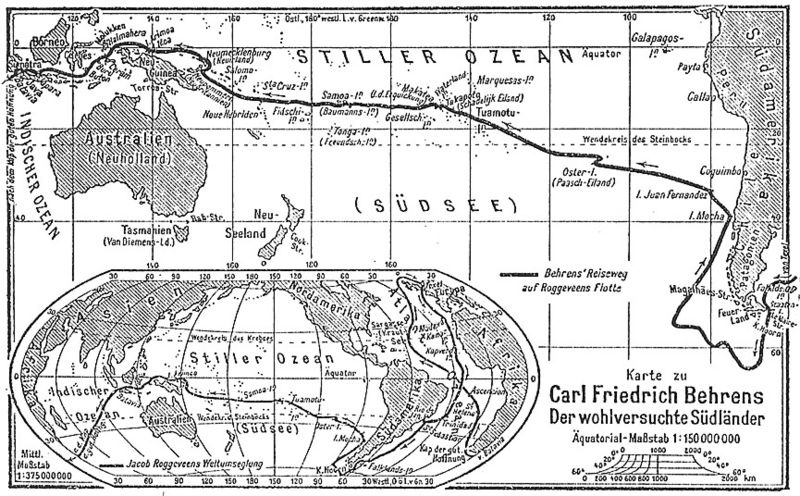
One of the first Westerners to reach Rapa Nui was the Dutch explorer Jacob Roggeveen in 1722. He was on his way to Australia when he reached the islands. At that time the deforestation had already happened, but it did not look like a society which had gone through a civil war. People were happy and well nourished with crops of yams, sweet potatoes and sugar cane.
But that short visit had far reaching consequences. Roggeveen left diseases that destroyed the society and it was similar to what happened in the Americas following the arrival of the imperial land grabbers and gold miners in the 15th century. Fifty years later Captain Cook stopped by at Rapa Nui and then the seeds of the demise of the civilization were evident. There were signs of disease and malnourishment. Some of the statues were toppled over. Between the period between Roggeveen and Captain Cook, there were Spanish ships, whalers and merchants that arrived there and the islanders who had not interacted with Westerners before, could not handle their diseases.
Most of these Westerners did not have noble intentions. In 1805 an American ship Nancy appeared and kidnapped the Rapa Nui. Indentured laborers were gathered for South American mines and plantations and just in the year between 1862 and 1863, around 1500 Rapa Nui were kidnapped. Following the merchants, Christian missionaries (French Catholic) followed for destroying the culture.
In the 1700s, there used to be a tradition called ‘birdman’ which was a contest among the various chiefs. As part of the birdman festival, people would scramble down a rocky path to the beach, paddle through shark infested water to an islet and wait for the birds to arrive. Once he got an egg, the contestant had to swim back to Rapa Nui and climb up the wall to finish. If he survived the ordeal, the chief of that group could claim the birdman title. Following the arrival of the missionaries, this was put to an end and what modern day visitors see is St. Peter standing on top of the birdman iconography. By 1877, only 111 people living there. Within 150 years of European arrival, the Rapa Nui had been wiped off. It was not ecocide, but genocide.
Many of the previous theories have also been falsified. The terrible violence that was attributed to overpopulation and deforestation was found to be very minimal and there was no evidence for a full blown civil war. There was no evidence for cannibalism; those came just from the European narratives. There was even a statue found with ribs protruding to show that there was famine, but carbon dating proved that the statue was created much earlier and the protruding ribs were just part of the iconography. It has also been shown that the Rapa Nui may not have used tree rollers to move the statues, instead they may have used ropes to walk the statues which had center of gravities designed for this purpose.

Thus the cutting of the trees did not drive them into starvation. The deforestation started much earlier, probably from the 13th century. But the innovative farmers of Rapa Nui had learned to farm in caves and they also had an ocean full of fish. Thus it is no surprise that the Dutch found them healthy and well nourished.
With this new evidence, the pattern of destruction of a culture is the same that we have seen elsewhere in the world. The Spaniards, through Guns, Germs and Steel, destroyed the native civilizations. Americans used the concept of ‘Manifest Destiny’ to grab Native American land in the continental United States. In Hawaii, it was the missionaries who arrived first and soon they were followed by American businessmen who were involved in whaling and the cultivation of bananas, pineapples and sugarcane. Rapa Nui was annexed by Chile on 9 September 1888.
In Pragati: Evidence for the continuity between Harappan Signs and Brahmi letters
(Original published link)
Instead of a complete termination of one civilisation and the beginning of a radically new one, there was a period of both continuity and change.

One of the most puzzling unsolved mysteries of the ancient world is the writing system of the Indus-Saraswati civilisation.Though there are over 4200 inscriptions, on seals, tablets and pottery, the writing has not been decoded. One of the problems is that the writing is too short mostly being four or five symbols long. The decipherment is also hard because the Indus writing falls into the most difficult category in the relation between script and language. While the easiest one is where the script and language are known, like English written using Roman alphabets, the most difficult one is where the script and language are unknown; the Indus writing falls into this category.
Now a 30 cm tall varaha found under the foundation of a home in Haryana is now providing an interesting clue into the later usage of the Indus-Saraswati script. This 2 kg, copper figure went on display for the first time in Brussels last year and will be exhibited at the National Museum in Delhi from March 6th for two months. According to the description which appeared in The Art Newspaper, “The figure has a cast relief on its chest of a unicorn-like animal, similar to motifs found on seals of the Harappa culture, which thrived until around 1900 BC.” But the most interesting part is the inscription above this creature; according to the curator Naman Ahuja the inscription represents “a combination of Harappan signs and Brahmi letters”, suggesting that it comes from “a period of overlap between the two cultures.” The inscription reads “King/Ki Ma Jhi [name of king]/ Sha Da Ya[form of god]” and according to the curator, “looks unmistakably like the Hindu god Varaha”. The Uttar Pradesh archaeological department has accepted this as an antique piece and dates it to the second to the first millennium BCE.

Before going into the relation between Harappan signs and Brahmi letters, we need to pay attention to the unicon like figure on the varaha. In his book, The Wishing Tree: Presence and Promise of India, Subhash Kak writes about the importance of the unicorn in Sanskritic texts. The Puranas referred to Vishnu and Shiva as ekashringa or the one-horned-one. The Mahabharata describes the varaha as triple humped, as shown in the Harappan iconography. In some seals, the unicorn is shown with the horn coming from the side as mentioned in Sanskrit texts.
Michel Danino too writes about the unicorn, which has been found in three quarters of the seals found in the Indus region, in The Lost River: On the trail of the Sarasvati. For Danino, the clues come from the Rig Veda. The Harappans added horns for not just the unicorn, but for tigers, serpents and various composite animals; the Vedic deities too have horns, sometimes even as high as four. The horn is prevalent all over the text: in describing how Indra destroyed the enemy’s den, to describe Soma, or while mentioning how the sun god spreads truth. Danino concludes that it cannot be proved that the carefully executed unicorn stood for Indra, but the affinity with Vedic concepts calls for attention.
Now to the writing. India’s first script which we can read is written in Brahmi; Asokan inscriptions were written in Brahmi and so was early Tamil. Many of the Asian scripts such as Burmese, Tibetan, Cham, Malayan, Javanese, Sumatran and the Tagalog were all derived from Brahmi. Even the so called Arab numerals, which are actually Indic numerals are derived from Brahmi. That said, there are different theories regarding the origins of Brahmi. One theory suggests that it was derived from an earlier Indian script while the other suggests it was derived from Phoenician or South Semitic scripts.

Indologist and scientist Subhash Kak wondered if there was a relation between Brahmi which has 48 letters and Indus script which has more than 300 signs and what he discovered was absolutely stunning. In his paper, On the decipherment of the Indus script – a preliminary study of its connection with Brahmi, he noted that letters of Brahmi could be combined to produce modified symbols and tabulating all the common modifications, he found they totalled between 200 and 300. He also identified the primary characters of the Indus script — ones which account for more than 80 percent of the signs — and they totalled 39 which is close to the letters in Brahmi. Also just looking at the Brahmi characters, he was able to identify many characters in Indus symbols which visually look similar. With this insight and by assigning sounds to those characters, Kak was able to read the names of Vedic deities into some texts. His work did not conclusively prove that Brahmi and Indus are related, but showed that the probability was high.
Continue reading “In Pragati: Evidence for the continuity between Harappan Signs and Brahmi letters”