Freedom of Speech: Communist Version

You know how much the Communists are for freedom of speech. So long as you are not searching for Tibet or Falun Gong, you are free to use Google in China. Their brothers in Kerala too love freedom of speech and they show their affection by pouring oil on people.
Recently the Director of All India Radio (Kozhikode) made some remarks against V.S.Achyutanandan, the head honcho of the Kerala Communists and it did not go well with the monkey brigade called DYFI.

Black oil was poured on C.P. Rajasekharan, Director of All India Radio (AIR), Kozhikode, as he came out from the Town Hall in Vatakara in the district on Thursday. A group of persons, said to be Democratic Youth Federation of India workers, shouted slogans against Mr. Rajasekharan after pouring the oil. [AIR Director comes under attack]

Women all around the world are fighting for equal rights as men. The Communists are all for that too. Oil was poured on Leela Abhilash who had the audacity to – and hold your breath here – to contest an election in a democratic India.

Looking for comedy

What makes Indians laugh? According to Albert Brooks, it is the other guy. In an interview on Fresh Air, he talks about how he traveled to India and got a crew of Hindus, Muslims and Sikhs to film – Looking for Comedy in the Muslim World. The Hindus would tell him Sikh jokes and Sikhs would tell Muslim jokes.
He then talks about his experience in filming in India, where he had to get permission from various authorities in at various levels to film. Then there was no crowd control and once he had to pay a bunch of Indian Army reservists to hold people back so that they would look into the lens. Indians love Americans which was like a surprise for him. He reasons it out by saying that all Indian anger is perpetually directed at the British and so Americans are considered friends.
The only question I have is, if he was looking for comedy in the Muslim world, why did he go to India?
Listen to the interview here.

Following Huen Tsang's Steps

Travel along a path taken by a historical figure is always exciting and many books have been written about those trips. For example Walking the Bible is a journey from Egypt to Jerusalem along the path followed by Moses. Chasing Che is a motorcycle trip along the route that Che Guevera took.

Last year some researchers attempted a bronze age trade route from Sur in Oman to Mandvi in Gujarat in a bronze age boat.

Recently there was a new book, Ten Thousand Miles Without a Cloud by Shuyun Sun which follows the path taken by Huen Tsang, the Chinese pilgrim who toured India during in the 7th century.

Now four Buddhist selected from Chinese mainland, Taiwan, Hong Kong and Macao are planning to retrace the steps of Huen Tsang.

The group will carry valuable gifts for Nalanda, including a Liuzu altar sutra embroidered on silk, a Sakyamuni statue and a copy of an ancient Chinese book, “records of the western regions of the tang dynasty” by Xuanzang`s disciple Bian Ji.

“The embroidered Liuzu altar sutra is the most valuable gift as it is the only sutra originated in China,” said shi Zhongyao, secretary-general of the trip organizing committee. “Others were all translated from Sanskrit,” he added.

In the late autumn of 628, monk Xuan Zang started his journey to South Asia. He walked 25,000 kms and spent 19 years [Retracing Zang`s journey to India]

Unlike Huen Tsang, these folks don’t plan to walk all that 25,000 on foot since they don’t have time for it. Still it would be an interesting journey and I hope someone makes a documentary on it, similar to the Walking the Bible series on PBS.

The History behind Ponniyin Selvan

Few days back, we had a review of Kalki’s epic novel Ponniyin Selvan and had the question – where does a historical novelist get his characters from?
Books on Indian history talk mostly about the North Indian dynasties and only a few lines are spent for the South Indian ones. Even in those few lines, only the famous kings are mentioned and details are just glossed over. Thus when it comes to the Cholas, you may hear about Raja Raja Choza I and Rajendra Choza, but not about Parantaka I or Parantaka II.

The Chozha dynasty

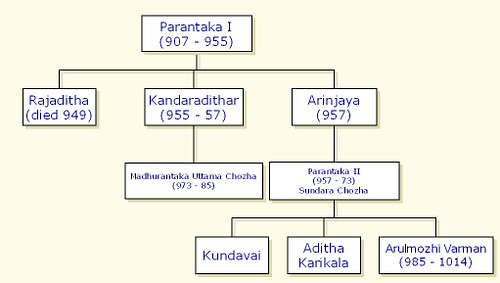
One of the authoritative histories of South India, Nilakanta Sastri’s A History of South India provides more detail. According to Sastri, Parantaka I ascended the throne on 907 A.D and ruled for forty-eight years. Even though there was prosperity during his time, thirty years (955 – 85) after his reign there was a period of weakness and confusion. Parantaka I was succeeded by his son Gandaraditya who with his queen Sembiyan-mahadevi played a major role in religion than in politics. By the time of the death of Gandaraditya in 957, the Choza dynasty had shrunk to the size of a small principality. Gandaraditya’s brother Arinjaya ruled only for a year and was succeeded by his son Sundara Choza Parantaka II.
His son Aditya II was made the yuvaraja and and Sundara Chozha turned his attention to the south to defeat Vira Pandya. Sundara Choza defeated him and Vira Pandya was killed by Aditya II. The last years of Sundara Chozha were clouded with tragedy and this is the story told by Kalki’s novel, Ponniyin Selvan.
According to Nilakanta Sastri, Uttama Choza conspired to murder Aditya II and compelled Sundara Chozha to recognize him as the heir apparent. He ruled till 985 A.D and after that Arulmozhi Varman, Sundara Chozha’s second son took over and started the period of Choza imperialism.
That’s all the information. So where does a novelist turn to find other characters and details of life at that time? What about Vandiyathevan or the conspirators Ravidasan and Soman, or Nandini? Did they really exist or were they created by Kalki?
Kalki’s other sources were stone inscriptions, copper plates and other books. There is a stone tablet in the great temple of Thanjavur which has the following inscription: “The revered elder sister of Raja Raja Chozhar, the consort of Vallavarayar Vandiyathevar, Azwar Paranthakar Kundavaiyar”. The book sources were K.A.Nilakanta Sastri’s The Chozas and T.V.Sadasiva Pandarathar’s Pirkala Chozhar Charitttiram. The second book has a five line reference to Vandiyathevan and from that, he became the hero of this novel. The names of the conspirators also came from a stone inscription.
Lot of information about the activities of various kings came from inscriptions like these as well as copper plates like the Anbil one. The Thiruvalangadu copper plates state, “The Choza people were very keen that after Sundara Chozan, Arulmozhi Varman should ascend the throne and rule their country. But Arulmozhi Varman respected the right of his Uncle Uttama Chozhan, the son of his father’s younger brother, Kandaradithan, to the throne and crowned him King”.
In the conclusion of the novel, Kalki frames a set of questions which the reader may have about the characters after the end of the novel and he talks about each one of them, but does not give any sources for the information.
Tags:

Podcast Recommendations

When I heard about podcasts for the first time, the immediate reaction was to who would want to listen to some guy saying something using a microphone and some audio recording tool. Already there are many terrible blogs and if such people switched to talking, it would be just more noise. I was pleasantly surprised to listen to many podcasts, some Indian, some American, some amateur and some professional and realized that I was so wrong about this, as wrong as the Main Stream Media was about bloggers. I want to share some podcasts which are now part of my regular listening schedule.
Let me start with the only two Indian podcasts which are in my list. Both of them are done by amateurs, but the programmes have a professional quality.

  • A Podcast about Indian Music by Amit Varshneya: The first program I listened to in his series was the one on disco themed songs and was hooked. This program was an analysis of all the disco songs of the 70s and 80s with songs from Rishi Kapoor movies like Karz, Hum Kisi Se Kam Nahi and the songs of Nazia Hassan. This program usually has a bunch of songs either based on a theme such as Music Director or the best songs of the month with commentary by Amit
  • M-POD by Jo: This Malayalam podcast is a talk show on news, music, literature etc. The episode I liked was the interview with Pradeep Somasundaran, of Meri Awaz Suno fame, where he talks about his association with music director Raveendran and general news about the music industry. In case you did not know, Jo is a talented singer himself. (just listen to this song even if you don’t understand Malayalam)
  • KQED Forum with Michael Krasny: The only station my car radio is tuned to is 88.5 FM, the National Public Radio station. Even though there is a liberal bias to most of the programs, it covers a wide range of topics with great depth. Forum, one of best programs on NPR is broadcast from the station here in San Francisco is very topical and covers everything from what is happening around the world to interviews with authors. Forum is one hour long, sufficient enough to overload you with information.
  • News Hour with Jim Lehrer Jim Lehrer is the grand daddy of American broadcasting and this hour long daily news is broken into segments where just a few issues are covered, but in depth.
  • Science Friday NPR has a daily talk show called Talk of the Nation. On Friday’s it is called Science Friday and very topical science events are discussed.

Besides this, my subscriptions include ABC News Nightline, CBS News 60 minutes and Ebert and Roeper. The software I use for subscribing/listening to podcasts is Apple’s iTunes, which is a free download.
Tags:

New Blog: Indian Sculpture

There are not many blogs on Indian history and so it gives us great happiness to see yet another software engineer on this low-visitor-count market. Also, this new blog Indian Sculpture is inspired by The Palm Leaf
Indian temples are a great source of cultural information and goal of this new blog is to glean information of dress, weapons or anything else of that time period.

I am fascinated by the detail in these sculptures. It’s almost like they were 3-D photographs of their day. Many of the sculptures that I saw had different faces and had different accesories. They were clearly meant to represent different people. Whether or not it was real people or the sculptor’s fancy is anyone’s guess. It’s pretty amazing how many details spring to your eye once you actually start looking for this sort of thing though.

Book Review: Ponniyin Selvan

Ponniyin Selvan by “Kalki” Krishnamurthy, Macmillan India, ~1800 pages.
Who should be the king? This was the question that members and enemies of the Chozha dynasty were asking each other in 10th century Tamil Nadu and the incidents around this episode forms the plot for R. Krishnamurthy’s (pen name: Kalki) epic novel Ponniyin Selvan. This novel was first published in serial form in the Tamil weekly magazine Kalki from 1950 – 1954. Though Krishnamurthy wrote a large number of short stories, it was as a novelist that he got fame. He was also the first significant historical novelist in Tamil and his other works include Parthiban Kanavu and Sivagamiyin Sabatham.
Parantaka Chozha was succeeded by his second son Kandaraditha as the first son Rajaditha had died in a battle. On the death of Kandaraditha, his son Maduranthaka was a child and hence Kandaraditha’s brother Arinjaya ascended the throne. After Arinjaya’s death, his son Parantaka II, Sundara Choza was coronated. He had two sons, Aditha Karikalan and Arulmozhi Varman and a daughter Kundavai.
When the story starts, the emperor Sundara Chola is ill and bedridden. Aditha Karikalan is the general of the Northen Command and lived in Kanchi and Arulmozhi Varman (who would be famous later as Rajaraja Chola I) is in Sri Lanka in battle and their sister Kundavai Piratti lived in Chola royal household at Pazhayari.
The story is set in motion, when rumor starts that there is a conspiracy against Sundara Chozhar and his sons. One person who gets a glimpse of the Pandya conspirators is a warrior of the Vana clan Vallavarayan Vandiyathevan. Even though the book is titled Ponniyin Selvan, the hero of the book is Vandiyathevan, a friend of Adhitha Karikalan.
It is through Vandiyathevan that we meet most of the characters in the novel such as Arulmozhi Varman, the prince whom all the people loved and Periya Pazhavetturayar, the chancellor who married Nandini when he was sixty. During his youth Aditha Karikalan had fallen in love with Nandini, but she turned vengeful after Aditha Karikalan killed Veerapadyan (who was either Nandini’s father or brother) and vowed to destroy the Chozha dynasty. We also meet Kundavai Devi, who after hearing the news of the conspiracy sends Vandiyathevan to Sri Lanka to give a message to Arulmozhi Varman to come back immediately.
Continue reading “Book Review: Ponniyin Selvan”

Book Review: Ponniyin Selvan

Ponniyin Selvan by “Kalki” Krishnamurthy, Macmillan India, ~1800 pages.
Who should be the king? This was the question that members and enemies of the Chozha dynasty were asking each other in 10th century Tamil Nadu and the incidents around this episode forms the plot for R. Krishnamurthy’s (pen name: Kalki) epic novel Ponniyin Selvan. This novel was first published in serial form in the Tamil weekly magazine Kalki from 1950 – 1954. Though Krishnamurthy wrote a large number of short stories, it was as a novelist that he got fame. He was also the first significant historical novelist in Tamil and his other works include Parthiban Kanavu and Sivagamiyin Sabatham.
Parantaka Chozha was succeeded by his second son Kandaraditha as the first son Rajaditha had died in a battle. On the death of Kandaraditha, his son Maduranthaka was a child and hence Kandaraditha’s brother Arinjaya ascended the throne. After Arinjaya’s death, his son Parantaka II, Sundara Choza was coronated. He had two sons, Aditha Karikalan and Arulmozhi Varman and a daughter Kundavai.
When the story starts, the emperor Sundara Chola is ill and bedridden. Aditha Karikalan is the general of the Northen Command and lived in Kanchi and Arulmozhi Varman (who would be famous later as Rajaraja Chola I) is in Sri Lanka in battle and their sister Kundavai Piratti lived in Chola royal household at Pazhayari.
The story is set in motion, when rumor starts that there is a conspiracy against Sundara Chozhar and his sons. One person who gets a glimpse of the Pandya conspirators is a warrior of the Vana clan Vallavarayan Vandiyathevan. Even though the book is titled Ponniyin Selvan, the hero of the book is Vandiyathevan, a friend of Adhitha Karikalan.
It is through Vandiyathevan that we meet most of the characters in the novel such as Arulmozhi Varman, the prince whom all the people loved and Periya Pazhavetturayar, the chancellor who married Nandini when he was sixty. During his youth Aditha Karikalan had fallen in love with Nandini, but she turned vengeful after Aditha Karikalan killed Veerapadyan (who was either Nandini’s father or brother) and vowed to destroy the Chozha dynasty. We also meet Kundavai Devi, who after hearing the news of the conspiracy sends Vandiyathevan to Sri Lanka to give a message to Arulmozhi Varman to come back immediately.
Continue reading “Book Review: Ponniyin Selvan”

Rashomon Effect – Episode 3

What were Mahatma Gandhi’s last words?
Tushar Gandhi:

Mahatma Gandhi’s last words after he was shot by Nathuram Godse on January 30, 1948 were `Hey Ram’, the Mahatma’s great grandson Tushar Gandhi said here today.
He cited testimony of Sardar Gurbachan Singh given during the Gandhiji’s assassination trial in 1948. “Singh said that after being shot at, Bapu folded his hands and I heard him utter `Hey Ram'”, he said.
Abha Gandhi, on whose lap Gandhiji died, said Bapu did not only say Hey Ram once but the chant of Hey Ram went on for a few seconds he lived after being shot, Gandhi said.

Venkita Kalyanam, Mahatma’s personal assistant

Mahatma Gandhi did not utter hey Ram when he fell to the bullets of the assassin 58 years ago, Gandhi’s personal assistant Venkita Kalyanam.
In fact, he did not utter anything when bullets from Nathuram Godse’s pistol pierced his chest, Kalyanam, who was a witness to the shocking event, told a meet-the-press in Kollam.
Kalyanam claimed he was just behind Gandhi when he was shot dead in Delhi on January 30, 1948.

Related Links: Rashomon Effect – Episode 2, Rashomon Effect – Episode 1