10th century Buddhist statues in Chennai

In Kalki’s epic novel, Ponniyin Selvan, which is about the the early life of 10th century Chola emperor Raja Raja Chola I, there are many references to Buddhism. In the second book, we get to see him in Sri Lanka restoring the Buddhist Viharas and getting impressed by the size of the statues of Buddha. Later when he gets caught in a cyclone and falls sick, he lives in hiding in the Buddhist Monastery of Nagappatinam in Tamil Nadu.

Recently the Archaeological Survey of India had found a 10th century Tamil inscription that mentioned the donation of land to build a Shiva temple in Kolapakkam, 20 km from Chennai. Deciphering the inscriptions, they found two Buddha statues in dhyana pose and some ornamental pillars.

S. Rajavelu, epigraphist, ASI, had recently found that the third inscription belonged to “Sri Vijaya Maharaja,” a king from Sumatra, and that it was issued in his eighth regnal year. The inscription mentions his donating 250 kuzhi (a measurement) of land to Agatheeswarar at Kolapakkam, which was in Perur nadu (country), a sub-division of Puliyur. Sri Vijaya was a contemporary of Raja Raja Chola and the palaeography of the inscription showed the script was similar to that of the period of Raja Raja Chola. Sri Vijaya had a cordial relationship with the Chola kingdom. Although the inscription mentioned Sri Vijaya’s donation to the temple, it indirectly indicated Buddhist activity nearby, because Sri Vijaya was a Buddhist.

Dr. Satyamurthy and Dr. Rajavelu explored the area and found the ruins of a Buddhist temple close to the Agatheeswarar temple. The two Buddha sculptures and ornamental pillars, in granite, were unearthed. The Buddha sculptures are three feet tall. One sculpture has a dharma chakra on either side of the Buddha. This was sculpted in the ancient region that is now Tamil Nadu. The other sculpture has a three-tiered umbrella above the Buddha’s head and women bearing fly-whisks.

According to Dr. Satyamurthy, the face of this Buddha has Mongoloid features and this sculpture shows South-East Asian influence. One of the ornamental pillars unearthed has a bas-relief of a human face, with a head-gear that shows South-East Asian influence. An image of Ganesa is carved on this pillar.

Kolapakkam perhaps was a centre of Buddhist activity. According to Dr. Rajavelu, this area coming under Tondaimandalam was noted for Buddhist activity about 1,000 years ago, prior to the Chola period. [Buddha statues unearthed near Chennai]

Update: It seems the statues are not that of Buddha, but of Jain thirthankaras
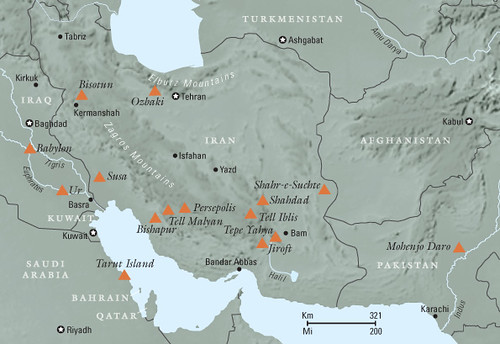
Jiroft

Even though Subhash Kak et al wrote a book asserting that India is the Cradle of Civilization, still Mesopotamia is though to be the one. Now some new discoveries in Iran may change all that.

Archaeological excavations in the lower layers of a cemetery in Jiroft have revealed that its history goes back to the fouth millennium B.C, much before Mesopotamia. Some inscriptions were also found which proves that the writing language of Jiroft was older than that of Mesopotamia.

As the author of a three-volume history of Mesopotamia and a leading Iranian authority on the third millennium BC, Madjidzadeh has long hypothesized that Jiroft is the legendary land of Aratta, a

The Oldest Buddhist Manuscripts

Remember the Dead Sea Scrolls , the 2000 year old manuscripts that tell us that everything attributed to Jesus–and Christianity–is borrowed from an extremist Jewish sect that existed in the Qumran region of Palestine on the west shore of the Dead Sea. Now, some manuscripts which are called the Dead Sea Scrolls of Buddhism have been dated to between the first and fifth centuries A.D.

The majority of the manuscripts were found in Bamiyan in Afghanistan and were smuggled out to a collector.

It was in 1996 that the first group of manuscripts was discovered. The finders set off towards Pakistan, and after being chased by the Taliban in the Hindu Kush they managed to cross the Khyber Pass, eventually reaching Islamabad. There the manuscripts passed through dealers before being acquired by London specialist Sam Fogg, who sold the 108 fragments to Mr Schøyen. This was followed by further batches, which were considerably larger and usually included hundreds of folios and the occasional complete manuscript. Altogether around 15 separate consignments of Bamiyan material have been acquired by Mr Schøyen.[Buddhism’s “Dead Sea Scrolls” for sale to Norway]

The antiquity of the manuscripts make it an important link in the history of Buddhism.

“Buddhism was originally an oral tradition but little is known about how it developed from spoken word to written word, so the discovery and date confirmation will give us a unique insight into the development of Buddhist literature,” he said. The new manuscripts are therefore the missing link in the historical chain.[‘Dead Sea scrolls’ may be missing link in Buddhism]

One article in the line says

“The Senior collection dating is of particular importance as this result makes a major contribution to Indian chronology in showing that an early date of 78 AD for a key historical figure, the Kushan emperor Kanishka, is no longer tenable.” ‘Dead Sea scrolls’ may be missing link in Buddhism]

There is no explanation on how this conclusion was reached. After reading all this, I am confused as to why these manuscripts are called the equivalent of Dead Sea Scrolls. The Dead Sea Scrolls challenge the origin of Christianity while so far we have not seen anything similar in the Buddhist documents. The only similarity between them is that both are old, which is nothing new in the field of archaeology. So why not just call it ancient Buddhist documents without any reference to the Dead Sea Scrolls.

Terrorist attack in Varanasi

They were normal people like you and me. They were old people like our parents who are religious. They had gone to pray to Hanuman in Varanasi, the holy city for Hindus and now they are dead due to the handiwork of few murderers.

The first blast came as devotees gathered for evening prayer at a 16th-century temple dedicated to Sankat Mochan. Tuesdays are particularly busy there, when special services are held for the Hindu monkey deity, Hanuman, who is known as the Liberator From Troubles. The second blast went off 45 minutes later at the main train station, Reuters reported. It was unclear how many people died in each place. Unexploded bombs were also found across Varanasi, including the maze of narrow streets in the oldest quarters of the 2,500-year-old city. Varanasi, also known as Benares, has a Hindu majority and a large minority of Muslims.[Bombs Rock a City Holy to Hindus, Killing at Least 15]

Also note their targets.

“The bomb was placed near a tree where women usually sit and take rest,” Singh said. “Moreover, a wedding was just over when the blast took place. Had the blast taken place a few minutes earlier, the toll could have been more.”[Indians Protest, Fear Violence Will Spread]

50 people in Delhi, 20 in Varanasi and God knows how many more to come.
The Indian Blogosphere comments on this mass murder: Die #$* Infidels!, Terrorists attack Varanasi, Caught in the cross-fire, Bomb blasts in Hindu holy city, What the Varanasi attack really is

1000 year old Gomateshwara Statues

Jainism like Buddhism started around the Magadha region and then moved down to South India. One famous migration is that of Chandragupta Maurya (Asoka’s grandfather). At the end of his regime, there was a famine and he led an exodus from the Ganga Valley to the Deccan. He spent his last days in Shravanabelagola, in present day Karnataka and died of starvation.
Shravanabelagola has two hills, Chandragiri and Vindyagiri and it is believed that Chandragupta Maurya medidated and died in Chandragiri. Now two statues of Gomateshwara, both 1000 years old have been found at Kambadahalli, near Shravanbelgola.

The sculpting of the 58.8-feet-tall statue of Gommateshwara in Shravanbelogla in 981 AD depicts him with curly hair, whereas the Gommateshwara statues recovered before 981 AD show him as having long hair reaching the shoulders.
The statues recovered in Kambadahalli have long hair falling on the shoulders and tendrils encircling the thighs. This proves that the statues found have been sculpted before the 9th century, say historians.
“Kambadahalli is a historical Jain centre. More research is needed to shed light on the other statues and Jain temples, which were distorted at the end of the 17th century.[1,000-year-old Bahubali statues discovered ]

The New Communist Hero

Shops in the city’s predominantly Muslim Charminar quarter were closed in protest of the president’s visit, The Associated Press reported. Several hundred communist and Muslim demonstrators chanted “Bush go home” and carried posters of Osama bin Laden.[Under Tight Security, Bush Arrives in Pakistan]

Osama bin Laden, responsible for the death of an estimated 2,825 people on September 11, out of which 34 were Indians is now the hero of the Communists and the Muslim demonstrators. After admiring mass murderers like Stalin, Chairman Mao and Pol Pot, this was the next logical step for these anti-nationals.

The Clueless Protestors

What’s that?
This is the best answer you get from the nearly one lakh people protesting against President George W Bush’s visit, when they are asked about the nuclear deal.
Interestingly, this was after several leaders from the Left and Samajwadi Party launched tirades against the nuclear deal, thundering that India was compromising its sovereignty. “I have no clue about this deal,” said D S Negi, a protestor from Rohtak, Haryana.
Even as A B Bardhan, general secretary, Communist Party of India, came up on stage and started complaining about the deal being a setback to Indian sovereignty, the masses remained unaffected. Most of them were seen scratching their heads or wearing a blank expression on their faces, while Bardhan spoke about the nuclear deal.
Another interesting answer came from Sarvesh Kumar, a Samajwadi Party leader from Benares, Uttar Pradesh – “I don’t know what the nuclear deal is all about. I only know that my leader, Mulayam Singh, opposes Bush’s visit and so am I opposing his visit. Netaji is never wrong in politics.”[Protestors clueless about the nuclear deal]

It is very common for political parties to pay money and bring truckloads of people for any protest. These people don’t really care what the issue is about. There was one Malayalam movie which made fun of this when a hired protestor goes to the wrong demostration and starts raising the slogans of the rival party. I am sure Arundhathi’s gorillas also find this amusing.
It should also be noted that there was no protest in Jammu and Kashmir from political parties as well as separatist groups. Also 99.99% of Indians did not protest this visit.
Update: Ashish asks: Why do the Left even pretend that they are for India’s interests?
Update 2 Stupid is as stupid does

Kerala's Jewish History

There are various theories on Kerala’s relation with the Jews. According to oral tradition Jews established trading contacts with Kerala during the time of Solomon. There are other traditions which claim that Jews came to Kerala during the time of King Nebuchadnezar of Babylon in 500 BC, the time of Buddha. According to Romila Thapar in her book Early India, the Jews came to India in the tenth and eleventh century AD.

The Jews of Cochin say that they came to Cranganore (south-west coast of India) after the destruction of the Temple in 70 C.E. They had, in effect, their own principality for many centuries until a chieftainship dispute broke out between two brothers in the 15th century. The dispute led neighboring princes to dispossess them. In 1524, the Moors, backed by the ruler of Calicut (today called Kozhikode) attacked the Jews of Cranganore on the pretext that they were “tampering” with the pepper trade. Most Jews fled to Cochin and went under the protection of the Hindu Raja there. He granted them a site for their own town that later acquired the name “Jew Town” (by which it is still known).
Unfortunately for the Jews of Cochin, the Portuguese occupied Cochin in this same period and indulged in persecution of the Jews until the Dutch displaced them in 1660. The Dutch Protestants were tolerant and the Jews prospered. In 1795 Cochin passed into the British sphere of influence. In the 19th century, Cochin Jews lived in the towns of Cochin, Ernakulam and Parur. Today most of Cochin’s Jews have emigrated (principally to Israel).[The Virtual Jewish History Tour]

Recently a reunion was held in the town of Chendamangalam by about 100 Jews to bless a synagonue built in 1614.

Among the ancient graves outside the synagogue, stand a tombstone which dates from 1264, making it the oldest Hebrew inscription found in India. The oldest such document is regarding a wedding that took place in the synagogue in 1812. [Kerala showcases its Jewish history, treasures]

Harappan Ruins in Haryana

When we say Indus Valley Civilization, we usually refer to the sites of Mohenjo-Daro and Harrappa located in present day Pakistan. Those are not the only ones though for Harappan sites have been discovered in other parts of India as well. Recently the first Harappan burrial site was discovered in Baghpat in Uttar Pradesh. In 2004, a Harappan site was found in the town of Bagasara in Gujarat. This site which dates back to 2500 B.C was found to have a shell making workshop, fortifications, and knives with bone handles.
Now archaeologists have found the ruins of a city dating back to Harappan times at Farmana Khas in Haryana.

He said that with the discovery of the ruins of Indus-Saraswati Harrapa civilisation on the banks of ancient course of river Yamuna, the belief has been further strengthened that it has been the civilisation of the people, who belonged to the era of Rigveda. The ruins related to the same civilisation have also been found at Sanoli in Uttar Pradesh along the ancient course of river Yamuna. [Harappan city buried in Haryana’s Rohtak district]

He said the site of the discovery, popularly known as Daksh Khera, was spread over 32 acres and the ruins were under a three-metre high hillock. He said the city would have been located on the banks of the river Yamuna, that could have been flowing through the area in ancient times. Ruins from the Harappan era have also been found at Sanoli in Uttar Pradesh along the ancient course of river Yamuna, he said. [Ruins of Harrappan city found in Haryana]

Moral Police in AMU

While many species are becoming endangered, one tribe that is increasing in population is the Moral Police in India. In case you have not heard, they will tell you what you can speak and what you cannot. You need their permission to hold your wife’s hands or to express your love. Now they are dictating what dresses women can wear.

Wearing a T-shirt can be dangerous as a girl student of the prestigious Aligarh Muslim University realised last week. For daring to wear what she wants to, Najma (name changed) is being threatened by fellow students who claim the sole right to interpret what is moral in Islam.
She has been told to replace the T-shirt with kurta and dupatta and to stop her campaign for an effective mechanism in the university to address complaints of sexual harassment.
AMU’s moral police have also found fault with Najma’s practice of sharing meals with boys at canteens. ‘‘Girls are not expected to be seen in public places,’’ she has been told. Najma defied such instructions and she and a group of students formed a cultural group, Saada, and raised issues related to gender[AMU moral cops target girl for wearing T-shirt on campus]

The folks has been harassing the lady in AMU, which I guess is perfectly legal in the moral police code of conduct.