Pre-Pallava plaque of Kuravai Koothu

In Kalki’s novel, Ponniyin Selvan, the hero Vandiyathevan happens to see a performance of Kuravai Koothu while visiting the Kadambur Palace. The performance starts with the arrival of nine girls on stage. They sing and dance praising Lord Murugan’s fame and valor, the skill of his victorious spear which killed the demons, Gajamukhan and Soorapadman. They also praise many of his qualities and his charities.
Now a terracota plaque depicting five women performing the kuravai koothu have been discovered near Mamallapuram. The location for this plaque is the oldest temple in Tamil Nadu which was discovered in post-tsunami archaeology. The original temple made of brick and dedicated to Muruga was built during the Sangam era (200 BCE to 300 CE). This temple was destroyed and the Pallava kings rebuilt it as a granite temple during 800 – 900 CE.

T. Satyamurthy, Superintending Archaeologist, ASI, Chennai Circle, said the terracotta plaque depicting the dancers “is one of the fabulous collections that will enrich the archaeological wealth of the State.” It is a 13 cm by 12 cm bas-relief panel that shows the women with headgear and prominent eyes. Their mouths are open as if they are singing. The plaque belongs to circa second or third century A.D., he said.
“It is an important find because it is difficult to find terracotta figurines of the pre-Pallava period,” said P. Shanmugam, Director, Institute of Traditional Cultures of South and South-East Asia, University of Madras. “This is the first time in Tamil Nadu that such a group dance plaque has been found,” he said. `Kuravai koothu’ performed in Muruga temples find mention in the Tamil epic Silapadhikaram. [Rare artefacts found]

This particular Murugan temple, at Thiruvizhchil, which is the present-day Salavankuppam has been mentioned in a few inscriptions which give more details on the temple’s history.

All spoke of the gift of gold for burning a perpetual lamp at the temple. One inscription on a pillar belongs to the Pallava king, Kambavarman (of 9th century A.D). Another was issued by the Rashtrakuta king, Krishna III, in his 21st regnal year of 971 A.D. The third belonged to the Chola king, Rajendra III, of 13th century A.D.
During the earlier excavation from July to September 2005, the ASI had discovered the sanctum sanctorum built of bricks of the Muruga temple of the late Sangam age or the pre-Pallava period. According to archaeologists, a tsunami or tidal action damaged it. The Pallava kings subsequently converted into a granite temple in the 8th or 9th century A.D. It too collapsed because of a storm surge or a tsunami. The temple had a third phase of re-construction under the Cholas.
During the excavation last year, the ASI had unearthed two pillars with Tamil inscriptions of two Pallava kings, Nandivarman II of late 8th century A.D. and Dantivarman of early 9th century A.D. They also spoke of donations to the Muruga temple at Thiruvizhchil [Rare artefacts found]
Bernice King – a racist

During the memorial service for Coretta Scott King, Martin Luther King’s wife, one of the speeches was given by Bernice King, his daughter, who is also a minister. In her speech she said the following about what is wrong in this world today.

See, what God is saying to us today, through the — through the transition of Coretta Scott King, is that we, here in this world, right now, are suffering from a — complications of cancer, from materialism, and — and greed, and — and selfishness, and arrogance, and elitism, and poverty, and racism, and perversion, and obscenity, and misogyny. and idolatry, and violence, and militarism. [Tribute to Coretta Scott King]

As a Hindu, I worship idols. So do about 800 million people. According to Ms. King, the world is suffering from people like us, and we rank along with perversion, violence and complications of cancer.
Did not know that the daughter of the man who fought against racism is a racist of the first order.

The many worlds in Pakistan

Nicholas Kristof, the Op-Ed Columnist of New York Times had an article on Aisha Parveen, a 20 year old Pakistani woman, who faces a terrible future because she ran away from a brothel. When she was 14, she was kidnapped and woke up in a brothel where she was sexually abused for about 6 years.

This went on for six years, during which she says she was beaten every day. The girls in the brothel were forced to sleep naked at night, so that they would be too embarrassed to try to escape. Ms. Parveen says she believes that two of them, Malo Jan and Suwa Tai, were killed after they repeatedly refused to sleep with customers. In any case condoms were never available, so all the girls may eventually die of AIDS.[A Woman Without Importance (TimesSelect subscription required)]

A man working in the brothel helped her escape and married her. Now she faces charges of adultry and the courts are planning to hand her over back to the brothel owner. She cannot go back to her parents since they could kill her for protecting the family honor. Now she lives in hiding.
That was one world. In another world within Pakistan, the Air Force has inducted four women as fighter pilots for the first time.

The women were part of a batch of 36 cadets who were awarded flying badges after three years of gruelling training at the PAF academy at Risalpur. Being a fighter pilot has until now been a purely male domain. Women could join the armed forces but only for non-combat jobs like the medical corps. Three years ago the PAF decided to allow women to train as fighter pilots.[Pakistan gets women combat pilots]

BBC withdraws Vinod Mehta's slanderous article

When the Shankaracharya was arrested allegedly for conspiring to murder Sankararaman, the media went overboard with their character assassination. A major critic was the editor of Outlook, a Vinod Mehta. He went on BBC Radio and gave his version of the story.

Two days later the talk was published as an article on the BBC website with the title of “Murder, Mystery and Politics in India.” Straight away Mr. Mehta set the tone. “The charges are a tabloid journalist”s dream – murder, sleaze, debauchery, greed and sex,” he said. The story he went on to recount was meant to illustrate each of these “charges.” But it was overwhelmingly fictitious and certain crucial details stood in contradiction with the findings of the Supreme Court of India, made public some three weeks before Mr. Mehta delivered his talk on BBC Radio Four. His tabloid dream was of his own making.

When the devotees of the Shankaracharya complained about the inaccuracies in the article to the BBC, they acknowledged it, but refused to remove it from their web site. Finally the devotees engaged some lawyers in London and when faced with the prospect of a lawsuit, the BBC withdrew the article. They also apologized and reimbursed the expenses.
Update (1): M F Hussein is found guilty of hurting Hindu sentiments by a court. According to the court, “Hussain had been found guilty of ‘making objectionable paintings to hurt the feeling of a community and of disturbing communal harmony’.”
Update (2): Various Hindu groups have been fighting the State Board of Education in California on what is being taught in textbooks. Now they have decided to take the State Board to court.

Fighting for rights in Dubai

The ultimate dream for a Malayali is to go to the “Gulf”. For people back home, Gulf is a place where anyone from the educated to the uneducated can get a job, send dirhams back home, and raise the quality of life of their family. Recently a friend was starting a business in Dubai and told me about the problems facing workers there. Whatever he told is mentioned in this New York Times article on the migrant workers in Dubai.

A growing number have resorted to suicide rather than return home with empty pockets: last year, 84 South Asians committed suicide in Dubai, according to the Indian Consulate here, up from 70 in 2004.
Mr. Kumaran, who earns 550 dirhams every month, or about $150, as a laborer, sends home almost half his earnings and lives on the equivalent of roughly $60 a month. That is barely enough to pay for food and cigarettes and using his cellphone from time to time. But he is not sure how he will repay the loan he took to get here.
“If I’d stayed in India and worked just as hard as I do now, I could have made the same money,” he said. “And I wouldn’t have needed to get a loan to come here.”[In Dubai, an Outcry From Asians for Workplace Rights]

Unable to take the abuse of the employers anymore, these immigrants took out protests, some of which were violent.

But the mass action on Tuesday was the most significant of its kind. Hundreds of workers building the Burj Dubai skyscraper chased security guards and broke into offices, smashing computers, scattering files and wrecking cars and construction machines. When they returned to work the next day, demanding better pay and improved working conditions, thousands of laborers building an airport terminal across town also laid down their tools, demanding better conditions, too. The workers also halted work on Thursday, until a settlement was negotiated.

Last time some Malayalees in Baharin and UAE took to the streets to protest and as a result many recruiting companies decided not to hire people from Kerala
There are many angles to this story. We are so used to fighting for our rights in Kerala that we think it will work everywhere. In countries where human rights do not exist, such protests may result in loss of job and deportation. At the same time, these countries require migrant workers to fuel their economy and do jobs which their citizens are not willing to do. Then there are people from less fortunate backgrounds who are willing to take the abuse for a good living and they can displace the protesting Malayalees.

Robert Clive's pet dies

He was around 250 years old and has witnessed the history of India like no one. If he could talk, he would have told many stories, but unfortunately he was a tortoise. Robert Clive’s pet tortoise, Addwaitya died in Calcutta this week.

“Historical records show he was a pet of British general Robert Clive of the East India Company and had spent several years in his sprawling estate before he was brought to the zoo about 130 years ago,” West Bengal Forest Minister Jogesh Barman said.
“We have documents to prove that he was more than 150 years old, but we have pieced together other evidence like statements from authentic sources and it seems that he is more than 250 years old,” he said.
The minister said details about Addwaitya’s early life showed that British sailors had brought him from the Seychelles islands and presented him to Clive, who was rising fast in the East India Company’s military hierarchy. [Tortoise that saw Sepoy Mutiny dies]

Links

  • Prabhu has lot of pictures of Uthiramerur. This is the temple which had 10th century inscriptions describing the procedure for selecting an officer
  • Varnachitram looks at the yoyoing careers of Malayalam film makers like M.T.Vasudevan Nair, Padmarajan, Lohithadas, Renjith, and Renji Panicker.
  • In this blog we have come out against the moral police in India many times. Now Chenthil writes on the new rules imposed by the Police Commissioner for the city of Chennai for browsing which seem straight out of 1984.
  • Elections are in April in Kerala and there are many possible outcomes. Vinod analyzes them. Mind Curry gives some depressing statistics about the state.
  • Jo and Meera Manohar sing a beautiful Deepak Dev compositionThumpi Kinnaram from the film Naran

Lockup deaths in Kerala

In the review of the new Malayalam movie, Vargam, Rishi Raj Singh writes about lockup deaths

The film Vargam serves to portray police officers as they are: both, at times philanthropic and at times swayed by mean desires involving graft and physical torture. There is only one point of disagreement with the theme — where the death of a young boy in police lockup is shown not properly investigated by senior police officers or the ever-alert press. In a highly literate State like Kerala, this kind of police brutality is neither possible nor plausible.[ A love story in police style]

1988, a movie called Piravi (Birth) was made by Shaji Karun on the disappearance of an engineering student in Kerala. This student was tortured and killed by police and is based on the real life incident of Rajan. That particular incident happened during the time of emergency when the police ran wild in India. Recently a parade was held in the Central Jail in Trivandrum to identify police constables in connection with the lockup death of an Udayakumar. That is not the only one and there have been allegations about other deaths as well.
The incidents of police brutality might be less due to a highly literate and political population, but it is certainly there.

GDrive and Privacy

It was probably on the last day of JavaOne 2005. There was a panel discussion with James Gosling, Bill Joy, Guy Steele, and John Gage on the future of Java. During that conversation, Gosling joked that since Google maintains a cache of of all the websites, we can shutdown the internet and use Google’s servers to access all information.
Now it seems Google wants to store all information on their servers, including your personal files. This is a new concept called GDrive which promises infinite storage for users.

With infinite storage, we can house all user files, including: emails, web history, pictures, bookmarks, etc and make it accessible from anywhere (any device, any platform, etc). We already have efforts in this direction in terms of GDrive, GDS, Lighthouse, but all of them face bandwidth and storage constraints today.[Google’s “GDrive” part of promise for infinite storage]

Google Desktop Search already allows you to share files across computers by storing them on Google servers. The only question then to ask is how secure will the data be. Recently Google accidently released details of their financial data on the web, which is very reassuring.
If you live in United States, you can be rest assured that your personal data is all over the place. Medical records are stolen, tax returns are sometimes made public, and whole set of credit card information is lost. The only protection you have is the possibility that hackers do not find your data interesting.

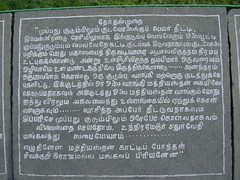
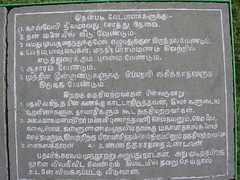
Uttaramerur inscriptions

(Images via Ravages)

Our history crazy man Ravages was on a tour of Kanceepuram, Uttaramerur and few other places. During his trip he went to a temple in Uttaramerur which was a Pallava temple rebuilt by Parantaka I and in the walls of the temple he found inscriptions which talk in detail about a process for selecting an officer. These instructions which are more than 1000 years old are one of the earliest explaining the process for conducting an election.

But broadly, it tells that to elect an officer, candidates are invited from the 30 families living in the 12 villages in and around Uttaramerur. Each member will put write the name of a candidate on a piece of palm-leaf (olai) and put into a small vessel (kudam) after which, one evening, every citizen, without any discrimination or differences will assemble in the hall of the temple. Here, the current village head (Madhiyastan) will accept all the ballot-papers, without cheating (the procedure for accepting is detailed – the head-guy should spread his fingers wide, accept the ballot paper on his fore-arms and prove to the assembly he hides no extra ballot)

The head-guy will then read out the name on the ballot-paper…and as he reads, the scribe will mark it down. This way, the one who gets the max-votes will be elected and everyone in the assembly will accept him as their officer. The final tablet describes the minimum requirements for a candidate as well as what circumstances bar him from competing the elections

Requirements
1) Must own a plot of land
2) His own house on his own land
3) Minimum age: 35. Max: 70
4) Must be well versed in the vedas, and other knowledges. Should be able to explain it competently
5) Must be pious
6) Should not have occupied the same post in the preceeding 3 years

Things that would disqualify a person from the polls

1) One who fails to show proper accounts after elections. (Apparently, bribery in India isn’t new 🙂 The best thing is, a corrupt official also means his family and dependants are barred from the elections
2) The one who has committed adultery, murder, burgulary, and alcohol consumption is disqualified…these four acts are considered great-sins. Also, anybody who has committed the sins and is reforming from them is barred
3) The one who eats that which shouldnt have been eaten (what kinda rule is this?)

Finally, the inscriptions talk of the tenure of the elected official – 360 days. (Perhaps based on the lunar calendar year?) At the end of the period, the official should voluntarily resign from his post. Also, if he faults along the way, he will be removed from his post immediately.

In a followup mail Kingsley says he is skeptical of this interpretation and states that this was pseudo-democracy since it was used only to rotate officers from a pool.
See Also: India – Democracy and Identity