Sacred Chants by Stephen Devassy

stephen2 stephen3

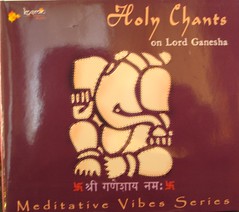
Stephen Devassy, the 24 year old keyboard player from Palakkad was unknown to me, till I head his version of Mahishasuramardini Stotram (link has a sample) at the Melody Corner Music Store in Trichur last month. He was the music director of the album which  mixed traditional devotional songs with non-traditional music along and vocals from Saindhavi, Uma Mohan and Ghayatri Devi. A student of Chetana Music Academy, he has played along with Hariharan and L. Subramaniyam as well as composed music for a bad Mohanlal movie called Hariharan Pilla Happy Aanu.

His music which has elements of gospel music  is not intrusive, but gives importance to the vocals. While the music is soothing and uplifting, the vocals too are clear and perfect with their pronunciation. The store had only the above two CDs, but like others I too would buy any of his Sacred/Holy Chants series in a heartbeat.

See Also: Video Interview with Stephen (Malayalam/English),  stage performance, The right keys to successVillage boy from Palakkad climbs the music ladder

Communist Comedy in Kerala

Just when you thought that  theatrics has reduced in politics, there is a revival of that art form thanks to the octogenarian Communist chief minister of Kerala. Achyutanandan is riding a popularity tsunami wave unseen in Kerala politics due to a demolition drive he has triggered all over Kerala. A special task force  assigned by him has been camping in the hill resort of Munnar demolishing any building constructed over encroached land,  mostly holiday resorts. The task force did not even spare one of the offices of CPI, a coalition partner, resulting in an increased sales of heart burn medicine in the capital.

The demolition drives were not just restricted to Munnar but also in towns all around Kerala. While driving into Kottayam last month we were held up for an hour because a bull dozer was pulling down a building right in the town and while driving from Thrissur town to Thalikkulam, a beach town, we saw that even church walls were not spared. Achyutanandan became the fearless Robinhood receiving support from everyone for taking such bold steps and Sugatha Kumari, the poetess, went on to write an op-ed piece in Mathrubhoomi praising him.

That’s when Achyutanandan decided to move it up a notch. He drove to Munnar in heavy downpour on a day in which his coalition members had decided to investigate the excesses done in Munnar and personally threw away a board from land which he said belonged to the Tatas. He touted that no one had the courage to touch the Tatas till then. He also warned the Tatas not to approach the judiciary and threatened that if they did so they would be left with no land at all.

The last statement sounded like it came  from a kidnapper who after saying, Tumhari maa hamare kabze mein hai, warns the victim not to go to the police than a person who has sworn to uphold the follow the laws of India. Then what can you expect from a Communist whose only claim to fame is destroying crops planted by farmers.

Events took a comic turn when Achyutanandan’s Revenue Minister stated in the Assembly that the land which the Chief Minister claimed belonged to the Tatas actually belonged to the Forest Department and the nearest Tata plantation was 2 KM away. In fact the land had been under the Government control since 1971. Instead of following the law Achyutanandan thought he was Suresh Gopi in his old age, decided to take the law into his own hands,  and ended up with coconut tree manure on his face. Thanks to the excellent  media coverage, Achyutanandan’s stupidity was telecast to a wide audience.

You would think Communists would learn from such embarrassments. Instead they have decided to threaten major newspapers for exposing corruption within the party.

Eight things about me

I have been tagged by
Sandeep
and so here are some random facts about me which will enrich your life.

  1. I always wanted to be an astronaut. That dream came to an end on the
    realization that I puke even on the simplest of a theme park rides.
  2. I hate bananas. This is considered very strange for a Malayali.
  3. One of the countries I have lived is Brazil.
  4. Till 1999 I had no interest in history. After that I got deeply interested,
    but there is no defining moment for that transition, unless it can be proved
    that the revolt against white washed history by the eminent historians lay
    dormant in my subconscious mind and during one session of meditation that
    vritti came
    to the surface and manifested)
  5. I have met
    Dave
    Barry
    .
  6. I cannot cook. The only thing I can make to perfection is green tea and that
    too only if hot water and tea bags are provided.
  7. In college I (along with three others) hand wrote a monthly class newspaper
    which pissed of pretty much everyone in the class.
  8. I had an e-mail address in 1993 in India.

Now I tag the following eight:
Shanti,
Niraj,
Ravages,
Jaffna,
Patrix,
Shantanu,
Sabarish and
Kuttan. I hope all of
you have read enough chain mails to know what will happen to you if you don’t
continue this meme.

Learning Sanskrit

Reader Sabarish wants varnam readers to share their experience in learning Sanskrit. We would like to know how you learned it (Samskrita Bharati, self taught, any other organizations, teachers etc.), the books you used (eg, Sanskritasya Vyavaharikaswaroopam) and what you think is the best way to learn.

Any tips and words of wisdom will benefit lot of readers as my post on Sanskrit Revival seems to have generated good interest.

Sanskrit Revival

When Israel became a nation, they chose Hebrew as their official language, while we in India ditched Sanskrit to chose Hindi as the national language. We now stand low, at the eminent historian level, having to depend on English translations of our scriptures to understand their meaning.

Due to work of an organization called Samskrita Bharati, Sanskrit is experiencing a revival and people around the world are getting a quick introduction to the language. The idea behind these classes are to get people comfortable talking in Sanskrit as soon as possible and the teacher does that by conversing only in Sanskrit for the entire 10 day duration.

Today, spoken Sanskrit is enjoying a revival – both in India and among Indian expatriates in the United States. There is even evidence of Sanskrit emerging in American popular culture as more and more people roll out yoga mats at the local gym and greet one another with “Namaste.”

Harvard, Yale, and the University of Chicago, among others, have long offered Sanskrit courses to undergrads. But the demand for these classes is growing beyond academic settings. A decade-long economic boom has brought Indians some measure of prosperity, and with it a sense of pride in the nation’s past. In large part, however, the revival is the result of the efforts of a private group, Samskrita Bharati, headquartered in New Delhi. The volunteer-based group’s mission: Bring the pan-Indian language back to the mainstream and lay the groundwork for a cultural renaissance.

Yoga practitioners in the US are seeking out the authentic Sanskrit names of various poses such as “downward dog” or “spinal twist” and the philosophy behind the practice as spelled out in the Yoga Sutras – the original treatise on the subject written in Sanskrit thousands of years ago.

Science-history buffs see old works in Sanskrit as treasure troves of ancient knowledge of astronomy, chemistry, mathematics, medicine, and metallurgy. When Copernicus announced that the sun was the center of the universe in 1543, it was a defining moment for Western science. In Samskrita Bharati’s recently released “Pride of India” – a compilation that offers a glimpse into India’s scientific heritage – Sanskrit scholars point to calculations from AD 499 that indicate astronomer Aryabhatta’s underlying concept of a sun-centered planetary model.

“This knowledge tradition is what we hope to revive through the spread of Sanskrit,” says Shastry.[Sanskrit echoes around the world]

Check the site for courses in your area.

Supporting the Trader Mafia

IMG_0821
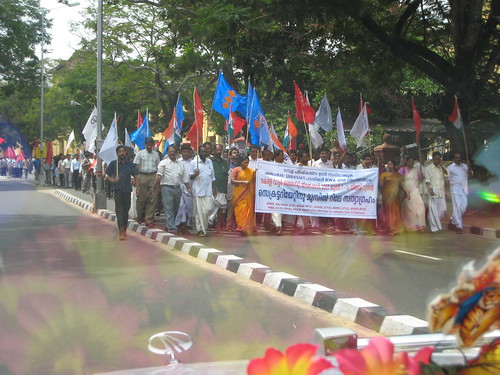
(A bunch of people protesting against something,
blocking traffic in Trivandrum)

A sales girl working long hours in a traditional shop in Kerala gets paid about Rs. 600/month. A consumer who wants to drink Frooti in Kerala is instead offered Maaza because the profit margin on Frooti is less. If you are a shop owner, you have to join this mafia type organization called Kerala Vyapari Vyavsayi Ekopana Samithi (KVVES) and they decide what is to be sold to the consumer and what not to be sold. Everyone including the suppliers and Government are blackmailed and they protest if legal action is taken against their illegal activities. While employees and consumers are exploited, any effort to provide an alternative is threatened with violence.

Upset that their hostage taking of an entire state is about crumble, the members of KVVES have  threatened to physically destroy Reliance outlets. At this point you would think that the State Govt. should step in, warn the traders, and advice them that they don’t live in Cuba but in India where citizens have the right to trade wherever they like, provided they follow the law. Instead in Kerala, members of the treasonous Communist Govt. are busy drafting legislation preventing the entry of retail giants.

The Communists have successfully converted Kerala into a protest state for events which they cannot influence like globalization and the imaginary American imperialism. Their brain damaged supporters also walk around attacking everyone, including farmers and the Chief Minister threatens businesses with severe action if they assert their fundamental rights like  going to the courts. Recently when it was mandated that all motorcycle riders would have to wear helmets, people protested by wearing plastic pots with holes in it with the attitude that they would rather die in road accident than wear such things.

Sitting in their air conditioned offices and residences in AKG Bhavan, their HQ in Kerala, the Communists have always said that they stand for the poor, but in reality the Communists are the biggest obstacle for the poor. Supermarkets like Reliance and Spencers can offer goods at a lower price than shops owned by the trader mafia which can benefit the low wage earner. It has been seen that supermarkets like Wal-Mart  have dwarfed anti-poverty programs and the biggest beneficiaries are the poor and so the opposition to giant retailers exposes yet more hypocrisy from the Communists.

Poor people are walking that extra mile (literally) to buy groceries from Reliance Fresh because fresh vegetables are fruits are 10-15% cheaper there than the street vendor. Private companies are investing in techniques to boost farm practices and irrigation systems which would raise farm income by 30 percent. Farmers in Ratnagiri have obtained 90 percent of the original cost compared to the 70 percent they would have obtained by going to Govt. regulated mandis. Then facts should never obstruct an opportunity to keep Kerala as the economic waste land that it is now.

A new Malayalam movie from Lal Jose exposes how the party of poor has  moved away from  ordinary people, its voter base, to be a party controlled by a corrupt leadership devoid of any ideology or social commitment and how the dogma of Communism has been kept alive by the leaders for their own survival. The lies peddled by the Communist leaders are swallowed by the “enlightened public” without any questioning.

In fact this opposition to the entry of retail giants very clearly shows where the loyalty of the Communist party lies. Rather than support something which will bring low prices for the poor, they would stand with the labor aristocracy, the bourgeoisie. This shift in stance has the logical explanation that the poor are, well poor, while the bourgeoisie traders have money.

What else do you expect from a party which has become filthy rich playing poverty politics?

CNN's World

cnnn

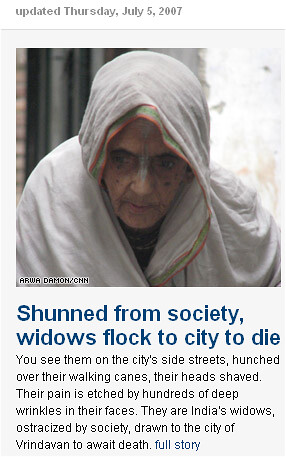
Some of the major headlines in United States today are related to the war in Iraq,  the Lal Masjid siege,  the presidential candidate parade in Iowa, the heat wave striking the west coast, the new al-Qaeda video, and the terrorist attack in Scotland. For some reason, CNN thinks that the top story of the day is the plight of Hindu widows (not South Asian widows), in Vrindavan.

Why is this the most important story in the United States today? 

The Science behind Mindfulness

If you drive to work, listening to an audio book while thinking about the edits
to be done to your draft post, then you are not practicing mindfulness. The
technique by which a person becomes intentionally aware of his thoughts and
actions is an important part of Buddhist spiritual practice and is one of the
steps of
Vipassana.
Besides giving insight into impermanence and thus reducing suffering,
mindfulness practice has also been found to have health benefits resulting in
Mindfulness
based stress reduction programs
in hospitals around United States.

Neuroscience now is able to explain why mindfulness practice is able to produce
health benefits. On seeing an angry or fearful face, there is an increased
activity in a region of the brain called
amygdala
which are almond shaped bunch of neurons. This in turn activates a series of
biological systems designed to protect the body from danger. If the feeling was
labeled, for example, if you associate the word angry with an angry face, then
the activity in the amygdala reduced, but in turn increases the activity in
another part of the brain called right ventrolateral prefrontal cortex.

“We found the more mindful you are, the more activation you have in the right
ventrolateral prefrontal cortex and the less activation you have in the
amygdala,” Creswell said.“We also saw activation in widespread centers of the
prefrontal cortex for people who are high in mindfulness. This suggests people
who are more mindful bring all sorts of prefrontal resources to turn down the
amygdala. These findings may help explain the beneficial health effects of
mindfulness meditation, and suggest, for the first time, an underlying reason
why mindfulness meditation programs improve mood and health.

“The right ventrolateral prefrontal cortex can turn down the emotional
response you get when you feel angry,” he said. “This moves us forward in
beginning to understand the benefits of mindfulness meditation. For the first
time, we’re now applying scientific principles to try to understand how
mindfulness works. “This is such an exciting study because it brings together
the Buddha’s teachings — more than 2,500 years ago, he talked about the
benefits of labeling your experience — with modern neuroscience,” Creswell
said. “Now, for the first time since those teachings, we have shown there is
actually a neurological reason for doing mindfulness meditation. Our findings
are consistent with what mindfulness meditation teachers have taught for
thousands of
years.”[The
Science of Mindfulness Meditation
]

Rage
Boy’s
amygdala will be bursting out by now and unless he practices
mindfulness, his ventrolateral prefrontal cortex will shrink to the size of his
intellect.

See Also:
Buddha’s
Contribution
,
Book
Review: West of Jesus

On Writing Well (1)

  • Let
    Your Blog Posts Marinate (4 Steps to Forming Great Ideas):
    Glen
    Stansberry gives four steps to create better blog entries
  • Paul
    Graham’s guide to writing

    …expect 80% of the ideas in an
    essay to happen after you start writing it, and 50% of those you start with
    to be wrong; be confident enough to cut; have friends you trust read your
    stuff and tell you which bits are confusing or drag; don’t (always) make
    detailed outlines; mull ideas over for a few days before writing; carry a
    small notebook or scrap paper with you; start writing when you think of the
    first sentence…

  • Booker
    prize winner Kiran Desai

    I work in the mornings and
    evenings. In the mornings, I am more clear-headed and focused. In the
    nights, it is my wild, dark imagination that is working. I also listen to
    Nusrat Fateh Ali Khan, and keep nibbling at my kababs. In the morning, I
    work on what I have written in the night, revise and revisit my
    characters.

  • So
    you want to be a writer

    In good
    writing, he observed, “every sentence shall palpitate and thrill with the
    mere fascination of the syllables.” To achieve this effect, one must employ
    certain “rules of style.” He warned budding writers, for example, “not [to]
    habitually prop your sentences on crutches, such as Italics and exclamation
    points, but make them stand without aid; if they cannot emphasize
    themselves, these devices are commonly but a confession of
    helplessness.”

  • A
    Guide to Becoming a Better Writer: 15 Practical Tips

    9. Revise. If you really crank out the text,
    and experiment, and just let things flow, you’ll need to go back over it.
    Yes, that means you. Many writers hate revising, because it seems like so
    much work when they’ve already done the writing. But if you want to be a
    good writer, you need to learn to revise. Because revision is where good
    writing really is. It separates the mediocre from the great. Go back over
    everything, looking not only for grammar and spelling mistakes, but for
    unnecessary words and awkward structures and confusing sentences. Aim for
    clarity, for strength, for freshness.