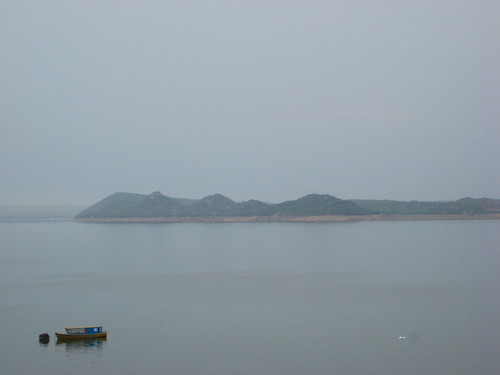
Kaveri River as seen in Mettur, Tamil Nadu
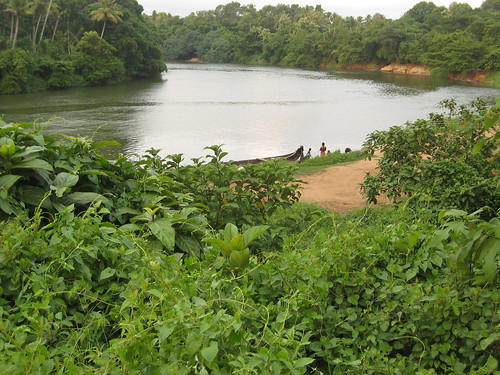
River Pamba as seen in Chengannur, Kerala
Indian History
Kaveri River as seen in Mettur, Tamil Nadu
River Pamba as seen in Chengannur, Kerala
Manusmrti says ‘na stri swatantryam arhati’ and this means that all
Indian women lack freedom to do anything. From my college days I have heard
speeches by members of the
treasonous
Communist Party and affiliated historians who have used such generalization to
put down Indian culture. In an article in Indian Express, Nanditha Krishna
explains some of the achievements of women of ancient India, you know, the ones
who did not have freedom.
Seventeen of the seers to whom the hymns of the Rig Veda were revealed were
women — rishikas and brahmavadinis. They were Romasa, Lopamudra, Apata, Kadru,
Vishvavara, Ghosha, Juhu, Vagambhrini, Paulomi, Jarita, Shraddha-Kamayani,
Urvashi, Sharnga, Yami, Indrani, Savitri and Devayani. The Sama Veda mentions
another four: Nodha (or Purvarchchika), Akrishtabhasha, Shikatanivavari (or
Utararchchika) and Ganpayana. This intrigued me so much that I had to learn
more about them, but I drew a blank. Who were these wonderful women who were
on par with their men and produced the greatest and longest living literature
of the world?In the Vedic period, female brahmavadinis (students) went through the same
rigorous discipline as their male counterparts, the brahmacharis. The
Brihadaranyaka Upanishad describes a ritual to ensure the birth of a daughter
who would become a pandita (scholar). The Vedas say that an educated girl
should be married to an equally educated man. Girls underwent the upanayana or
thread ceremony, Vedic study and savitri vachana (higher studies). Panini says
that women studied the Vedas equally with men. According to the Shrauta and
Grihya Sutras, the wife repeated the Vedic mantras equally with their husbands
at religious ceremonies. The Purva Mimamsa gave women equal rights with men to
perform religious ceremonies. Vedic society was generally monogamous, and
women had an equal
place.[The
equals of men]
Once again we converge to the era that Pratibha Patil mentioned
Islamic rule in North India saw a sharp decline in the status of
women, now relegated to the veil, both as an influence of the new dispensation
as well as for their personal protection. Jauhar protected Rajput women from
captivity. If women came out of the confines of the home, the new court culture
made them either entertainers or chattels, both highly degrading positions.
Thousand years of the purdah was to have a highly detrimental effect on women,
something from which the northern states have yet to
recover.[The
equals of men]
Next time someone talks about Manusmriti, ask
them about the status of women as mentioned in the Brihadaranyaka
Upanishad and Purva Mimamsa and chances are they would know nothing about it.
It is said that life is tough for a Dalit in India and atrocities committed on
Dalits are given prominence in the media except
when
the atrocities are committed by Dalits themselves. Still there is no denying
that they are abused simply because of their caste. In such an
environment when someone and that too a woman breaks ranks and achieves
unimaginable wealth, it has to become a case study.
Her father was a clerk in the Telecommunications department in Delhi and mother
a house wife. She was a teacher and then she joined politics. The latest
statement filed by Mayavati gives an indication why a career in politics is
always better than the
Resident
Idiot’s whipping boy, the IT sector.
UP chief minister Mayawati has assets worth over Rs 52 crore,
according to an affidavit filed on Monday by her along with the nomination
papers for the Vidhan Parishad. And to add glitter to her wealth, the lady has
diamonds worth nearly Rs 50 lakh.The CM’s assets, including movable and immovable property, bank balance are:
Cash: Rs 50.27 lakh; Deposits in banks, financial institutions and non-banking
financial companies: Rs 12.88 lakh; jewellery: Rs 50.87 lakh;diamonds 380.17
carat: Rs 49.75 lakh; a 18.5-kg silver dinner set costing Rs 1.12 lakh.Among her other assets, the CM has murals worth Rs 15 lakh.
Behenji, as she likes to be called, lists the following commercial and
residential establishments as her own in New Delhi and Lucknow. She owns two
commercial establishments in Connaught Place, New Delhi, priced at Rs 2.05 crore
and Rs 1.27 crore and another commercial establishment at Okhla which is priced
at Rs 15.50 crore.
[Mayawati
reveals assets: Rs 52 crore]
How she earned so much money would
bring tears to the eyes of even politicians. Naive BSP workers, assuming that
the leader did not have any money sent her money and asked her to use it
for
whatever purpose she seemed fit, like buying bungalows or jewellery. Really!
That feeling of happiness knowing that the leader is eating in a dinner set
costing Rs. 1.12 lakhs while you are struggling to make a living is called, and
let me use a technical term here,
nirvana.
The view is best summed up by Columnist
Chandrabhan Prasad who says that the ordinary
Dalit
would feel happy that at least one of them is
doing well. Mayavati is an inspiration not only for Dalits, but for
all of us.
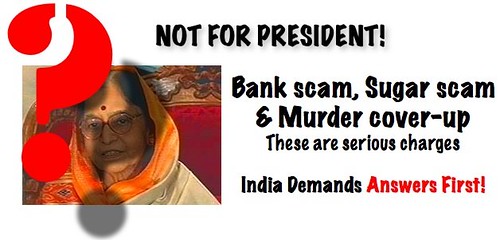
There are lot of accusations against her for which the answer has been silence and she has lot of explaining to do before she becomes another Zail Singh. One thing though, please don’t accuse her of getting her history incorrect.
Here’s why this banner needs to go up. And here’s where you can get this banner from.

About 60 elephants, all belonging to Lord Sri Krishna of Guruvayoor, live in Punnathur Kotta located about 3 KM away from the temple. The 10 acre compound is open to public and you can watch them being fed and bathed. The elephants were donated by various devotees including Jayalalitha (The joke is that the elephant asked Jayalalitha, why me, why not you?).
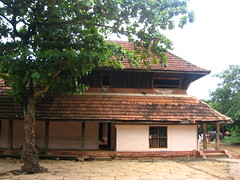
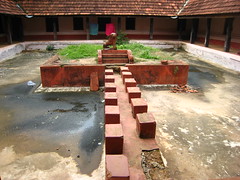
The compound also has a naalu kettu, a traditional rectangular home with a central courtyard, which belonged to the Punnathur Raja which as the two photos below show, remain in very poor condition.
 |
 |

While it was a pleasant surprise to see a full page Jet Airways advertisement in last Sunday’s New York Times, it was baffling why they would want to spend so much money to announce to people in United States that they fly daily from Mumbai to Brussels. Hopefully Jet Airways will fly from various cities in United States to India and capture that lucrative market.
Update: Due to attention deficit disorder, I did not notice that they were flying from New York to Mumbai and Brussels (Thanks Vivek)
The discovery of the Gospel of Judas has not only given as an insight into the formation of present day Christianity, but has also exposed the non-spiritual techniques the Church Fathers have used to promote the Gospels they favoured.
Why do these conclusions continue to be drawn by biblical scholars, as if the canonical gospels are any more accurate (or “peerless”) theologies and histories than the non-canonical gospels? All these texts are theologies, and whether or not they are “peerless” depends upon where you are standing. None of our texts are histories, let alone accurate histories. And how much historical information we can actually reap out of any of them, and the procedures for doing so, are questions more problematic than not.
As for the accuracy of the Church Fathers’ descriptions. Their accuracy is not how I frame any discussion of a normative debate. The Church Fathers passed on false information, ill-informed interpretations, and fabricated stories in their struggle against those forms of Christianity that they hated. As the old saying goes, “All is fair in love and war.”
As scholars, it is our job to stop buying into the normative rhetoric, and figure out what was really going on on the ground. The Gospel of Judas helps us tremendously in this venture. We can see that it was not connected with Cain or the Cainites as some of the Church Father testimony suggests. It is written by Sethians, for whom Cain was an evil Archon! The evidence from the Gospel of Judas leads me to conclude that the Cainites were a fantasy of the Church Fathers, a result of their war to become the dominant form of Christianity.[Short Article on Gospel of Judas]
While Biblical scholars claim that the Bible is not history, the more Catholic than the Pope types like Max Muller have used the Bible to produce imaginary dates for the composition of the Vedas based on the creation of the world sometime in 4000 BC. Unfortunately those imaginary dates are still taken seriously.
Adrianus Melkert, a Dutch politician who is also an associate administrator at United Nations Development Program has threatened to retaliate against the United States if it tries to get to the bottom of what UNDP was doing in North Korea. The UN Board of Auditors found that the UNDP violated many rules by hiring staffers selected by the North Koreans, paying their salary directly to Pyongyang, and inspecting only a few projects. UNDP had no idea for what purpose the North Koreans were using the money for and Melkert did not like the American enquiries into the gory details of what his organization was doing and hence the anti-American stand.
When it comes to human rights activism, the United Nations would give the Booker prize winning verbal terrorist a run for her money. The UN’s new Human Rights Council, formed last year to replace the much discredited UN Human Rights Commission, has decided to halt all investigation into Cuba and Belarus while continuing investigations of Israel. In fact Israel is the only country mentioned by name by the council.
The very notion that Israel, a vibrant democracy surrounded by fanatical religious dictatorships seeking to hurl it into the sea and the only nation ever formally censored by the HRC, is a bigger threat to human rights than the totalitarian dictatorships in Cuba and Belarus is a crude slur on the intelligence of every person whose tax dollars fund the United Nations. How can the UN possibly claim any moral legitimacy to address human rights issues if it proceeds in this manner? The saddest thing of all is that this salaciously fraudulent enterprise is actually a replacement of another UN group that was so corrupt it had to be abolished.[Annals of HRC Fraud at the UN]
Isn’t it time the UN is moved from New York to Pyongyang or Havana?
It was the failure of Jawaharlal Nehru and V K Krishna Menon and those in India’s ministry of external affairs who were their advisers to understand the Chinese mindset, which led to the national humiliation in the Sino-Indian war of 1962.
Repeated warnings from the Intelligence Bureau about the large-scale Chinese intrusions into the Aksai Chin area of Ladakh and their construction of a road there were not only ignored, but these disturbing developments were kept away from the knowledge of the public and Parliament. They fondly believed that they would be able to make the Chinese see reason and withdraw from this region by observing a policy of silence and not articulating our concerns in public. Their fond hopes were belied.
It was not the Indian intelligence and security forces which were responsible for the 1962 debacle. It was the political leadership, which was living in an illusory world of its own creation [Tawang: Some Indian plain-speaking at last!]
Not much has changed from the days of Nehru in terms of preparedness, but now it is hard to hide such information from the public and Parliament and that in turn forces the Ministers to make hard hitting public statements.
Talking to journalists in Shillong on June 16, Mukherjee said ‘he had made it clear to his new Chinese counterpart that any elected Government of India is not permitted by the provisions of the Constitution to part with any part of our land that sends representatives to the Indian Parliament.’
The minister added: ‘The days of Hitler are over. After the Second World War, no country captures land of another country in the present global context. That is why there is a civilised mechanism of discussions and dialogue to sort out border disputes. We sit around the table and discuss disputes to resolve them.’
Antony told journalists in New Delhi on June 18, ‘China has been building infrastructure (near the Line of Actual Control). We are also building infrastructure. Nobody can prevent both sides. There is nothing wrong in that. They have the right to build infrastructure on their territory. We have the right to do that on ours. We are also trying to hasten the development of our infrastructure. They have their perception (about Arunachal Pradesh). On our part, we are very categorical that Arunachal Pradesh is part of India.’ [Tawang: Some Indian plain-speaking at last!]
I wish they tried some of our suggestions as well.
When members of the Royal Navy were captured by the Iranians in March, the Iranians made sure that the British were decently humiliated. The sailors had to apologize for straying into Iranian waters and later thank president Mahmoud Ahmadinejad for magnanimously releasing them. The entire nation could do nothing, but watch this public humiliation in silence. Now displaying something called spine, the British have knighted Salman Rushdie providing employment opportunities for suicide bombers. The Iranians are upset and made the usual remarks.
There is a lesson from this for us. Now that China is making noise about Arunachal Pradesh (in the spirit of Hindi-Chini-Bhai-Bade Bhai) we can follow the British model and cause some discomfort to the Chinese. One great way would be to ask the Prime Minister of India to give the keynote on the first ‘Conference for an Independent Tibet‘ organized by Friends of Tibet from June 23-24, 2007 in Delhi. Later in the day we could organize a discussion on the teachings of Falun Gong and compare their spiritual practices with Indian spiritual techniques.
Yes, it is juvenile, but sometimes it is the best way to get the message across.