Chandragupta Maurya or Chandragupta?

Reader Kedar asked two questions recently

  1. There is a huge gap between Mahabharata (3100 BCE, 2450 BCE, 1500 BCE) and the Mahajapadas. What happened there?
  2. Who was the contemporary of Alexander of Macedonia? Chandragupta Maurya or the Guptas? Do Mahavira, Buddha and Adi Shankara belong to an earlier period?

We will look at (2) today and deal with (1) later.
At the International Conference on Indian History, Civilisation and Geopolitics 2009, Dr Subramanian Swamy gave the valdedictory speech on the need to defalsify Indian history. In this speech, Dr. Swamy stated that most dates  related to Indian history – Rigveda, Mahabharata, Buddha, Asoka —  are wrong. This happened because European historians identified Sandrocottus, mentioned by Megasthenes, as Chandragupta Maurya. This Sandrocottos was a contemporary of Alexander and from associated calculations, the date of Chandragupta Maurya’s coronation was found. Based on this point, Asoka’s corononation was calculated, so was the time of Buddha.
But according to Swamy,  the correct dates are as follows

However, on the basis of these calculations we can say that Gupta Chandragupta was “Sandrocottus” c.327 B.C. His son, Samudragupta, was the great king who established a unified kingdom all over India, and obtained from the Cholas, Pandyas, and Cheras their recognition of him. He also had defeated Seleucus Nicator, while his father Chandragupta was king. On this calculation we can also place Prithu at 6777 B.C. and Lord Rama before that. Derivation of other dates without discussion may also be briefly mentioned here: Buddha’s Nirvana 1807 B.C., Maurya Chandragupta c. 1534 B.C., Harsha Vikramaditya (Parmar) c. 82 B.C.[Non-random-Thoughts: ‘De-falsify Indian history’ — Dr Subramanian Swamy]

Thus, a case is presented that Western historians distorted Indian history and it is our responsibility to correct it. So let us accept for a moment that Buddha lived in 1807 BCE. We don’t have archaeological evidence of the cities and kingdoms mentioned in Buddhist texts dating to that period.
If Rama lived in 6777 BCE, he belonged to the Neolithic age and would have fought with axe heads and chisels. This Rama would be vastly different from the one portrayed in Ramayana, like King David. The Tel Dan Stele mentions David’s existence, but archaeology has found that he would have been not a king, but a petty warlord of a small chiefdom with few settlements. So did this Neolothic Rama’s exploits survive as a mnemohistory, like how David’s lives in the Torah?
Whether due to colonial bias or not, we have certain dates and there is an effort to propose new ones. But these new ones have to take into consideration the social order of the time and also be backed up by archaeology.

The Ming Dynasty ship sinks

One documentary I watched while writing Chinese Power in Indian Ocean (2/2) was based on Gavin Menzies’ best selling book  1421: The Year China Discovered America. The thesis of the book was that Zheng He’s fleet had reached America in 1421. But in the documentary, they put Gavin Menzies on camera and contradicted most of his assumptions. Mr. Menzies agreed with the producers that most of his evidence is flimsy, but he still stood by his theory.
To prove that Zheng He’s fleet could have reached America, a replica of the Ming Dynasty ship was built and it set sail to America from Xiamen. The ship made of wood held together with nails docked in San Francisco in October 2008 after a 69 day journey.
But tragedy struck while returning back to Taiwan.

After surviving several storms during its 10-month voyage, the junk broke in two and sank after it was rammed by a freighter just off Taiwan’s coast.
All 11 crew members were rescued after being found adrift on the wreckage.
“We have worked so hard for so many years, but we failed at the last minute, I’m really ashamed,” said Taiwanese captain Liu Ningsheng after being rescued by the coast guard. [BBC NEWS | Asia-Pacific | Ming Dynasty replica junk sinks]

Rashomon Effect – 10: Sri Lanka

Recently Sri Sri Ravishankar visited Sri Lanka and provided some video footage.
Ms. Jayalalitha:

“I met Art of Living founder Sri Sri Ravishankar who has just returned from the war-zone in the Vanni. He gave me CDs and photographs of the atrocities. My heart boils when I looked at it,” the AIADMK leader said. If this pathetic situation of the Tamil people has to be removed, if the problems of the Lankan Tamils has to come to an end, an independent Eelam is the only solution, she added

Defence Secretary Gotabhaya Rajapaksa

“When Ravishankar met President (Mahinda Rajapaksa) after visiting the IDP camps he said it was one of the best camps he has ever seen in the world,” the powerful official, who is the brother of the President, said.

See Also: Episode 1, 2, 3, 4, 5, 6, 7, 8, 9

Indus Script: A Formal Language

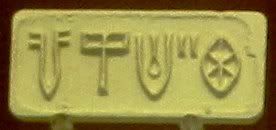
This picture shows a Harappan seal with five inscriptions or characters, which have been undeciphered. In fact there are many decipherments, but no scholarly consensus. One of the disputes is at a fundamental level: do these markings belong to a language or were the Harappans illiterate?
Finally, in a breaking news moment, we have an answer.

Now, a team of Indian scientists reports in Friday’s issue of Science journal that the Indus script has a structured sign system showing features of a formal language. Using mathematical and computational tools, researchers show that the script has well-defined signs, which begin and end texts, with strong correlations in the order in which the signs appear.[Scientists inch closer to cracking Indus Valley script – Home – livemint.com]

According to Asko Parpola, an expert on Indus seals

“It’s a useful paper,” said University of Helsinki archaeologist Asko Parpola, an authority on Indus scripts, “but it doesn’t really further our understanding of the script.”
Parpola said the primary obstacle confronting decipherers of fragmentary Indus scripts — the difficulty of testing their hypotheses — remains unchanged. [Artificial Intelligence Cracks 4,000-Year-Old Mystery | Wired Science from Wired.com]

Also

J. Mark Kenoyer, a linguist at the University of Wisconsin-Madison, says Rao’s paper is worth publishing, but time will tell if the technique sheds light on the nature of Indus script.
“At present they are lumping more than 700 years of writing into one data set,” he says. “I am actually going to be working with them on the revised analysis, and we will see how similar or different it is from the current results.”[Scholars at odds over mysterious Indus script – life – 23 April 2009 – New Scientist]

Additional Reading:

  1. The original paper: Statistical analysis of the Indus script using n-grams
  2. Indus script encodes language, reveals new study of ancient symbols
  3. Artificial Intelligence Cracks 4,000-Year-Old Mystery

Hatshepsut and Mistress of the Lioness

Photobucket
Thutmose III and Hatshepsut (via Wikipedia)

Recently the Public Radio Station in Boston had a one hour discussion on one of the rare female pharoah’s of Egypt — Hatshepsut (1479 to 1458 B.C.E.) — who ruled 150 years before Akhenaten, the monotheist pharoah. National Geographic had a cover story as well.

Though a woman, in one temple carving she is shown born as a boy. She would also walk in a striding pose, like males instead of keeping the legs close together, like other Egyptian women. Some statues depicted her with a beard. It was as if she was trying to convince the world that she was male. Her motivation for doing so is known.
Her mummy was discovered almost a century back, but remained unidentified. She was called KV60a.

KV60a had been cruising eternity without even the hospitality of a coffin, much less a retinue of figurines to perform royal chores. She had nothing to wear, either —no headdress, no jewelry, no gold sandals or gold toe and finger coverings, none of the treasures that had been provided the pharaoh Tutankhamun, who was a pip-squeak of a king compared with Hatshepsut.
And even with all the high-tech methods used to crack one of Egypt’s most notable missing person cases, if it had not been for the serendipitous discovery of a tooth, KV60a might still be lying alone in the dark, her royal name and status unacknowledged. [The King Herself]

Hatshepsut was not the first woman to rule Egypt, but she ruled more than all other women — for 21 years. She erected four granite obelisks at the temple of Karnak. This animation takes the viewer from eastern Karnak across the sacred lake to the shrine of Thutmose III, who would succeed Hatshepsut.

After her death, around 1458 B.C., her stepson went on to secure his destiny as one of the great pharaohs in Egyptian his­tory. Thutmose III was a monument maker like his stepmother but also a warrior without peer, the so-called Napoleon of ancient Egypt. In a 19-year span he led 17 military campaigns in the Levant, including a victory against the Canaanites at Megiddo in present-day Israel that is still taught in military academies. He had a flock of wives, one of whom bore his successor, Amenhotep II. Thutmose III also found time to introduce the chicken to the Egyptian dinner table.
In the latter part of his life, when other men might be content to reminisce about bygone adventures, Thutmose III appears to have taken up another pastime. He decided to methodically wipe his stepmother, the king, out of history. [The King Herself]

While Egypt had other female Pharoah’s, it was believed that Caanan had only male rulers. But now a recently found plaque depicts an image of the first female “king” of the region.

The plaque itself depicts a figure dressed as royal male figures and deities once appeared in Egyptian and Canaanite art. The figure’s hairstyle, though, is womanly and its bent arms are holding lotus flowers — attributes given to women. This plaque, art historians suggest, may be an artistic representation of the “Mistress of the Lionesses,” a female Canaanite ruler who was known to have sent distress letters to the Pharaoh in Egypt reporting unrest and destruction in her kingdom. [Was A ‘Mistress Of The Lionesses’ A King In Ancient Canaan?]

This lady, a contemporary of Akhenaten, is displayed in male iconography as well. she is dressed as a male and archaeologists think she too ruled as a king.

See Also: Hatshepsut gallery in National Geographic, Digital Karnak: Animations from UCLA of the Karnak temple.

The origins of Crucifixion and Resurrection myth

In the early days of Christianity, the practice was to appropriate pagan practices and celebrations. The Roman emperor Constantine presided over the First Council of Nicaea and it was there that Dec 25 was picked as the birth date of Yeshua. During those times, two important pagan festivals were celebrated – the first one starting on Dec. 17 honored Saturn, a major Roman deity of agriculture and harvest and the second one starting on Dec 25, celebrated the birth of Mithras, the Persian god of light. Constantine combined both and we now have Christmas.[Dec 25, 326 CE | varnam]

Now it turns out that even the story of crucifixion and resurrection has a pagan connection. According to Valerie Tarico, “it is an historicized version of a very ancient myth from Mesopotamia.” In the Sumerian tradition it is called “The Descent of Inanna” and “The Descent of Ishtar” in the Babylonian version.

Let’s start with the first part of the myth. Inanna and Jesus both travel to a big city, where they are arrested by soldiers, put on trial, convicted, sentenced to death, stripped of their clothes, tortured, hung up on a stake, and die. And then, after 3 days, they are resurrected from the dead. Now there are, to be sure, a number of significant differences between the stories. For one thing, one story is about a goddess and the other is about a divine man. But this is a specific pattern, a mythic template. When you are dealing with the question of whether these things actually happened, you have to deal with the fact that there is a mythic template here. It doesn’t necessarily mean that there wasn’t a real person, Jesus, who was crucified, but rather that, if there was, the story about it is structured and embellished in accordance with a pattern that was very ancient and widespread.[Valerie Tarico: Ancient Sumerian Origins of the Easter Story]

Communists do a Nehru

In election posters dead people are mandatory. But in Kerala, the featured dead people are Saddam Hussein and Yasser Arafat. India’s ties with Israel is the biggest crisis facing Kerala right now according to the campaign speeches. The previous crisis – if the library of Alexandria was burned by Arabs — was somehow amicably resolved.
India’s deal with Israel is a big issue for the Communists because of the recent Indo-Israeli missile deal, which will protect India from, to borrow the Prime Minister’s words, “neighboring countries.” Now the Communists have become more Nehru than Nehru himself .

Nehru’s opposition for the creation of Israel, did not stand his way of asking their help during the 1962 war with China. Nehru asked David Ben-Gurion for help and Israelis sent military equipment. During the 1965 and 1971 wars too Israel sent mortar rounds, while our so called friends did pretty much nothing. India also demanded that while Israel sent ammunition, they remove any Israeli markings from it. The ammunition was obtained regularly as demanded and India condemned them in public and always supported the Palestinian cause.[Einstein, Nehru and Israel]

One way to be a Nehru is to oppose Israel while asking for help. (There are other ways too which is left as an exercise to the reader). This is exactly what the Communists did.
While the party is against Israel, one of their ministers, C. Divakaran of CPI, wanted to import Israeli bulls to impregnate Malayali cows; the Kerala bulls were only good for calling hartals. The goal of this exercise was to combine business and pleasure – for the Israeli bulls. The Israeli bulls were expected to do their magic and many mooos later milk production was to increase by 20%. Even the farmers unions were enthusiastic about this: they identified the hill station of Mattupetti for the bulls to sing songs.
C. Divakaran was not setting up new standards in Nehruvian school of geo-politics; he was just following the path of Jyothi Basu. During his tenure as the person in charge of taking Bengal to stone age, Basu wanted an industrial tie up with Israel. It also turns out that we blogged about this in 2003.
Thus we have Nehrus all around us, replicating rapidly, like Agent Smith in Matrix Reloaded. There is no problem with that, but if only they stopped dumping the other stuff which the bull produces on us.

Indian History Carnival – 16

The Indian History Carnival, published on the 15th of every month, is a collection of posts related to Indian history and archaeology.

  1. Recently about 70 Harappan graves were discovered in Farmana, Haryana. From this is it possible to find out if Harappan were an indigenous population or migrants? Suvrat Kher says, “My money is that they were like the rest of us living Indians, mostly native but with little pieces from outside as well.”
  2. “There are also no historical records of slave trades, prices, quantities, ownership anywhere in India. In fact, Sanskritic Indian languages have no word for slaves,” writes Anuraag in a post about Demons, Satan and Ogres and Monsters.
  3. While we know details of Chandragupta Maurya’s death, less is know about the last days of Chanakya. At varnam, there is one story of Chanakya’s death.
  4. “We do think now, that Akbar had not only finally managed to come out of the prison of Islam, and returned to his own roots, but that he was also determined to stamp out Islam from India, forcefully if needed, just before his life came to a premature end when he died of poisoning
    (killed?).” Sarvesh K Tiwari explains this in a multi part post, A Ghazi turned Kafir: the Case of Akbar’s U-Turn (Part 1, 2, 3)
  5. A Mughal painting from 1625 shows Holi being celebrated including a “drunk Jahangir being carried to to bed.”
  6. According to Thomas Hervey Baber (1777 to 1843), the man who tracked Pazhassi Raja, “the natives of the Malabar Coast were more strict observers of truth than the other inhabitants of Hindostan”
  7. “The irony can’t be harsher: While the Muslim League demanded — and got — separateness, the Hindu Mahasabha was reprimanded for fighting against this very demand for separatism.” Sandeep explains the importance of the Lucknow Pact of 1916 and Pirpur Report of 1938.
  8. In a post about Nagas in World War II Feanor says, “It is a sad fact that Indian history (at least as taught when I went to school there) has nothing at all to say about the Northeast.
  9. As India goes to the polls, Hari, based on excerpts from Ramachandra Guha’s India After Gandhi looks at the first election of 1951.
  10. Is there any difference between Manmohan Singh and Flavius Belisarius? Arby finds out
  11. Combining mythology and history, Kamini Dandapani has a travelogue about Kanya Kumari.

f you find any posts related to Indian history published in the past one month, please send it to jk AT varnam DOT org or use this form. Please send me links which are similar to the ones posted, in terms of content.The next carnival will be up on May 15th.
See Also: Previous Carnivals

New Exodus Theory

Then comes the major event of the parting of the Red Sea. It seems the Hebrew word, Yam Suf was mistranslated as Red Sea while it actually means Reed Sea. Instead of looking for the sea scholars should have been looking for a lake. Based on the new evidence, the film makers find the location of the Reed Sea, a lake currently dried up, due to the Suez Canal. Again, the parting of the lake is attributed to the seismic activity.[Exodus Decoded (1) | varnam]

Besides this, archaeology too has not found any evidence of the Exodus, in the scale mentioned in the Bible.

That is one of the conclusions of the two hour NOVA documentary, Bible’s Buried Secrets, which aired on PBS on Nov 18th. This conclusion is not revolutionary; it has been suggested before, most recently by Dr. Zahi Hawass, Egypt’s chief archaeologist.
The Exodus, the most repeated story in the Hebrew Bible immortalized by Charlton Heston, suggests that about six hundred thousand men and their families escaped Egypt and reached the promised land. A century of archaeological work has found no such evidence but has found that during the time of the Exodus, dated between the Merneptah Stele (1275 B.C.E) and the Zayit Stone (1208 B.C.E), the promised land, Canaan, had just 25 settlements with 3000 – 5000 inhabitants.[Bible’s Buried Secrets (1/2) | varnam]

Still that has not prevented people from coming up with theories of the partition of the Red Sea.

Accepting the biblical account as a “possible ‘qualitative’ description of an event,” Florida State oceanographer Doron Nof set out to investigate whether the parting of the Red Sea is “plausible from a physical point of view.” Using a common phenomenon called wind set-down effect, he found that “a northwesterly wind of 20 m/s blowing for 10-14 h is sufficient to cause a sea level drop of about 2.5m.” Such a drop in sea level, Nof speculates, might have exposed an underwater ridge, which the Israelites crossed as if it were dry land. Although the event is plausible, Nof estimated that the likelihood of such a storm occurring in that particular place and time of year is less than once every 2,400 years.[La scienza e i miracoli dell’Esodo]

Jesus, Interrupted

In his book, “Misquoting Jesus: The Story Behind Who Changed the Bible and Why ,” Bart Ehrman, Professor of Religious Studies at UNC, Chappel Hill, argued that the Bible was mistranslated by scribes during translation. The fact that Bible was not the word of God, but a human creation had huge ramifications for his faith; he left it. Besides this books, Ehrman, a former evangelical, is also known for his various debates on topics like Did the Bible misquote Jesus? or Is the Resurrection of Christ Provable?
Now he has a new book Jesus, Interrupted: Revealing the Hidden Contradictions in the Bible in which he talks about what happened before the scribes got the texts which they mistranslated.

It seems Ehrman’s main aim is to introduce biblical scholarship to a popular audience so as to reveal that fundamentalist biblicism doesn’t make sense. This argument will appear to theological liberals (and some moderates) and to the broad secular audience that is fascinated by religion. Few can explain biblical scholarship to a broad audience as effectively as Bart Ehrman does. But marketing makes all the difference. As scholars, Allison and Ehrman are reaching mostly the same conclusions with nearly identical methodologies. Yet consider Ehrman’s dust cover: “Jesus, Paul, Matthew, and John all expressed fundamentally different religions.” [Jesus, Research, and Faith: Bart Ehrman and Dale Allison]

Here is another review

I highly recommend Ehrman’s book as a readable overview presenting information about the Bible and early Christianity that ought by now to be common knowledge. The reason it is not probably is due largely to the belief that such critical study of the Bible it antithetical to the Christian faith, and that the appropriate Christian stance is to affirm the Bible’s inerrancy rather than allow one’s view of the Bible and other matters to be shaped by the Bible’s actual contents. [Review of Bart Ehrman, Jesus, Interrupted]

This book is currently ranked 11th in the New York Times best seller list.

See Also: Transcripts of Erhman’s recent debates .