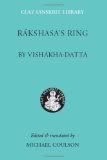
The Death of Chanakya

In Episode 2 of The Story of India, Michael Wood, journeys from Patna to Sravanabelagola following the footsteps of Chandragupta Maurya. According to Jain tradition, after a teacher warned Chandragupta about an impending famine, Chandragupta made Bindusara the king, took a begging bowl and walked to Deccan. Even now there is a cave with a carving of a stone foot, where the Mauryan emperor is believed to have starved to death (See from 35 min onwards)
But what about Chanakya? While most popular accounts of Chanakya end with coronation of Chandragupta Maurya’s coronation, Visakshadutta’s Mudrarakshasa is about events after the coronation where Chanakya tries to get the deposed minister of the Nandas, Amatya Rakshasa, to serve as the Emperor’s minister. We don’t know what happened after that.
The only information I could find about Chanakya’s life after this period is in the book The Lives of the Jain Elders by the Jain monk Hemacandra. This narration talks not just about the death of Chanakya, but also about the birth of Bindusara and associated palace intrigues.
According to Hemacandra, while Chanakya served as the Prime Minister of Chandragupta Maurya, he started adding small amounts of poison in the Emperor’s food so that he would get used to it; railway meals was not available then. This gourmet cuisine was prepared to prevent the Emperor from being poisoned by enemies.
One day a pregnant queen Durdha shared the food with the Emperor. Since poisoned food was not her staple diet, she died. Chanakya decided that the baby should not die; he cut open the belly of the queen and took out the baby. A drop (bindu) of poison had passed to the baby’s head, and hence Chanakya named him Bindusara.
After Chandragupta abdicated the throne, Chanakya stayed as the Prime Minister of Bindusara. One person who did not like this was Bindusara’s minister Subandhu who revealed to Bindusara that Chanakya was responsible for the murder of his mother.
On hearing that the Emperor was angry with him, Chanakya thought he had nothing to lose but his life. He donated a his wealth to the poor, widows, and orphans and sat on a dung heap, prepared to die by total abstinence from food and drink. Bindusara, meanwhile heard the full story of his birth from the nurses and rushed to beg forgiveness of Chanakya. But Chanakya would not relent. Bindusara vent his fury on Subandhu, who asked for time to beg for forgiveness from Chanakya.
Subandhu, who still hated Chanakya, wanted to make sure that he did not return to the city – alive. He arranged for a ceremony of respect, but unnoticed by anyone, slipped a smoldering charcoal ember inside the dung heap. Aided by the wind, the dung heap was on fire and the man behind the Mauryan Empire and the author of Arthashastra was burned to death.
R.C.C. Fynes writes in the introduction to the translation of The Lives of the Jain Elders that the stories told by Hemacandra are legend and not history. He has a point since there are no other sources to verify this story. Also it is told entirely from a Jain perspective which adds its own bias. But then most legends have a kernel of truth to them, only sometimes that kernel is hard to find.

A Chanakyan Lesson for Obama

In 2007, speaking at the London School of Economics, Benazir Bhutto declared that nurturing Taliban was a mistake ; in the 90s it looked like a wise move. In 90s Afghanistan was in disarray: the Americans had left, various Mujaheddin warlords controlled the supply route from Pakistan to Central Asia, and there was no central leadership. Aided by Pakistan, Afghan refugees who attended Islamic schools took over Afghanistan and according to the view at that time – brought stability.
While handing over Afghanistan to Taliban looked like a bad idea after 9/11, we are now back to early 90s thought process again. The American plan calls for negotiating with “moderate” Taliban, through a combination of “political accommodation, financial rewards and astute exploitation of inter-tribal rivalries.” Thus the same entities against which a war was fought and is still being fought, by a simple switch, are going to be rewarded with power.
In Mudrarakshasa, Vishakhadutta’s 4th century novel about the battle of wits between Chanakya and the deposed minister Amatya Rakshasa, a question arises about reinstating people who were thrown out.
In Act III, there is a heated conversation between Chakakya and Chandragupta Maurya on why certain people switched allegiance to the enemy camp. Among them there are, Bhadrabahata, the superintendent of elephants and Purushadatta, the superintendent of horse. Chanakya explains that these two superintendents were given over to women, drinking and hunting. They neglected their duties and hence were removed from their posts.
Chanakya explains that two kinds of action can be taken against subjects who have grievances; they can be rewarded or they can be punished. In the case of Bhadrabahata or Purushadatta rewarding them would mean giving them their jobs back. To reinstate people who have been dismissed for incompetence, Chanakya explains, would be to strike at the very foundation of government.
The question in Mudrarakshasa is domestic politics while it is international terrorism in Afghanistan and the Taliban were removed from power, not exactly for incompetence. One point is moot though: you do not forget why they were dismissed in the first place; you do not give them an opportunity to commit the same crimes again.
Later in Mudrarakshasa, one of the characters Bhagurayana laments about politics.

Turning friend into foe, foe into friend
on grounds of practical advantages
Politics takes a man while he still lives
Into another birth where earlier memories are lo
st
Bhagurayana’s lament is true about geo-politics as well. There is no excuse, if a decade later, we look back at 2009 and repent like the 2007 Benazir.

Advice for Peace Missions to Pakistan

After the Mumbai massacre, 13 Indians went to Pakistan to promote peace and friendship.

The delegation includes eminent Indian personalities like former Indian diplomat and journalist Kuldip Nayar, renowned filmmaker Mahesh Bhatt, social activist Swami Agnivesh, historian and academician Prof KN Panikar, former diplomat Salman Haider, human rights activist Prof Kamal Mitra Chenoy, journalist Seema Mustafa, Sandeep social activist Pandey, social scientist Kamla Bhasin, etc. [Indian delegation in Pakistan to promote peace ]

The same set of people, in various permutations and combination, have been holding candles at Wagah for peace since India was a floating landmass in Pangea. Sometimes they forgot the candles, but people forgave them; there are not many stand up comics in India.

These peace missions tell us that Pakistanis too are mango men (aam aadmi) like us, thirsting for peace. These peace missions also tell us that we need more P2P (people to people) contact. But if such P2P contacts happen a lot, it would violate the first law of P2P which states that the total amount of Peace in the universe must be constant. To maintain equilibrium, alternate P2P events like the Mumbai Massacre and Kupwara happen.
Besides increasing entropy, there is another problem with P2P missions. The candle holders on this side meet candle holders on the other side. Over a platter of Kabab and Rooh Afza, they agree on everything, except on whether they should use scented candles or not.
What they should do instead is visit some mango men from Mohammad Ajmal Amir Kasab’s village. Then chat about a few things: weather, water issues, candles, and maybe, if time permits, on what they think of terrorist training camps.

Mohammad Ajmal Amir ‘Kasab’ could have been inspired by the high regard shown to him by the people in his village.
Police sources have indicated that when Ajmal returned home from his training camp, he saw that he had risen in stature in the eyes of his fellow villagers and that they respected him.
So, when a group of trained cadre was allegedly presented the option of becoming fidayeen, seven youths raised their hands; Ajmal was among them. These seven, joined by three others who had already been part of combative action, came to Mumbai on November 26, 2008. [What motivated Ajmal ]

Looks like that Rooh Afza is not always sweet.
(Hat tip: Ranjith)

The Imaginary Essenes?

The History Channel documentary on the Lost Years of Jesus mentioned a possibility that the concept of baptism came to Jesus when he and John the Baptist lived among the Essenes and that later the Essenes moved to Qumran in the West Bank from Jerusalem due to the fear of Romans. The documentary also suggested a theory that Jesus was a revolutionary fighting the Romans and those activities have been left out of the Bible since it would be difficult to circulate such a document while being governed by the Romans due to which there is no mention of what he did between the ages of 12 and 30.
We know that the Essenes consisting of about 75 men, moved to Qumran, a desolate desert site, sometime between 130 and 100 B.C to escape Roman persecution. It is believed that they lived in a monastery, whose ruins are present even now, and wrote the Dead Sea Scrolls, the only surviving texts of the Hebrew Bible written before 100 AD.[The Virtual Qumran | varnam]

According to John Marco Allergro, a Biblical scholar, who had access to the Dead Sea Scrolls, Jesus was a “personification of the Messianic expectations of the members of an extremist Jewish sect of Qumran in the first century of Christianity.”The Essenes, besides sharing a messianic belief, lived in a community embracing poverty and abstinence from worldly pleasures.
So far so good.
Now according to one Biblical scholar, the Essenes never existed: they were fabricated by the 1st century historian Flavius Josephus.

Elior contends that Josephus, a former Jewish priest who wrote his history while being held captive in Rome, “wanted to explain to the Romans that the Jews weren’t all losers and traitors, that there were many exceptional Jews of religious devotion and heroism. You might say it was the first rebuttal to anti-Semitic literature.”

As Elior explains, the Essenes make no mention of themselves in the 900 scrolls found by a Bedouin shepherd in 1947 in the caves of Qumran, near the Dead Sea. “Sixty years of research have been wasted trying to find the Essenes in the scrolls,” Elior tells TIME. “But they didn’t exist. This is legend on a legend.” [Scholar Claims Dead Sea Scrolls ‘Authors’ Never Existed – TIME]

So if Essenes did not write the DSS, then who did it? According to Elior, it was written by Sadducees, a sect descending from the high priest Zadok. Another scholar, Norman Golb, too has claimed that the DSS were not written by the Essenes. He also claimed that other scholars are trying to silence him.
Instead of an imaginary group called Essenses, a priestly class wrote it. So what’s the big deal you may wonder. The problem is with the behavior of the group: while Jews are asked to “go forth and multiply”, this group violated that by remaining celibate. This contrarian behavior, by thousands, never found any mention in Jewish texts of that period.
Then it was pointed out that Philo of Alexandria who lived a generation before Josephus and Pliny the Elder, who was a contemporary, too wrote about Essenes. Elior responded.

Are any Essenes mentioned in the Dead Sea Scrolls? The answer is: no.
Are any Essenes mentioned in this name in contemporary literature written in the Land of Israel (other then Josephus/philo/pliny written elsewhere) such as the Apocrypha, sages, or the New Testament? The answer is: no.
Is it reasonable to assume that thousands of people had lived as celibates in the Land of Israel for many generations, as the well-known Greek and Latin sources suggest, while no reference to this prohibited existence, which contradicts the first biblical law of “be fruitful and multiply”, will be found in any Hebrew or Aramaic text?
Is it possible that thousands of people had lived in communities of communal residence and communal money with no private property and not a word will be found about it in any Hebrew source? [Rachel Elior Responds to Her Critics]

A new book – Memory and Oblivion – coming out next month, will give more details than what can be gathered from the press reports.

Shoguns vs Jesuits

Photobucket
That was a report from the Malayalam newspaper, Kerala Kaumdi (March 3, 2009), about an organization called Love Jihad whose goal is to convert girls from “other religions”, marry them, and produce at least four children. Around 4000 such marriages happened in the past 6 months, inviting the attention of the Special Branch. No religion was mentioned, except that most marriages happened in Malappuram district.

Photobucket

The second report comes from Bangalore, where Father Joseph Menengis of St. James Church tells the B K Somashekhara Commission of inquiry that idol worship was practiced in churches to attract Hindus with the aim of converting them to Christianity.
What happened to those times when folks worked hard to convert people?
In MMW4, Prof. Matthew Herbst talks about the time when Jesuits converted 300,000 Japanese to Christianity in 1600 CE. The Jesuits, members of the Society of Jesus formed by Saint Ignatius of Loyola, emerged from Paris to spread Catholicism.
They did it the hard way. They adopted local dress instead of staying in robes like the Franciscans or Dominicans. They learned the local language. They learned the classical texts. Then through the local language, using the classical text as a bridge, they spread the “good word.”
But this story had a tragic ending – for the Jesuit priests.
The Tokugawa shoguns who ruled Japan after 1600 knew their history for they had seen what happened in Philippines: first came the missionaries, then the army. There was also the question of loyalty. When someone became a Christian, the Tokugawa wondered, were the converts loyal to Tokugawa or the priests.?
Realizing that the Jesuits would undermine Japan, the Tokugawa asked Jesuits to leave. Being Japanese and Christian was outlawed and Christians were asked to convert back to Buddhism. Even Jesuit priests were made to convert and forced  to take an oath declaring Christianity was evil.
For couple of centuries the Japan was free of missionaries. But they came back again, in the 19th century.
(Hat tip: Ranjith, Dheeraj)

Interview with Romila Thapar

The problem began with the British periodising Indian history into Hindu, Muslim and British and maintaining that Hindus and Muslims were always antagonistic towards each other. “This cannot be sustained historically. But now this ideology is used for mobilising political power. Basically, the mobilisation is through appealing to Hindu sentiment.”

Which raises the issue of her rebuttal of the “Golden Age” theory — another point that rankled with historians of a religious nationalist persuasion. “Golden ages all over world in various histories were a fashion among nineteenth-century historians. Most historians of present times have given up the idea. Nationalist thinking didn’t pay enough attention to the implications of the description nor was any attempt made to define it in detail. They just went on saying ‘it was a marvellous age of harmony and prosperity’. It’s like today when one hears talk about India Shining; few analyse what it means and what the implications are for the Indian citizen.”[Lunch with BS: Romila Thapar]

In this interview over a Rs. 3400 sushi platter, the Kluge Prize winner talks about Hindutva and Hindu-Muslim relationship. She also talks about her current work: to prove that Indian civilization had a sense of history.

Two Fiction Writers

1863:
In 1863, six years before the birth of Mahatma Gandhi, Mark Twain was working as a journalist in Virginia City, Nevada. Mr. Clemens had adopted a new pen name and according to his own words was, “the most conceited ass  in the Territory.”
Ron Powers’ new biography, Mark Twain: A Life, narrates what happened in October when he published a newspaper report  titled,”A Bloody Massacre near Carson .” It was a the description of the murderous rampage of one Philip Hopkins of Ormsby County, who after killing nine children and his wife, killed himself as well. It shocked people due to the graphic description of the corpses and was reprinted in newspapers from Sacramento to San Francisco.
There was one problem though: the Hopkins family did not exist. In his defence, Mark Twain said that he had invented the story to expose a system of companies tricking investors into buying overpriced stock. He also explained that the only way to get such a story into San Francisco newspapers was through some tragedy.
2002:
In the May 6th, 2002 edition of Outlook, novelist Arundhathi Roy, wrote about the murder of Congress MP Iqbal Ehsan Jaffri in Gujarat. According to Roy, the mob stripped Jaffri’s daughter’s and burned them alive as well.
Nicole Elfi asks:

Wait a minute. Jaffri was burned alive in the house, true — is it not awful enough? Along with some other 41 people. Not enough? But his daughters were neither “stripped” nor burnt alive.Nobody knew my father’s house was the target (Asian Age, May 2nd, Delhi ed.), felt obliged to rectify:

There we are, reassured as regards Ehsan Jaffri’s children. He had only one daughter, who was living abroad. No one was raped in the course of this tragedy, and no evidence was given to the police to that effect. [GODHRA: THE TRUE STORY]

Then

The Gujarat Government sued Outlook magazine. In its May 27th issue, Outlook published an apology  to save its face. But in the course of its apology, the magazine’s editors quoted aclarification from Roy, who withdrew her lie by planting an even bigger one: the MP’s daughters were  not among the 10 women who were raped and killed in Chamanpura that day! From Smita Narula to Arundhati Roy, four or five girls had swollen to “ten women, equally anonymous and elusive.[GODHRA: THE TRUE STORY]

Finally

The police investigations revealed that no such case, involving someone called Sayeeda, had been reported either in urban or rural Baroda. Subsequently, the police sought Roy’s help to identify the victim and seek access to witnesses who could lead them to those guilty of this crime. But the police got no cooperation. Instead, Roy, through her lawyer, replied that  the police had no power to issue summons.[6][GODHRA: THE TRUE STORY]

1863:

When he found that people were outraged over his fictional news reports, Mark Twain published a brief byline, “I take it all back.”

Indian History Carnival – 15

The Indian History Carnival, published on the 15th of every month, is a collection of posts related to Indian history and archaeology.

  1. On February 21 and 22, a conference on the Sindhu-Saraswati civilization was held at Loyola Marymount University, Los Angeles. K B Nair has a report.
  2. Prof. Arvind Sharma explains why “Western assumptions of time and space can be potentially distorting when applied uncritically in an Indian context.”
  3. Anuraag Sanghi has a long post on three battles that changed both world and Indian history
  4. Three silk fragments dating to the Mature Harappan Period (2600-1700 BCE) has been found in Harappa and Chanhu-daro which shows that Indus people knew about wild silk around the same time as the Chinese.
  5. The Thalassery Protestant Church was built sometime after 1840 and was in real bad shape when local authorities decided to restore it. Nick Balmer has a post with some photographs.
  6. In his trip to Kerala, Nikhil visited many forts, temples and caves. He  too mentions the Thalassery church.
  7. Sir Richard F. Burton,  known for his translation of Arabian Nights and Kamasutra visited Malabar in 1846. He met the Zamorin as well as a crowd of dames in the palace: “The translator of Kamasutra turns poetic while describing the ‘sight of Nair female beauty’ : ‘The ladies were very young and pretty-their long jetty tresses, small soft features, clear dark olive-coloured skins, and delicate limbs, reminded us exactly of the old prints and descriptions of the South Sea Islanders”, writes Calicut Heritage.
  8. Chandrahas in his post on the Surya Mandir at Modhera in Gujarat writes, “The idol of Surya inside the garbhagriha, or sanctum sanctorum, of the Modhera temple is long gone, plundered by Mahmud of Ghazni on one of his many raids on northern and western India in the eleventh century CE.”
  9. Now that the general elections are upon us, Arby_K looks at the elections from 1952 to 1999 and reads between the numbers.

If you find any posts related to Indian history published in the past one month, please send it to jk AT varnam DOT org or use this form. Please send me links which are similar to the ones posted, in terms of content.The next carnival will be up on March 15th.
See Also: Previous Carnivals

A 3800 year old design

In September 2005, researchers built a boat which was similar to the one that plied the bronze age route between Sur in Oman and Mandvi in Gujarat and set sail. This boat, unlike the bronze age ones, had GPS, navigation lights, emergence beacon and life jackets. Also an Indian naval vessel followed it. On the maiden journey, the boat did a Titanic.
In Egypt, recently, they built a ship modeled on a 3800 year old design and set sail.

Douglas fir from North America best resembled the cedar wood used by the Egyptians, in terms of strength and density. Naval architect Patrick Couser drew on better-known watercraft designs from ancient Egypt to design a ship which matched relief images seen on Hatshepsut’s funerary temple.
The 66-foot-long by 16-foot-wide ship was completed by October 2008 using ancient Egyptian techniques. Frames and nails didn’t enter the equation — instead planks were designed to fit like pieces of a puzzle. The timbers swelled snugly together after being immersed in the Nile River.[Sail Like An Egyptian | Popular Science]

They went down the Red Sea for about 150 miles, instead of the 2000 usually covered by these ships, and called it quits. The reasoning was simple: if modern ships cannot face pirates, what chance does a boat made of Douglas fir have?

Restoring the secular ethos

After eight years of religious pandering America is about to move in a secular direction, where faith remains personal and stays away from the steps of the 1600 Pennsylvania Avenue. This was the way it was always meant to be and the founding fathers — Thomas Jefferson and James Madison who were behind the separation of church and state — will be smiling.[My Op-Ed in Mail Today: Obama Presidency | varnam]

That’s what I wrote when Barack Obama became the President.Now as America is becoming less Christian and less religious,President Obama signed an executive order providing federal funding for embryonic stem cell research.

This Order is an important step in advancing the cause of science in America. But let’s be clear: promoting science isn’t just about providing resources – it is also about protecting free and open inquiry. It is about letting scientists like those here today do their jobs, free from manipulation or coercion, and listening to what they tell us, even when it’s inconvenient – especially when it’s inconvenient. It is about ensuring that scientific data is never distorted or concealed to serve a political agenda – and that we make scientific decisions based on facts, not ideology[President Obama’s Speech on Stem Cell Executive Order – US News and World Report]