Train your mind, Change your brain

There was a study done some three years back on the effect of meditation on the brain and it was observed that during meditation the brains of monks showed increase in brain waves called gamma waves during compassion meditation. There is a new book called Train Your Mind, Change Your Brain by Sharon Begley which has more details on the research in this area.

The question asked by the Dalai Lama was “Can mind shape brain matter” and the answer provided by neuroscientists was that physical states give rise to mental states and not the other way around. Now there is evidence that it can happen the other way as well.

Prof. Davidson then used fMRI imaging to detect which regions of the monks’ and novices’ brains became active during compassion meditation. The brains of all the subjects showed activity in regions that monitor one’s emotions, plan movements, and generate positive feelings such as happiness. Regions that keep track of what is self and what is other became quieter, as if during compassion meditation the subjects opened their minds and hearts to others.

More interesting were the differences between the monks and the novices. The monks had much greater activation in brain regions called the right insula and caudate, a network that underlies empathy and maternal love. They also had stronger connections from the frontal regions to the emotion regions, which is the pathway by which higher thought can control emotions.

In each case, monks with the most hours of meditation showed the most dramatic brain changes. That was a strong hint that mental training makes it easier for the brain to turn on circuits that underlie compassion and empathy.

“This positive state is a skill that can be trained,” Prof. Davidson says. “Our findings clearly indicate that meditation can change the function of the brain in an enduring way.”[How Thinking Can Change the Brain]

Where is Mullah Omar?

Apparently in Quetta protected by the ISI according to a captured Taliban soldier.

Afghan president Hamid Karzai has made similar allegations in the past.

However, Pakistan’s interior minister, Aftab Khan Sherpao, rejected the claim, saying “this is totally baseless”.

“We have no information on the whereabouts of Mullah Omar. He is not living in Pakistan,” he said, adding that the Afghan intelligence service had “made contradictory statements since the arrest of this so-called spokesman of Taliban”.[Mullah Omar ‘hiding in Pakistan’]

Turns out this information is the same as that found in some secret U.S Military documents found by ABC News.

Lesson from Somalia

When the Islamic Courts Union took control of Somalia it was like a repeat of the Taliban taking over Afghanistan.  They did the usual things, like banning football and enforcing Sharia, but soon it became obvious that Somalia was becoming a terrorist state.

These men have seized power in a country that contains 17 operational terrorist training camps, as described in a confidential report prepared by the nongovernmental group Partners International Foundation in 2002. The claim in this report has been confirmed by a military intelligence source. Today, hundreds of terrorists from Afghan istan, Chechnya, Iraq, Pakistan, and the Arabian peninsula are said to be flocking to Somalia to train in or staff these camps. According to a military intelligence source, the camps provide training in the use of improvised explosive devices to counter Ethiopian vehicles.[A New Terrorist Haven]

Also came reports that al Qaeda was operating in Somalia and unlike 1993 the United States did not run away from fighting. In 1993 the American forces were sent into Mogadishu to capture two lieutenants of a Somali warlord. The raid was successful, but two Black Hawks were downed by the Somali militia and a battle at close range between the Americans and the Somali militia erupted.

Continue reading “Lesson from Somalia”

Avesta and Rig Veda

The Acorn recently had a post on the divergence of Persian and Indian cultures over values suggesting that Persians went for morals while Indians went for might. He quotes Rajesh Kochhar’s observations on the similarities between Avesta,  the sacred texts of Zoroastrianism and Rig Veda. In this context it will be useful to see the relation between Avesta, Avestan, Rig-Veda, and dates of all of them.

The Backstory

In 1786, Sir William Jones, a British judge in Calcutta noticed that there were striking similarities in the vocabulary  and grammar of Sanskrit, Persian, Greek, Latin, Celtic and Gothic. This discovery resulted in the creation of a new field called comparative linguistics which led scholars to believe that all these languages were derived from a pre-Indo-European language which had its origins somewhere in Northern Europe, Central Asia, Southern Russia or basically anywhere-but-India.

According to Romila Thapar, Indo-European speakers had central Asia as their habitat and gradually over many centuries they branched out in search of fresh pastures. According to her, it is these central Asian migrants who wrote the  Avesta in Iran and Rig-Veda in India. According to Thapar there is an argument that people who migrated to India were dissidents of the Old Iranian, hence you find a significant reversal of meaning in concepts common to both Avesta and Rig-Veda.

Continue reading “Avesta and Rig Veda”

Climate and Civilizations – Mayans and Tang

Sometimes civilizations die due to climate change. Sometimes civilizations arise due to climate change. According to research by Geologist Anil Gupta of IIT Kharagpur declining monsoons could have caused the decline of the Indus Valley Civilization and now it turns out that the Tang dynasty of China and the Mayans were also bought down by shifts in monsoon cycle.

The records show that around the time that these civilizations went into decline, they experienced stronger than average winds in the winter and weaker summer monsoon rains. These weak rains would have reduced crop yields.

The Mayan civilisation and Tang dynasty were contemporary and there is a striking similarity between the Chinese and Latin American climate data. These include a general shift towards a drier climate around AD 750 and three very dry periods between then and AD 910, the last of which coincides with both the Maya and the Tang collapse. [Collapse of civilisations linked to monsoon changes]

Troubling people again..

The other day, Kerala High Court struck down certain provisions of Self Financing Professional Colleges Act enacted by the Communists. According to the court some of the provisions of the act were unconstitutional and would violate the fundamental rights of the petitioners.

The sections declared null and void include admission to professional self-financing colleges through a single entrance exam.

The government’s power to decide the minority status of institutions providing reservation to SCs and STs and deciding fee structure have also been struck down.

This is a setback for the CPM led government, which had taken on the private professional college[Kerala HC slams private college’s rule]

Delivering the verdict the court gave a lecture and said that such private colleges should be encouraged and the Government should stop interfering in their business. I though the court would send copies of Lexus and the Olive Tree to the Honorable Ministers, but it did not.

One man, Kerala School Teachers’ Association (KSTA) general secretary A.K. Chandran went so far as to tell the High Court of Kerala that this was against the “spirit” of the constitution. Since the judiciary has turned down something you would think the natural course would be to appeal the decision till all options are exhausted. Then that would be very un-commie.  Public life has to be disrupted and some agitation has to be planned.

Terming the High Court Division Bench’s judgment revoking certain key sections in the Kerala Professional Colleges Act “a verdict against the collective will of the people in the State,” the Students Federation of India (SFI) State leaders have warned of an intense agitation on the issue.

SFI State secretary M. Swaraj and president P. Sindhu Joy said at a press conference here on Thursday that the SFI would organise student marches to the High Court and 13 district courts on January 15 to protest against the judgment, which, they alleged, favoured commercial interests in the education sector. [SFI plans agitation]

The idea of private businesses free from Government control must be more shocking to the Communists than Saddam’s hanging. If this were China, then all this court business could have been avoided, but thankfully we live in a country where there is a sensible judiciary.

Yakshas

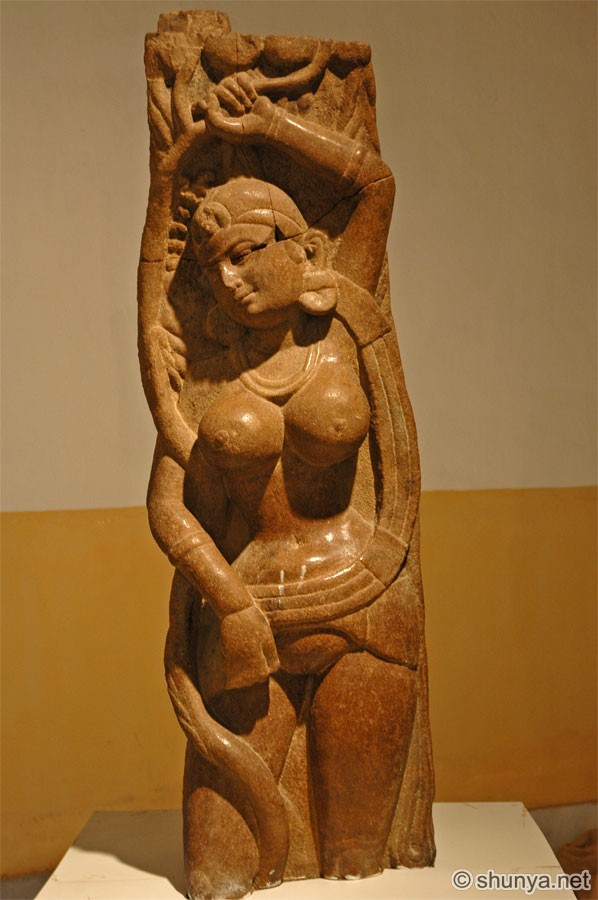
A 2000-year-old aesthetically carved sculpture of dancing Yakshas has been excavated from a famous Buddhist site in the State’s Krishna district close to a National Highway that runs between Vijayawada and Hyderabad.
The fragmented sculpture on a stone slab measuring 15 x10 x5 cm had once adorned the roof of the Maha Stupa at Gummadi Durru in the district.
Giving details of the recent exploration at the site, he said that the sculpture depicts the Yakshas playing instruments and dancing.
“The garments and facial expressions of the Yakshas in the sculpture are akin to the Amaravathi school of Buddhist art,” he said.
The site was first discovered during the excavation made by East India Company during British Raj and has been unapproachable till recently as it was covered with thick bushes and shrubs.
After cutting the thick forest strip embracing a hillock at the site, ASI has taken up the excavation work for the conservation of the antiques, Das said.[Sculpture of dancing Yakshas excavated in Hyderabad]

In Hinduism besides the pantheon of main Gods, there are a large number of lesser ones like the snake-spirits (Nagas) and earth-spirits (yakshas). Of these the Yakshas associated with Kubera and are considered friendly, but those of the female gender, the Yakshis, would sometimes have you for dinner. Some Yakshas are romantic, like the one who convinces a cloud to take a message to his wife in Kalidasas’s Meghadūta, while some are quiz masters, like the one Yudhistira encountered near a lake.

From Hinduism, Buddhism too inherited the yakshas and they are the attendants of Vaiśravaṇa, a chief modeled like Kubera. One famous sculpture from the Mauryan era is that of the Didarganj Yaksi (pic). The stupa railings in Bharhut in Madhya Pradesh are carved with both yakshas and yakshis besides scenes from the Jataka tales.

See Also: Buddhist Art at Amaravati

Excavations in Nalanda

Hindustan Times: ASI to carry out major excavations in Nalanda

According to Director (Exploration and Excavation) RS Fonia of ASI, “The Indian Space Research Organisation (ISRO) gave us detailed satellite imagery of about 16 square kilometre area around the ancient site of Nalanda. Till date excavations have been carried out only in 1.5 sq km area.”

“The satellite data helped us to understand the topography and structural remains around Nalanda and this year during August-September ASI carried out initial explorations leading to the discovery of a number of mounds in villages of Baragaon, Begampur, Machhardiha, Juafardih, Rukministhan,

Paparnausa, Jagdishpur, Sarichak, Kul, Bhadari, Nanana, as also remains of ancient sculptures, gates, pillars, potsherds of Red ware of medieval period,” he said.

Fonia said, “Baragaon used to be part of the trade route to Nepal and Lhasa from eastern India to reach China and Central Asia.”

History of Nalanda goes back to the days of Mahavira and Buddha in the sixth century BC. It was the place of birth and nirvana of Sariputra,one of the most famous disciples of Buddha.

See Also: Reconstructing Nalanda,  Along Huen Tsang’s path, again

Buddhist sutra found in Bamiyan

A part of a Buddhism sutra was found inside one of the two giant Buddhas of Bamiyan, providing a hint for unveiling the mystery surrounding the creation of the statues, a Japanese news agency reported Sunday.

The fragment of the scripture was believed to be the original Sanskrit document, written with the letters often used in the 6th and 7th century, according to a Kyodo news dispatch from Kabul.

Although various scripts have been found inside Buddha statues in Japan, it was the first time a sutra was found inside an Afghan Buddha statue, Kyodo said. The script was written in “Gilgit/Bamiyan type one characters,” which were used in a region that spread over what is now northern India, Pakistan, and Afghanistan, Kyodo said.

The document was the beginning section of a sutra that spelled out the basic belief of Buddhism and said all things were mortal, Kyodo said. It was written on pieces of birch bark and wrapped in a piece of cloth with mud balls, which could have been symbols of Buddha bones, according to the researching team, Kyodo reported. [Secret sutra found in rubble of Bamiyan Buddha]

Last year a Buddhist residence was discovered by a Japanese team in Bamiyan and at that time I wrote

Archaeology has returned to Afghanistan in a big way. First there was the announcement regarding the Bactrian Gold.. Then there was constant news about the search for a third reclining Buddha in Bamiyan by Zemaryali Tarzi based on a note written by Huen Tsang. Now a Japanese archaeologist team has found some new structures in Bamiyan.

Besides this, the Japanese team also discovered Buddhist caves dating back to the eighth century about 120 KM west of Bamiyan, but when it comes discovering documents, this is not the first discovery in that region. Last year ancient documents, which for some reason is called Buddhism’s Dead Sea Scrolls were found in Bamiyan. Actually there were found in 1996 and was smuggled out to Pakistan. Some of these manuscripts, the earliest of which were dated to 1st century AD were some of the oldest Buddhist manuscripts ever written. While the recently discovered sutra was written in Sanskrit, more earlier ones were written in a language called Gāndhārī.

“Before the discovery of these manuscripts, Gandhari was primarily known through coin legends and inscriptions which are highly formulaic and have a limited vocabulary,” he said. “These manuscripts therefore substantially increase the corpus of documents in this language.”

The Gandhari manuscripts are constructed of birch bark which becomes brittle with age, or palm leaf. A large number are damaged or fragmentary, and they are exceptionally difficult to read: there are no spaces between words and the spelling was never standardized. For example, the Sanskrit word dharma, meaning ‘law’ or ‘teaching’ may appear in Gandhari as dharma, darma, dhama, dhrama, or dhrarma. [Master of Gandhari sheds light on Buddhism]

Archaeological Work in Dwaraka

Indian Express: To bring to surface Dwarka’s past, ASI to dig in deep & in the deeps

IT has long beckoned pilgrims and researchers alike, and is believed to have been a thriving port once. Now, to bring submerged Dwarka’s past to the surface, the Archaeological Survey of India (ASI) and an Indian Navy team are planning to not only go down into the ocean’s deeps, but also dig along the shore and land. The excavation operations, which were launched at a site opposite Dwarkadheesh Temple on Monday, are the first on such magnitude undertaken by the ASI at the site.

‘We have begun excavations in a small area, measuring 5×5 opposite Dwarkadheesh temple. This was the only open site available adjacent to the main temple. The excavations near Dwarkadheesh will be followed by similar operations at Gomti Ghat and along the sea shore. Undersea excavation, to be undertaken by the team from Indian Navy, will begin on January 7,’’ said Tripathi. ‘‘The site earmarked for undersea excavation is some 500 km from the ashore. The excavation will be conducted at a depth of 3-15 m. This will be a time-consuming process. Initial results will dictate how much time will be requires for conclusive research,’’ he added.

‘‘The ASI plans to take up research with a different perspective, while keeping in mind earlier findings. Post-excavation, we will involve a range of experts to analyse the findings of our 20-member team,’’ said Tripathi.

See Also: Where is Krishna’s Dwaraka?, More on Dwaraka