State of Hindu Temples

In Pakistan

The ancient Hindu temple at Katas Raj, some 40 kilometres from Chakwal, has been robbed of all its relics, save for a stone carving depicting a god and a goddess, who are sitting, and two female slaves standing on either side.Kumar accused the Punjab Archaeology Department (PAD) for lack of interest and not providing the temple enough security. He said the temple had been a continuous victim to smugglers of ancient sculptures. He said the surviving statue was priceless and was also in threat of being stolen.[Only one Hindu relic left at Katas Raj temple]

In Tamil Nadu

In the last one month, there have been at least three cases of idol thefts, the latest being Thursday, where a wooden elephant was found being smuggled to France.The exquisitely carved Natarajas, Alwars and Murugans, crafted prior to 12th century have been stolen from these poorly guarded temples and make their way to many foreign countries

Officials from the idol wing say that there are idol thieves active in every district of Tamil Nadu, constantly targeting temples in Tanjavur and Madurai belonging to the Chola period, temples in Kancheepuram and Vellore belonging to the the Pallava period and temples in Tirunelveli belonging to the Pandian period.[Idol thieves target Tamil Nadu temples]

Update

In Balochistan

Lawmakers in Pakistan’s southwest Balochistan assembly have demanded that the federal government drop plans to build a dam in the region as the structure will damage a historical Hindu temple visited by thousands of pilgrims every year.

In a joint resolution moved by several provincial ministers and backed by all lawmakers, except one, members of the assembly wanted the federal government to cancel plans for building the dam on Hangol river that would pass near the Makran coastal highway close to the Hinglaj Mata temple. [Balochistan lawmakers oppose dam construction near temple]

The James Ossuary

Early this year, film makers Simcha Jacobovici and James Cameron made the case in their documentary, The Lost Tomb of Jesus, that a tomb found in Jerusalem belonged to Jesus. This claim was made based on the fact that the tomb contained ossuaries with inscriptions reading “”Jesus son of Joseph”, “Miriam”, and “Judah son of Jesus”, among others. When the tomb was discovered in 1980, it had ten ossuaries; currently it has only nine.

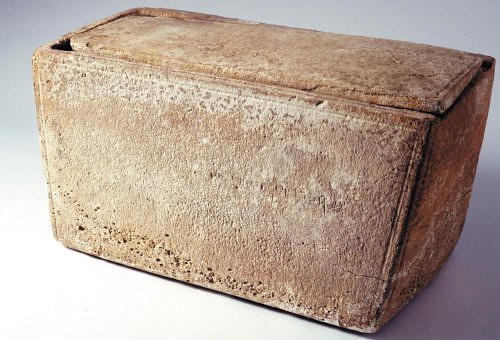
The tenth ossuary, the documentary claimed, was the James ossuary which surfaced in Israel in 2002. This limestone box carried an inscription “James son of Joseph, Brother of Jesus” and if it was proved to be true, could be historical evidence for a man named Yeshua.

The American TV program 60 Minutes found the Israeli who possessed the ossuary. They also tracked down an Egyptian who had fabricated various artifacts for the Israeli. A committee of the Israel Antiquities Authority (IAA) declared it a forgery. Most scholars believe it to be fake.

Now Hershel Shanks, the editor of Biblical Archaeological Review, who first published news of the ossuary has come out with a letter in which he alleges that most scholars claim the ossuary is a fake, based on a hunch and they have not been able to reason it properly. Some expert paleographers still believe the inscription to be authentic and it turns out no committee of the IAA has found it to be fake. Even the Egyptian shown on 60 minutes admitted that he had not seen the ossuary before.

Shanks letter which is similar in tone to B. B. Lal’s lecture on the 19th century paradigms, finally says

Either I’m way off the mark or there has been a successful effort to “hustle” this inscription. Maybe it’s just a better story if the inscription is a forgery than if it’s authentic. Maybe the IAA hates the antiquities market enough to lump the ossuary inscription with other alleged forgeries where it has a better case. Or perhaps the strong suspicion that Oded Golan is a forger is enough. Perhaps he’s forged other stuff.[Help Me! I’m Desperate!]

This brings the ossuary back into news and if the inscriptions are found to be true, it could profoundly affect the historicity of the Jesus.

Those Primitive Vedic People

Photobucket
(image via archaeologyonline.net)

In a recent review of Frits Staal’s Discovering the Vedas, Pramit Pal Chaudhuri writes

  1. Even a non-history buff will find the role of the Bactrian-Margiana Archaeological Complex (BMAC) and the Iranian Wedge in the evolution of Hinduism fascinating.

  2. What led such primitives to dwell so much on infinity or develop numbers so large they “have nothing to do with the universe,” he wonders.

After the Aryan Invasion theory failed, some proponents moved to a convenient migration-of-cattle-breeders-looking-for-pastures theory and the BMAC was hailed as new Aryan homeland They found some evidence too; an antennae-hilted sword found in Bactria looked similar to one found in Fatehgarh. It was also claimed that BMAC people had fire-worship temples, supposed use of soma, a horse skeleton assumed to be used in ashvamedha and cult motifs on precious stones

On closer examination however it was found that most of these claims required imagination in liberal doses. Looking at the evidence of the sword, Dr. B. B. Lal, who was the Director General of the ASI said, “if I said that the occurrence of a cylinder seal at Kalibangan in Rajasthan entitles Rajasthan to be the ‘motherland’ of the Mesopotamian Culture, I am sure my learned colleagues present here would at once get me admitted to the nearest lunatic asylum.Analysis of other evidence found no use of soma, no proof of ashvamedha, and in case of fire worship, that the migration was from India to Central Asia.

Even if they had some connection, the BMAC people, who belonged to the Bronze age culture of Central Asia, were not primitives, for they had well planned structures, multi-roomed temples, pottery kilns, metal objects, and sculptural art. But as soon as they completed their journey from Bactria to India, they became primitives.

The usual view of Vedas, the composition of these neo-primitives, is that of semi-civilized people wondering about nature, creating anthropomorphic gods and goddesses, moving from polytheism to monotheism to monism. People like Staal condescendingly wonder how such people are able to produce great concepts? Maybe they were not culturally primitive. As Chandradhar Sharma notes, “the correct position seems to us to be that the Vedic sages were greatly intellectual and intensely spiritual personages who in their mystic moments came face to face with Reality and this mystic experience, this direct intuitive spiritual insight overflew in literature as Vedic hymns.”

This attempt to cast people who wrote the Nasadiya Sukta as primitive comes from 19th century models which portrayed the natives as semi-civilized. Pick up a book like Karen Armstrong’s The Great Transformation which is used as text book in graduate courses, and you will find that colonial politics is still alive. Even when one part of their theory contradicts the other, it is presented to us with a straight face and if you disagree you are labelled a Hindu nationalist.
Groping Around

Recently Santosh Madhavan aka Swami Amritachaithanya, a self proclaimed godman, was arrested in Kerala for among other things molesting girls and blackmailing them with videos of it. The Communists were all over the news marching against godmen and speaking sanctimoniously.

Then the other day a television channel showed the image of a woman being groped by a Communist party district leader as the Chief Minister was inagurating a bridge. The abused woman, it turns out, was a Communist MLA and the image was shown on Kairali TV, a Communist TV channel, thus making the whole thing an in-house entertainment package.

“We did not know that the lady in it was an MLA. So we went ahead and included it in the episode. We thought if there was anything against any party member, the channel would cut it out during preview. But the pictures were broadcast with her face masked,” said Leen.[MLA files complaint against TV channel (via Ranjith)]

Stop All Terrorists

Recently Bal Thackeray suggested that ‘Hindu Suicide Sqads’ be created to fight ‘Islamic Terrorism’. Thackeray was of proud some terrorists who planted a bomb in an auditorium in Thane which injured seven people. Justifying this, he said that Hindus were safe only because Shivaji took up arms against the Mughals.

Now according to an Indian Express report, there are other Hindu terrorist groups who are preparing to take arms.

While the SS and the HJS are both registered in Goa as charitable organisations, the Dharmashakti Sena was set up in 16 Maharashtra towns and cities on Gudi Padwa day this April. Its stated aim: establishing “Ramrajya” and to make Hindus “capable of action”.Publications linked to the three groups say the Dharmashakti Sena offers free training in self-defence and the training involves inculcating “mental courage”. It also reminds readers of the “armed battle of revolutionaries and saints”, RSS leader Golwalkar’s work on “protecting Hindus” and his teaching that “weapons should be countered with weapons”.[Those Hindu Terrorists]

This has to be nipped in the bud and such “leaders” should be stopped using strong anti-terror laws before these groups become deadly like SIMI or Naxalites. Now that the Hindu terrorists have arrived, the ‘concerned citizens‘ should have less opposition for such laws.

The World's Oldest Church?

Abdel-Qader al-Housan, director of the Rihab Center for Archaeological Studies in Jordan, announced that they had found the world’s first church. It was not a building, but a cave located under Saint Georgeous Church near Amman. In the cave they found a circular worship area with stone seats and a tunnel leading to a source of water.

The reason why they believe it to be a church was an inscription found on the floor, which read, “the 70 beloved by God and the divine.” The theory was that this 70 referred to the seventy disciples who fled Jerusalem fearing Roman persecution.

Many have found this argument quite a stretch since organized churches did not exist till the time of the Gupta empire in India. There were small communities till then, like the ones which wrote the gospels, who mostly worshipped in homes, domestic buildings and by the riverside.

“If they are talking about a cave, it could have been a hiding place. In time—if there were martyrs there or something significant that took place there or a well-known individual who was among the disciples of Jesus—then you would have had reason to commemorate the site, which could later be used by the church’s monks.”

“But the cave that’s there is one that doesn’t necessarily commemorate anything … I don’t know how you can take an underground cave and say it could present itself as a first-century church.”[“Oldest Church” Discovery “Ridiculous,” Critics Say]

Hampi's North Pole

The Hindu, recently had a feature on Hampi.

From the DVD we know that the city was planned as a microcosm of the Universe, suggesting an equivalence between divinity and kingship. John Malville explores this idea in depth. The principles of Vastu appear to have been used to create a totality, with interlocking relationships between constructed and natural features. Several examples, with detailed measurements, support this argument.

For instance, the Royal Centre is divided into public and private spaces by a north-south axis that passes from the king’s Audience Hall in the east to a palace structure in the west.

Other structures such as the Virabhadra temple atop Matanga Hill are set in a precise alignment with this axis, and if the night sky is viewed from the ceremonial gateway one can see that the north pole of the rotating heavens lies immediately above the tower of the temple. This conjunction between the pole and the axis of the city indicates an astonishing degree of architectural and astronomical sophistication long before the telescope was invented.[New light on Hampi]

If the north pole is right above the tower of the temple, shouldn’t the temple be located at the north pole?

World's Oldest Wheat

Wheat, which resulted from a sinful relationship between einkorn and emmer, was previously thought to be 6000 years old, but now..

A series of DNA analyses conducted on ancient wheat samples have led scientists to conclude that the oldest known wheat was grown in Çatalhöyük, a Neolithic settlement in southern Anatolia. Professor Mahinur Akkaya from the Middle East Technical University’s (ODTÜ) department of chemistry says the world’s oldest wheat found so far comes from Çatalhöyük, this according to a series of DNA analyses made on 8,500-year-old wheat samples. “Our discovery is of great importance as it gives us significant insight into the birth of the first civilization in Anatolia. With our analyses, we have shown that the oldest known wheat was grown in Çatalhöyük,” she said in an interview with the Anatolia news agency.[Oldest wheat found in Çatalhöyük]