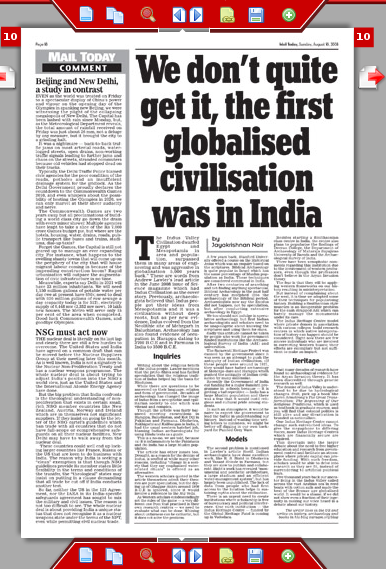
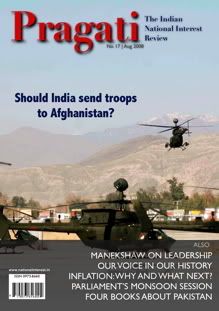
My article, Our Voice in Our History, published in the Aug 2008 edition of Pragati was printed in Mail Today.
Their editor sensationalized the title of the article to, We don’t quite get it, the first globalized civilization was in India which demonstrated that the person who did not quite get it was the copy writer who came with the title. In the article I make no claims that India was the first globalized civilization. The article was not about proving it either but about the need for more voices in Indic studies. As it stands now there is disconnect between the title of the article and contents.
Now, back to the break.
Author: जयकृष्णः | ജയകൃഷ്ണൻ
Short Break
This blog is on a short two week break. Regular programming will resume approximately around Aug 25th.
The history carnival will be published as scheduled on Aug 15th
Domestic and International Hindu Disputes
![]() |
| (Preah Vihear temple. Image credit: mofaitsontd) |
An beautiful idol of Lord Lashminarayan found in the river Kosasthalaiar is now the reason for a fight between two villages in Thiruvallur district. When the idol was discovered during quarrying, the villagers of Nemili and Adukkalpat claimed ownership. To maintain peace, the RDO has locked up the idol and informed the archaeology department officials.
Meanwhile an international dispute has erupted between Thailand and Cambodia over the ownership of the 900-year-old Preah Vihear temple. This temple dedicated to Shiva was built by kings Suryavarman I (1002 -1050) and Suryavarman II (1113 -1150) and has been at the center of a fifty year dispute between Cambodia and Thailand. In 1962, the International Court of Justice had ruled that the temple belonged to Cambodia.
Recently Cambodia filed a request with United Nations to approve the Preah Vihear temple as a Heritage site and Thailand’s Govt. actually offered support for this. Then Thailand’s Constitutional Court questioned this support and asked the Govt. to get parliament approval. Opposition leaders suddenly became like Bruce the Shark, who got a whiff of blood and decided to campaign to remove the Foreign Minister from his position.
It got more interesting as three Thai protestors reached the temple and Thailand send troops to get them back. During their travel, the Thai soldiers forgot to cross through the immigration checkpoint, which was unusual in South East Asia, but a daily ritual in the Indian subcontinent. In the subcontinent, such trespassers are sent back with gold, frankincense, and myrrh, but the Cambodians held the Thai troops.
Thailand sent four hundred troops to the border; Cambodia eight hundred. All of them sat in the Shiva temple, singing Om jaya Jagadiśa hare, Swāmi jaya Jagadiśa hare. The Cambodians and Thais again did something which is popular in the subcontinent – talks. The talks, like all other talks, failed, but produced something priceless. Both sides agreed that ” force must not be used to resolve the nearly week-long crisis over disputed land.” It is as if they stole the template file from the Indian Prime Minister’s office.
In a move that would have made Chacha Nehru proud, the matter was taken to the UN Security Council. By then the Thai troops had increased to 4000 and were running out of bhajans. Bill Clinton, if he were President would call this the most dangerous spot in the world; President Bush probably has no idea where Cambodia is.
Now both Thailand and Cambodia have found a way to defuse the tension in Preah Vihear. This is a brilliant solution which can be used in the subcontinent as well; it would do good if foreign policy experts paid attention. They have started a new dispute over the Ta Muen Thom ruins along the border and Preah Vihear is no longer the top news. The alternate plan was to send the RDO from Thiruvallur district to Cambodia.
See Also: Taking the high ground at Preah Vihear
Our Voice in Our History
(An edited version of this article was published in the Aug 2008 issue of Pragati)
“The Indus Valley civilization dwarfed Egypt and Mesopotamia in area and population, surpassed them in many areas of engineering and was aggressive in globalization 5000 years back.” These are words from Andrew Lawler’s lead article in the June 2008 issue of Science magazine which had Indus Civilization as the cover story
Previously archaeologists believed that Indus people got their ideas from Mesopotamia and was a civilization without deep roots, but as per new evidence, Indus evolved from the Neolithic site of Mehrgarh in Baluchistan. Archaeology has also found evidence of occupation in Harappa dating to 3700 B.C.E and in Farmana in India to 3500 B.C.E.
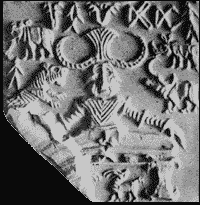
Writing about the religious beliefs of the Indus people, Lawler mentions that the proto-Shiva seal has fuelled speculation that the religious tradition of Indus helped lay the basis for Hinduism. While there are questions to be answered on their language, religion and form of government, decades of archaeology has changed the image of Indus from a xenophobic and egalitarian society to one which was vibrant and complex.
Though the article was fairly balanced covering excavations in Harappa, Baluchistan, and Kot Diji in Pakistan and Farmana, Dholavira, Rakhigarhi and Kalibangan in India, it had the usual western hatchet job, blaming Indian archaeologists for using Hindu texts as a guide. This is a no-no, we are told, because (a) it is inflammatory to the Pakistanis and (b) India has a large Muslim population.
The article has other issues too. Drought, as a reason for the demise of Indus, is scoffed at while many other reasons, including “change in a society that they say emphasized water-related rituals” is offered as an alternative. The western scholars quoted in the article themselves admit their theories are pure speculation, but the drying up of Ghaggar-Hakra around 1900 B.C.E is ignored, since it would involve a reference to the Rig Veda.
As Western scholars condescendingly set the rules of the games — a very different one from that practised in their own research centers — we need to evaluate what can be done. Whining about unfairness can be cathartic, but it does not solve the problem.
Different Standards and Inept Government
Few years back, Stanford University offered a course on the Historical Jesus which was an enquiry based on the scriptures. Biblical Archaeology is quite popular in Israel which has the same percentage of Muslim population as India. These techniques are considered communal in India.
After two centuries of searching and not finding anything spectacular, Biblical Archaeology in the past half century has morphed into the archaeology of the Biblical period. Archaeologists now say the Exodus did not happen, not by speculation, but after conducting extensive archaeology in Egypt. We too should not indulge in speculative archaeology, but first Indian archaeologists and scholars need to be unapologetic about knowing the scriptures and using them for clues.
Sadly this attitude cannot be taken by people who work for government funded institutions like the Archaeological Survey of India (ASI) and Universities. The Saraswati Heritage Project was canned by the government since it was seen as an attempt to push the antiquity of Indian civilization. (If these people were around in 1921, they would have halted archaeology at Mohenjo-daro and Harappa which pushed the antiquity of Indian civilization by many millennia)
Recently the Government of India cut funding for a major Sanskrit program in schools because – it is getting tad repetitive – India has a large Muslim population and there was a fear that it would instil religious and cultural pride among students. In such an atmosphere, it would be naive to expect the government to lead the battle in understanding our history. Instead of wasting time writing letters to ministers, we might be better off digging in our own backyard for Painted Grey Ware.
The second problem is mentioned in the Lawler’s article itself. Indian archaeologists have done excellent work, like R. S. Bisht in Dholavira and Vasant Shinde in Farmana, but they are slow to publish and collaborate. Bisht’s work has revealed “monumental and aesthetic architecture, a large stadium and an efficient water-management system”, but has largely been unpublished. The lack of data from people who had first access to the location helps in sustaining myths about the civilization.
Solutions
There is an urgent need to create institutions where scholarship is free of bureaucracy and political interference. One such institution — the Indus Heritage Center — funded by the Global Heritage Fund is coming up in Vadodara. Besides starting a Smithsonian class center in India, the center also plans to popularize the findings of Deccan College, the Department of Archaeology of Maharaja Sayajirao University of Baroda and the Archaeological Survey of India.
There have been xenophobic comments regarding this institution due to the involvement of western professors, even though the professors don’t believe in the Aryan Invasion theory. The fear is that they will be applying western frameworks on our history resulting in misinterpretation.
But instead of complaining about west, it is time we adopted some of their techniques for popularizing history. Building a Smithsonian style museum is an insuperable problem for the cash strapped ASI which can barely manage the monuments under its care. The Indus Heritage Center model where private donors in association with various colleges build research centers in which native interpretation of history can happen should be considered. Right now there are few sincere individuals who are involved in correcting Western biases; their efforts are exemplary but not sufficient to make an impact.
Past many decades of research have found no archaeological evidence for the Aryan Invasion theory. It has been discredited through genetic research as well. The demise of Indus valley is understood to be due to hydrological changes. Still, pick up a book like Karen Armstrong’s The Great Transformation: The Beginning of Our Religious Traditions, which is used as text book in graduate courses, and you will find that colonial politics is still alive and any divarication is branded as nationalism.
One Indus Heritage Center cannot change such entrenched ideas. To give the megaphone to differing voices, more Indus Heritage Centers which are financially secure are required. This dovetails into the larger debate about the need to free higher education and research from government control and facilitate an atmosphere where private capital can provide funding. With such freedom, scholars would be able to delve into research as they see fit, instead of surrendering to artificial political fears.
Five thousand years back our ancestor living in the Indus Valley sailed across the vast Arabian sea in reed boats with cotton sails and made the best of the Bronze age globalized world. It would be a shame, if we did not show even a fraction of their ingenuity in making our voice heard in a debate about our history.
The State of Absaroka
While the history of United States is reasonably well documented, there are some less known facts, such as the existence of a short lived plan to create a state called Absaroka in 1939.
The tale of the would-be rebels, who called their new state Absaroka (pronounced ab-SOR-ka), from the Crow word meaning “children of the large-beaked bird,” then faded into the mist. Details were forgotten — how a baseball-player-turned-street-commissioner in Sheridan named A. R. Swickard appointed himself governor and began hearing writs of grievance, and how license plates were distributed along with pictures of Miss Absaroka 1939, the first and apparently last of her breed. There was even an Absarokan state visit, when the king of Norway made a swing through Montana. [Going Down the Road – A State That Never Was in Wyoming – Series – NYTimes.com]
Video Tour of Bamiyan Caves
Earlier this year, archaeologists looking into the caves behind the destroyed Buddha in Bamiyan found oil paintings believed to be earliest in the world. BBC has a video tour of those caves
Japanese, European and American scientists restoring the cave murals dating back to around 650AD, discovered oil was used in the paint.Yoko Taniguchi, one of the Japanese experts working on the caves, told reporters this is the earliest known use of this technique in the history of art. She said it was previously thought the technique originated in Europe during the Renaissance, eight centuries later. But wandering through the Buddhist temples carved out of the rock, there is little left of the murals destroyed in the last 30 years of war after surviving for centuries.[Rediscovering treasures of Bamiyan]
Defining the Historian
![]() |
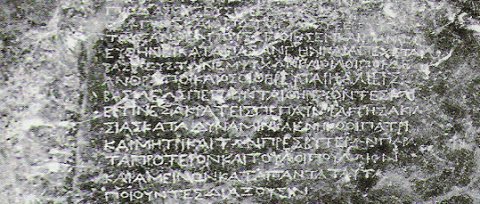
| (Asoka’s Edict in Greek and Aramaic. Found in Khandahar) |
In an opinion piece in The Hindu, Upinder Singh writes highly about Marxist historians and offers the following criticism:
While making these valuable interventions and contributions, Marxist writings often tended to work with unilinear historical models derived from Western historical and anthropological writings. Texts were sometimes read uncritically, with insufficient attention paid to their problematic chronology and peculiarities of genre. Archaeological data were included, but the basic framework of the historical narrative remained text-centric. Initially, the focus on class meant less attention to other bases of social stratification such as caste and gender. Religion and culture were sidelined, or mechanically presented as reflections of socio-economic structures [Changing interpretations of early Indian history]
The bigger problem is in applying a 19th century model in analysing ancient India without accepting that people of ancient India lived by different codes and philosophy. For example, when you apply Marxist historiography, with the theme of of social class and economic constraints in determining historical outcomes, on the Asokan empire, the results are ridiculous, but in India that passes off as serious research.
The Codex Sinaiticus Model

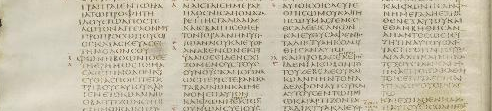
The Codex Sinaiticus, a Greek Bible written between 330 – 350 C.E., is now available online. This is believed to be one of the fifty copies of Bible commissioned by the Roman Emperor Constantine and the earliest complete copy of the New Testament. Besides displaying the scanned manuscript, the website displays verse by verse transcription and translation in various languages on the right side.
In India, the National Mission for Manuscripts was established to “not merely to locate, catalogue and preserve India’s manuscripts, but also to enhance access, spread awareness and encourage their use for educational purposes.” Right now the cloth, paper and bamboo leaf manuscripts scanned by the mission can only be used as thumbnails and is not of use to any serious remote researcher. By adopting the Codex Sinaiticus model of the British Library, the Mission can genuinely enhance access and spread awareness.
The Butterfly Effect
However, the Government has argued in court that such a bridge cannot exist and to support its claim, it has reffered to the Padma Purana in Ramayan which mentions that Lord Ram destroyed the bridge built by him using his magical bow and arrow.[Oh Lord! Now Govt says Ram destroyed Setu]
President Bush tells Prime Minister Manmohan Singh that the Nuclear deal is valid till the end of his presidency. Manmohan Singh develops spine and asks Karat and Co to become fossil fuel. To win the vote Congress cuts deals with DMK. DMK’s pound of flesh is that the Sethusamundram Shipping Canal Project should go on. Govt. officials read Padma Purana and find that Lord Rama, who did not exist before the vote, not only existed, but he himself destroyed the bridge.
Who would have thought that President Bush flapping his wings in the White House would result in the Govt. accepting the existence of Lord Rama? Even Valimiki could not have come up with such a twist.