King Agathocles's Coins

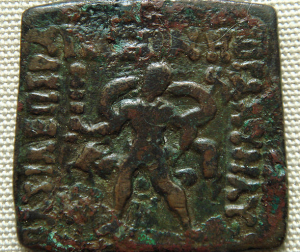
(Balarama depicted on a 1st century BCE Maues coin. via wikipedia)

Between 190 and 180 BCE, towards the end of the Mauryan empire, there lived a king named Agathocles near Ai-Khanoum, in the Kunduz area of Afghanistan. There are no cities, monuments or accounts about him and he would have remained unknown if not for one thing – coins.

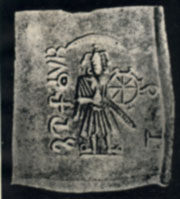
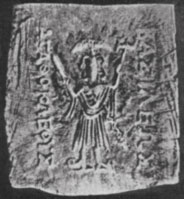
Some time in the 70s, archaeologists found two types of coins issued by him. One set was Greek silver coins depicting Zeus and Dionysos. He also issued bronze and silver coins, square or rectangular in shape, which portryated Indian gods like Vishnu, Shiva, Vasudeva, Buddha and Balarama. On these coins were written, in Brahmi or Kharoshthi, that the money belonged to Rajane Agathuklayasa.

“These square coins, dating back to 180- BC, with Krishna on one side and Balram on the other, were unearthed recently in Al Khanoun in Afghanistan and are the earliest proof that Krishna was venerated as a god, and that the worship had spread beyond the Mathura region,” says T K V Rajan, archaeologist and founder-director, Indian Science Monitor, who is holding a five-day exhibition, In search of Lord Krishna,’ in the city from Saturday. [New finds take archaeologists closer to Krishna-Chennai-Cities-The Times of India]

The images show Vasudeva carrying a chakra and sankha on one side and Balarama carrying a gada (club) and hala (plough) and are some of the earliest coins depicting Krishna and Balarama. But these are not recent discoveries as mentioned in Times of India; a paper on it (Narain, A.K. “Two Hindu Divinities on the Coins of Agathocles from Ai-Khanum”, Journal of Numismatic Society of India) was published in 1973.
References:

  1. Alexander the Great and Bactria By Frank Lee Holt
  2. Iconography of Balarama By N.P. Joshi

History of Harivarasanam

That is a video of Yesudas singing one of the most famous Ayyappa songs – Harivarasanam – in his divine voice. This devotional song is sung every night and is Ayyappa’s lullaby. The Hindu blog has the history of the song.

This divine song which drenches the eyes of Ayyappa devotees in tears was written Kumbakudi Kulathur Iyer. Harivarasanam lyrics were composed in 1950. Kumbakudi Kulathur Iyer used to sing it daily when the temple doors were closed after performing the Athazapuja — serving the last meal of the day to Ayyappa. Today it is known as the Urakku Pattu — or the song that sends Ayyappa to sleep.
In the beginning, the main priest used to play flute while closing the doors of the temple. Harivarasanam became the Urakku Pattu of Ayyappa after the infamous fire incident in the 50s, which burn down the old temple. When the new temple was built and the pujas commenced, Harivarasanam was inducted as the Urakku Pattu — the song to send Ayyappa to sleep.[Who is the author of Harivarasanam?]

The e-Anjali newsletter of Kerala Hindus of North America has more details.

The ashtakam (8 stanza song) was first rendered at Sabarimala in 1955 by Swami Vimochanananda. In those days, only a few ardent devotees managed the difficult pilgrimage to Sabarimala in the deep jungles. The temple remained open during the November to January season but otherwise only on the first day of every Malayalam month. One Sri VR Gopala Menon from Alapuzha used to accompany the Melshanthi (head priest) Thirumeni Eashwaran Namboothiri to the Sannidhanam, and he would often stay there by himself in a shack even when the temple was closed, undisturbed by the wild animals, and often even feeding some animals. He used to sing Harivarasanam as the “urakkupaattu” (lullaby) for ayyappa swami at night. Later, when the Devaswom Board was formed, some say that he was asked to move out and he eventually passed away at a tea estate at Vandipperiyar.
When Thirumeni Eashwaran Namboothiri heard about the passing of the ardent bhaktha, he was deeply saddened. At the end of the day’s rituals, thirumeni was about to close Sannidhanam doors when he remembered the dedication and sacrifice of the bhaktha and he began to recite “Harivarasanam,” starting a tradition that remains unbroken to this day.