In Pragati: An earlier date for Indo-Europeans in Northwest India

Between 4500 BCE and 2500 BCE, in the steppes north of Black and Caspian seas, in what is Southern Ukraine and Russia, there lived a group of people who spoke a language, called Proto-Indo-European (PIE). This language was the ancestor of later languages such as English, Sanskrit, Latin, Old Saxon, and Lithuanian among others. Once they domesticated the horse and acquired the wheel, PIE speakers traveled long distances with their tents and supplies, spreading the Indo-European language around the world. One of PIE’s descendants, Proto-Indo-Iranian developed between 2500 BCE and 2000 BCE implying that Vedic, which descended from Indo-Iranian, could only have a date later than 2000 BCE. Following this period, Indo-European speakers either conquered or migrated into the Harappan region and imposed Vedic culture, Sanskrit language and caste system transforming Northwest India.

So far archaeologists have not found any intrusive material culture dating to this period. If Indo-European speakers arrived in large numbers and culturally and linguistically transformed the region, such evidence is absent on the ground. A late migration also fails to explain how Vedic people knew about the mighty Saraswati whose flow had reduced by then. Still many historians are wedded to an invasion/migration model derived from linguistics, an area of research done predominantly outside India.

Earlier migration of farmers

Now a 2012 paper by Peter Bellwood, Professor of Archaeology at the School of Archaeology andAnthropology of the Australian National University suggests that Indo-European speakers may have been present in Northwest India much earlier, maybe even two millennia earlier. This theory is based on new archaeological discoveries in the Gangetic basin working alongside another Indo-European dispersal theory. According to the West Anatolian model, that has been in existence for a while, Indo-European originated in Anatolia and not near the steppes near the Black Sea. The spread of the language happened due to population growth and  the gradual spread of farming techniques and not due to carts, horses and wheels. Based on paleoethnobotanical dates, a date of 7000 BCE has been proposed for the spread of farming into Europe from Anatolia.

Around 6300 BCE, the catastrophic drowning of agricultural lowlands near the Black Sea may have triggered the migration of the farmers to other regions around the world. From Anatolia, the language spread through Armenia, Northern Iran, and Southern Turkmenistan and entered Pakistan by 4000 BCE. This implies that regions like Mehrgarh, the Neolithic antecedent which lead to the Harappan culture, could have been Indo-European speaking. According to Bellwood, the urban Harappan civilisation had a large number of Indo-European speakers alongside the speakers of other languages which may have included Dravidian. Thus the composers of Rig Veda were not the first Indo-European speakers in the region; their ancestors were present in the region at least two millennia before the current consensus.

Another piece of data, on which this earlier date is based, comes from extensive archaeology conducted in Haryana, Rajasthan and Gujarat. Just between Saraswati and Yamuna, around 350 sites were discovered and pottery in some of those sites date as far back 3700 BCE. Usually the Gangetic plains enters Indian history following the decline of the Indus-Saraswati civilisation, but new evidence indicates movement of farming techniques from Middle East to the Gangetic basin and from Gangetic basin to the Indus region. A version of rice, legumes, millets and humped cattle were domesticated in India, but there was an external flow of wheat, barley, sheep and goats from the Middle East. Also between 3500 and 2000 BCE there is an increase in settlements from the middle gangetic plains towards lower gangetic plains indicating population movement.

The suggestion that Indo-European speakers lived in the Harappan cities is not one of those theories, which does not have much academic support. In a 2010 paper, Professor Jonathan Mark Kenoyer, who has been excavating at Harappa for three decades wrote that even though the Indus script has not been deciphered, he thinks more than one language was spoken in the settlements. The language families that co-existed include Dravidian, Austro-Asiatic, Sino-Tibetan and Indo-Aryan. Paul Heggarty, a linguist at the Max Planck Institute for Evolutionary Anthropology, in a 2013 paper writes that Indo-European speakers may have reached Mehrgarh much earlier than 4000 BCE. The model that these studies present is not of a civilisation dominated by one language as imagined by Dravidian politicians and textbook historians, but an Indus-Saraswati region which was cosmopolitan.

New possibilities

All these have serious implications to Indian history.

First, the theory suggests the possibility of the development of Vedic in the Indus region. There are many versions of the theory that describes the origins and spread of the Indo-European language family. Most historians have been using the short chronology tied to the decline of the Indus-Saraswati civilisation and subsequent arrival of large Indo-European speaking population. Bellwood and Heggarty revive the longer chronology in which Indo-European speakers arrived early, much early than the Early Phase of the Harappan civilisation. As some farming techniques spread from the Indus region to the Gangetic plains, proto-Vedic too must have spread. This version allows for the possibility that Indo-Iranian branch and its children crystallized locally on the banks of Indus and not in the steppes of Central Asia. It also explains why the authors of the most ancient Indian text, the Rig Veda, had great awareness of the geography of Northwest India.

Second, many historians have argued that after the collapse of the Indus cities, a new civilisation emerged in the Ganges Valley and there was no continuity of material culture; according to them most of the second millennium BCE was a long dark age. In his book, The Lost River, Michel Danino contradicts this by listing many such continuities from the Harappan period to the present. These include symbols like the swastika, the patterns used in kolams, motifs like the pipal tree and seals like the pashupati seal which display a figure seated in yogic posture. Other elements like fire altars used by Vedic brahmins even now made John Marshall to comment in 1931 that the Indus religion was so characteristically Indian as hardly to be distinguished from still living Hinduism.  The new evidence of agricultural relationship between people who lived around the sapta-sindhu region and the Gangetic region confirms that the Ganges Valley urbanism was related to its Harappan antecedents.

Third, this theory discards the ‘elite dominance’ version of the migration theory. As per the short chronology, the Indo-European speaking people with their horses and chariots arrived in the Harappan region and influenced the residents to change their language or imposed their language. Even though the Indo-Europeans were few in number, people switched the language due to some utility of attaching themselves with the elites. The long chronology supports demic diffusion, a gradual spread which comes without the invasion and massive migration components. It is now clear that the decline of the Harappan civilisation was not caused by the invading or migrating Bronze-Age riders from the Eurasian steppes, but rather due to vagaries of nature: tectonic movements blocked the course of lower Indus river which must have caused floods that submerged Mohenjo-daro while either tectonic movements or weakened monsoons affected Saraswati and forced the residents to migrate east and south. (See: What caused the decline of Harappa?)

Finally, after two centuries of Indo-European studies there is no consensus on the homeland, on the path of dispersal or the time frame of Proto-Indo-European.  A debate which is going on this year is if Basque, the ancestral language spoken by people living in the region spanning northeasternSpain and southwestern France, is an Indo-European language or not. According to Paul Heggarty, linguistic data does not convincingly support the claim that Proto-Indo-European speakers domesticated the horse. Even if they were domesticated, there is less evidence of the saddle or the stirrup that are required for riding, and hence a Mongolian style invasion from the steppes could be an anachronism.  Further, the words that were reconstructed for wheeled vehicles refer to just movement and time and it is one interpretation that refers them as carts. Also, even now there is no agreed sequence of Indo-European branching, which could mean that there was no such straightforward branching, but rather a diffusion of people in waves. Hence the chronology of Indian history based purely on linguistics should be taken with a pinch of salt.

(This article was published in Pragati. Many thanks to Carlos Aramayo for providing the research papers)

References:

  1. Peter Bellwood. “How and Why Did Agriculture Spread.” In Biodiversity in Agriculture: Domestication, Evolution, and Sustainability. Cambridge University Press, 2012.
  2. Heggarty, Paul. “Europe and Western Asia: Indo-European Linguistic History.” In The Encyclopedia of Global Human Migration. Blackwell Publishing Ltd, 2013. http://onlinelibrary.wiley.com/doi/10.1002/9781444351071.wbeghm819/abstract.
  3. Bryant, Edwin. The Quest for the Origins of Vedic Culture: The Indo-Aryan Migration Debate. Oxford University Press, USA, 2004.
  4. Jonathan Mark Kenoyer. “Indus Civilization.” In Encyclopedia of Archaeology. Academic Press, 2007.
  5. Danino, Michel. Lost River: On The Trail of the Sarasvati. Penguin Books India, 2010.
  6. Danino, Michel. Indian Culture and India’s Future. New Delhi: D.K. Printworld, 2011.
  7. Anthony, David W. The Horse, the Wheel, and Language: How Bronze-Age Riders from the Eurasian Steppes Shaped the Modern World. Reprint. Princeton University Press, 2010.

3000 year old India-Israeli Cinnamon trade

An article in live science points to evidence of three millennia old trade between South India and the Israelites.

Researchers analyzing the contents of 27 flasks from five archaeological sites in Israel that date back around 3,000 years have found that 10 of the flasks contain cinnamaldehyde, the compound that gives cinnamon its flavor, indicating that the spice was stored in these flasks. At this time cinnamon was found in the Far East with the closest places to Israel being southern India and Sri Lanka located at least 3,000 miles (nearly 5,000 kilometers) away. A form of it was also found in the interior of Africa, but does not match the material found in these flasks.[Evidence of 3,000-Year-Old Cinnamon Trade Found in Israel]

Cinnamon was one spice that was a used for embalming dead kings as well as for manufacturing perfumes and holy oils. One line in that article mentions that this discovery raises the intriguing possibility of long distance trade from the Far East.  The article also mentions that this was not direct trade and could have happened using intermediaries.

In fact this long distance trade is not intriguing at all as there has been plenty of evidence for commodities from India appearing in far away places, even further back in in time. Archaeologists in Dhuwelia, a seasonal hunting site  in Eastern Jordan found cotton thread embedded in lime-plaster dating to the fourth millennium BCE. Cotton is not native to Arabia and that particular species could have come from only one place in the world: Baluchistan, where it has been cultivated since the fifth millennium. Queen Puabi, who lived in Iraq during the Mature Harappan period (2600 – 1900 BCE)  had Harappan carnelian beads in her tomb. Following her, Sargon of Akkad (2334 – 2279 BCE) boasted about ships from Meluhha, mostly identified with this Indus region), docked in the bay.   This suggests that ships from the Indus region made journeyed all the way to Iraq about 5000 years back.

Burial sites in third millennium BCE Mesopotamia had shell-made lamps and cups produced from a conch shell found only in India; Early Dynastic Mesopotamians were consumers of the Harappan carnelian bead. By 2000 BCE, the trade between Africa and India intensified. While crops moved from Africa to India, genetic studies have shown that the zebu cattle went from India via Arabia to Africa.  Around 1200 BCE, among the dried fruits kept in the nostrils of the mummy of Ramses II was pepper which came from South India. If you are familiar with the trading hubs of the old world (1, 2), there is nothing unusual about this trade from both North and South India.

Indian History Carnival-68: Linguistics, Perumals, Peacock Throne, Cotton Textiles, Wazir Khanam

 A map showing the approximate present-day distribution of the Indo-European branches
A map showing the approximate present-day distribution of the Indo-European branches
  1. Giacomo Benedetti writes about Indo-European linguistic theories, specifically some issues he finds in the Indo-Iranian branch

    It seems that the average linguist is not aware of the problems of this theory and generations of linguists did not find anything strange in the fact that ‘Indo-Iranians’ have transformed every e and o without exception into a, which is also not very useful for distinguishing words. The only justification that I can imagine for such an incredible theory is that the substrate language did not know e and o, like Classical Arabic. But this would imply that the Indo-Iranians were practically unmixed with the original Indo-European speakers and we also wonder why did they develop those sounds later in every Indo-Iranian language. And how is it possible that no Indo-Iranian dialect preserved them?

  2. Calicut Heritage has a post on Prof M.G.S.Narayanan’s book Perumals of Kerala (which was his Ph.D thesis) and the information it reveals

    He marshals arguments based on sound epigraphical evidence to disprove the existing accounts of a hundred years’ war between Cheras and Cholas which led to the disintegration of the Chera dynasty and the rise of smaller principalities. He re-examines and re-interprets the Keralolpatti chronicle which was once accepted as history and then rejected as nonsense. He discovers sufficient epigraphical and other evidence to support “the Keralolpatti legend about the last Perumal’s partition of Kerala and conversion to Islam. However, there is a vital change regarding the date of this event – the popularly accepted date was 825 AD but the new date is 1122-24 AD. The ‘Partition of Kerala’ is found to be the transformation of districts of the Chera kingdom into independent principalities”. (page 20)

  3. Maddy has the fascinating tale of Shah Jahan’s Peacock Throne and some theories on where it might be now

    Nevertheless inconsistencies in the various accounts about what actually happened to the peacock throne during the last days of the Moghuls, keep people guessing and researching. Perhaps someday some more of those jewels as listed and detailed by Tavernier will be found in NE Iran, or perhaps in Tehran or Afghanistan. Still it will be difficult to find out what actually happened to the throne that cost twice the Taj Mahal. As for the people who sat on it, the curse of the throne ensured that almost all of them died violent or horrible deaths. It is like someone said, vanity kills!!

  4. Kazuo Kobayashi explains how the demand for Indian cotton textiles among Africans underpinned the trans-Atlantic slave trade in the eighteenth century.

    European merchants bartered with local brokers along the African coast for slaves and other African products. They had to barter with highly desirable goods since discerning African brokers were known to reject the goods that Europeans brought across. The list of commodities imported from Europe into Africa included textiles, iron, brass, military goods, cowrie shells, beads, and alcoholic beverages. Indian cotton textiles comprised a large proportion of the imports. In the case of Anglo-African trade, piece goods of Indian cottons were the most important trades in exchange for African slaves, making up 30 per cent of the total export value in the mid-eighteenth century.

  5. India Ink blog has an interview with literary critic and novelist Shamsur Rahman Faruqi who has written a 984-page fictional account about the life and times of Wazir Khanam, the mother of the famed Urdu poet Daag Dehalvi

    I didn’t do any systematic, formal research. As I wrote, I did consult a few books when I needed to verify some particular detail, dates mostly. It would not be an exaggeration to say that the novel had always existed in my head as an amorphous, identity-less entity. Facts, memories, impressions — and of course my reading before I’d began to compose the novel — it was all there — a chaos, especially because I didn’t have anything like an idea to write a novel with Wazir Khanam as the chief character.

  6. The next issue of History Carnival will be up on September 15th. Please e-mail your nominations to varnam.blog @gmail. Please make sure they are blog entries and not newspaper articles.

Mahendraparvata, Angkor and their decline

When we think of the Khemer capital, the image that usually comes to mind is that of the famous temple complex at Angkor-Wat. Since it was built using stone, the temple complex survived, while other structures built using perishable materials vanished. Even though archaeologists knew that the city was quite big, it was hard to excavate due to the dense tropical vegetation which made conventional remote sensing ineffective.

Thanks to a cost effective airborne laser scanning technology called lidar, which has the ability to penetrate the vegetation in tropical countries and map archaeological remains on forest floors, archaeologists were able to map the surrounding landscape recently. This technology was successfully used in Mesoamerica and applying it in Angkor has revealed a lot more about the civilization that flourished in the region. Among these, we now know that the urban spaces were formally planned and the settlement did not have a single central point. The region was divided into city blocks which followed a regular pattern with temples, settlements and ponds.  It was a distributed network with many temples in the periphery forming part of the network which depended on agricultural goods. New studies have also  revealed that the size of Angkor urban center was thirty five square km instead of the nine previously assumed.

Also a newly mapped site, North-East of Angkor has been found to correspond to the city named Mahendraparvata, which was founded by Jayavarman II. This king, who was the founder of Angkor moved his capitals quite often. Initially it was at Indrapura, then at Hariharalaya, then at Amarendrapura and eventually at Mahendraparvata. At this place, a Brahmin named Hiranyadama consecrated him as a king, independent of Javanese overlordship. This was one of the early settlements and it had unique water management features which was seen in sites like Angkor later.

From the epigraphic record, there was an idea about how the towns developed and how the urban space was related to the temples. Combined with archaeological data, there is a detailed explanation of how the town expanded. During the early period (9th century CE), life revolved around  the moated temple. The area inside the temple complex itself was unstructured and the urban space around it was not demarcated in particular. Few centuries later there is evidence of urban planning with rectangular grids of canals and roads. All the occupation regions, the location and size of the ponds all followed a standard pattern. Few centuries later, as the city expanded a lot more, the standardization fell off. But still food security was provided due to the efficient water management system. Apparently, it was this water management system that eventually failed the people of Angkor. Eventually, the canals and reservoirs became dysfunctional leading to the decline of the urban centers.

  1. Coedes, G., and George Cœdès. The Making of South East Asia. University of California Press, 1966.

  2. Evans, Damian H., Roland J. Fletcher, Christophe Pottier, Jean-Baptiste Chevance, Dominique Soutif, Boun Suy Tan, Sokrithy Im, et al. “Uncovering Archaeological Landscapes at Angkor Using Lidar.” Proceedings of the National Academy of Sciences (July 11, 2013). doi:10.1073/pnas.1306539110.

In Pragati How old is Proto-Dravidian?

Dates for the branching of different language groups. PD: Proto-Dravidian (via Pagel)

(This article appeared was published in Pragati in Julu 2013. This is an expanded version of an earlier post)
According to linguists, there is a relation between the Sanskrit word satam, Latin centum, Old Saxonhunderod and Lithuanian simtas; these words derived from a common word in an ancestral language named Proto-Indo-European (PIE). The word in this theoretical ancestral language was deduced by listing the daughter terms and applying some linguistic sound change rules to figure out if the daughter terms were cognates of the mother term. Using this technique, a substantial vocabulary has been constructed for PIE, which is assumed to have been spoken between 4000 – 3500 BCE to 2500 BCE.
In India, about 75 percent of the population speaks a language that belongs to the Indo-European family (Hindi, Bengali, Marathi among others and 22 percent speak languages belonging to the Dravidian language family (Telugu, Tamil, Kannada and Malayalam). While Indo-European languages are spoken mostly in North India, Dravidian languages are spoken in South India. This fact, along with some interpretations that the Indus-Saraswati script is Dravidian, has led to a theory that the Indo-European speakers came from outside India and pushed the Dravidian autochthons to the South of the peninsula. This is a contentious issue even now, popping up in elections speeches by Dravidian politicians who like to split people as ‘us’ versus ‘them’.
In the midst of this Aryan controversy, as it is popularly known, comes a new paper which claims that there existed a super linguistic ancestor, older than Proto-Indo-European, around 15,000 years back. The authors identified a class of words whose sound meaning lasted long enough to retain traces of their ancestry between language families separated by millennia. While half of the words in various languages are replaced by a new word roughly every two to four millennia, the authors argue that there are some ultra-conserved words that live as old as ten to twenty millennia. These words, which include adjectives, pronouns and special adverbs (Thou, Not, To Give, Mother Fire), are spread over such diverse language families as Indo-European and Dravidian.
Another interesting piece of information from the paper is regarding the date when Pro-Dravidian split from the ancestral language and when Proto-Dravidian speakers moved to the subcontinent. One of the first language families to split from this Eurasiatic ancestor was Proto-Dravidian, which was around 14,000 years back, much earlier than Proto-Indo-European. These Proto-Dravidian speakers expanded from Central Asia to South Asia and reached a region at the border of Afghanistan and Pakistan from where they were displaced by Indo-European speakers much later. Though the model does not specify when the Dravidian languages evolved from Proto-Dravidian, it is clear that the evolution happened in the subcontinent. There are some who believe that Dravidian speakers lived in the Indus-Saraswati area until the invading Indo-European speakers displaced them and this model augments that theory.
So far there has been no consensus on the origins of Dravidian and only speculation on the time and place of the distinctive origins of its speakers. Some scholars have put their origins around 4000 BCE in Northeastern Iran from where they moved to India. However there have not been any traces of Dravidian languages outside India, which makes the external origins of Dravidian, a challenge to explain. Regarding Proto-Dravidian itself, a date of 3000 BCE was previously suggested which others claimed was in the realm of ‘guesswork’. But the new paper not only suggests a much older time frame for Proto-Dravidian, but also a Central Asian origin which disagrees many previous theories. For example, one theory argues that there was no Dravidian influence in the early Rig Veda; Dravidian lone words appear only in subsequent stages suggesting that Dravidian speakers arrived around the same time as the Indo-European speakers in North-West India.
With the new discovery, does this paper change the chronology of events and change the narrative of Indian history? It is too early to get into the impact of an earlier date for Proto-Dravidian as other linguists have panned the paper; it seems the paper has a “garbage in, garbage out” problem. The semantic looseness with which the reconstructions have been made of Indo-European words has been extreme and does not agree with the consensus. For example, taking one of the reconstructed words, one linguist was able to show that the word had the meaning “with the teeth, biting together” in Greek and “reach, strike” in Sanskrit. The problem was not just with the semantic interpretation; the Sanskrit word that was reconstructed did not match with the word in the Indo-European database. Since there are doubts on some reconstructions, the relationships among such words in different family trees are questionable.
But the bigger problem is this. After five to nine millennia, most words change so much in their meaning that it is hard to figure out other words, which originated from the same ancestor. Sometimes you don’t have to go that far either as words change quite a lot within a couple of millennia. Thus a sentence in one language family would be incomprehensible to a member of another language family even if they derived from the same ancestor as seen from the difference in meaning in Sanskrit and ancient Greek of the same word. Due to all this, critics have mentioned that the paper is of poor academic quality, displayed poor knowledge of linguistic geography and linguistic history. Thus even though this paper claimed a sensational finding, the origins of Proto-Dravidian and Dravidian continues to remain in the realm of guesswork.
References:

  1. Pagel, Mark, Quentin D. Atkinson, Andreea S. Calude, and Andrew Meade. “Ultraconserved Words Point to Deep Language Ancestry Across Eurasia.” Proceedings of the National Academy of Sciences (May 6, 2013). doi:10.1073/pnas.1218726110.
  2. Singh, Upinder. A History of Ancient and Early Medieval India: From the Stone Age to the 12th Century. 1st ed. Prentice Hall, 2009.
  3. Bryant, Edwin. The Quest for the Origins of Vedic Culture: The Indo-Aryan Migration Debate. Oxford University Press, USA, 2004.
  4. Anthony, David W. The Horse, the Wheel, and Language: How Bronze-Age Riders from the Eurasian Steppes Shaped the Modern World. Reprint. Princeton University Press, 2010.
  5. Ultraconserved words? Really?? by Sally Thomason at Language Log
  6. Do ‘Ultraconserved Words’ Reveal Linguistic Macro-Families?” GeoCurrents.

Importance of Thar in Out of Africa Migration

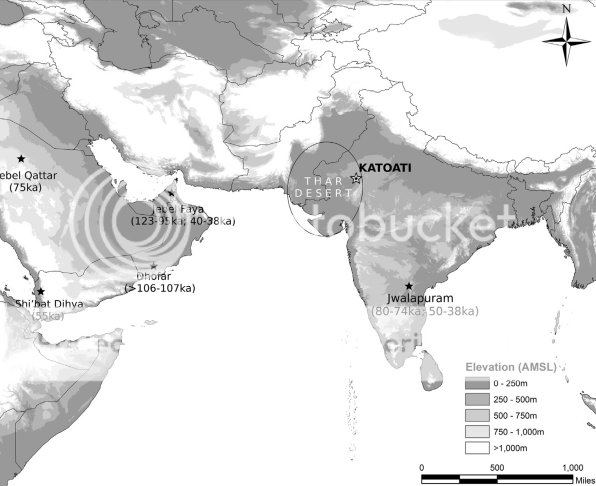
Map showing Katoati site along with other  Palaeolithic sites (via Blinkhorn et al)
Map showing Katoati site along with other Palaeolithic sites (via Blinkhorn et al)

Few years back, it was believed that the volcanic eruption of Mt. Toba (74, 000 years back) affected Indian population catastrophically, but evidence from Jwalapuram in Andhra Pradesh indicated that Indians were a tough lot. Going further back in time, we now find new evidence regarding the path the Out of Africa humans took as they reached India.
One of the theories suggest that the early humans took a coastal route from Africa and reached Kerala where they made bird sounds. A new paper now suggests that the humans actually lived in Thar desert around 95,000 years back. During that period, Thar was not that arid, had fluvial activity and hence vegetation. Thus rather than using the coastal route, humans may have used a continental route and the river network to travel.
Another interesting find is the similarity of the tools used by the people who lived in Jwalapuram and in the Thar region and it suggests technological continuity between people who lived in North-West India and South India. That’s  not it. There were similarities between tools found in Thar and Sahar and Arabia and it could either be due to independent technological evolution in those places or due to cultural connections. It looks like Thar desert has now become an important region in the study of the dispersal of humans from Africa to rest of the world.
References:

  1. Blinkhorn, James, Hema Achyuthan, Michael Petraglia, and Peter Ditchfield. “Middle Palaeolithic Occupation in the Thar Desert During the Upper Pleistocene: The Signature of a Modern Human Exit Out of Africa?” Quaternary Science Reviews. Accessed July 22, 2013. doi:10.1016/j.quascirev.2013.06.012. (Thanks @Karmasura)

Indian History Carnival-67: Tantra, Malayalam Calendar, Sakuntala, Ḥāfiẓ of Shiraz, Huzur Paga

  1. Koenraad Elst has a review of Tantra Illuminated. The Philosophy, History and Practice of a Timeless Tradition (Anusara Press, The Woodlands TX, 2012) by Christopher D. Wallis

    A necessary explanation here is that Tantra has nothing to do with the Kāma Sūtra and very little with sexuality. (And to the extent it has, it teaches intercourse with retention of semen, so what most men look for in the sex act is the one thing to be avoided.) Of course, New Age channels and the internet are full of disinformation on the matter, and for some more time we will have to live with the Western conception of Tantra as related to sex. Sometimes workshop on Tantra are announced by teachers unconnected with the legitimate tradition: “If you feel like testing them, you can ask them what Tantra [scripture] they are drawing on (…) and which Tantric mantra they use in their daily sādhana [regular spiritual practice].” (p.432) But at least this gives the writer the opportunity to unchain his devils against the internet, an endless source of false claims about Indian religions.

  2. The Malayalam calendar starts in the year 824 CE and Maddy writes about various theories on why that was the first year

    According to late Historian M.S. Jayaprakash the launch of Kollavarsham marked the complete transition of Kerala from the Dravidian-Buddhist tradition to the Aryan-Vedic system. According to him, Kollavarsham also marked the political transition of the land from the reign of Perumals to a caste-based rule. The commencement of Kollavarsham was in fact the declaration of a political and cultural change in Kerala. He also opines that the Kollavarsham declaration was made by two separate sessions of almanac experts and mathematicians held simultaneously at two places known by the same name Kollam – one the present headquarters of the southern district and the other one near Kozhikode in the north. So that is another train of thinking about the reasons for a new system, we need to get into. The implementation still follows the earlier theories. In conclusion, one can assume that the rather unique solar, current calendar was developed by the immigrants moving in from the North, perhaps the Namboothiri’s who settled down in Malabar and later in Quilon, and then the calendar got a little bit adjusted to what we know as the Kollam calendar. This has some traction due to the fact the calendar was first established in Malabar and a month later in Quilon, though it does not explain it satisfactorily. Nevertheless, due to the fact that it is also called Kolamba era, it is somehow more associated with Kurakkeni Kollam. But these are all assumptions based on obscure documents and you can perhaps imagine that with more research on the Buddhist – Jainist past of Kerala more facts will slowly come to light including the Sankaracharya aspects and you may even see the conclusions of Dr Jayaprakash gaining more credence.

  3. Fëanor writes about the world wide popularity of Abhijñānaśākuntalam in an illustrated post

    Others have been fascinated with Kalidasa’ tale of the unfortunate Sakuntala. Nikolai Karamzin, the great Russian historian, translated the tale into his language, claiming that it was a literature for the world. Here he was joining the likes of Goethe, Schelling, Herder, William Jones and de Chézy, in celebrating the great poem. Indeed, Abhijñānaśākuntalam was incredibly popular – nearly 10% of all works translated from Indian literature into Russian between 1792-1965 were of it! [2] It’s not just the Hungarians who were inspired by Sakuntala. Camille Claudel sculpted the remarkable ‘Çacountala’ or ‘L’Abandon ou Vertumne et Pomone’ between 1886 and 1905. It received much attention, and was kept in storage for several years. Claudel, of course, was channelling her own passion for Auguste Rodin. From Çacountala, she made subsequent variations, one of which is this lovely Vertumnus and Pomona:

  4. Asian and African studies blog writes about a manuscript of Dīvān by the Persian lyric poet Ḥāfiẓ of Shiraz.

    In the painting, it may be that the seemingly righteous are represented by the two figures seated to the right (our left) of the faqīh, one of whom seems to be remonstrating with him. Possibly they have brought the miscreants before him in the expectation of having them sentenced to the ḥadd punishment (in other words, a severe beating) for drunkenness. Imagine their surprise at having the moral tables turned upon them by the representative of Sacred Law! Meanwhile, in the foreground two figures struggle to hold up or resuscitate a beardless young man whom they may have been introducing to corrupt practices. There are no signs of spiritual ecstasy, or of spiritual practices of any kind. That the opposite is the case is amply shown in the figure on the far right, possibly the brother of the one on the left. His turban has unravelled in picturesque style. What is more, he is quite unmistakably throwing up on the floor of the madrasa courtyard.

  5. Mohini writes about Huzur Paga or the Royal Stables of the Marathas

    The horses used in the campaigns were mostly procured from auctions and were gifted or looted from the losers of the battles. These were thoroughbreds. The Arabian Horse, The Neela (pure white), and the Panchakalyan (one with White hoofs). The other horses were used for purposes such as, pulling carriages, or carts or short rides to nearby destinations for personal reasons. These were mostly indigenous. Some of the Peshwa’s had their own favourite horse and had even named them. Nanasaheb Peshwa had a horse called ‘Varu’, and Madhavrao Peshwa had ‘Matvali’. The Huzur cavalry, at any given time housed about 2000 horses these were kept in ‘Paga’s’ in and around Pune, Chas (Close to Chakan), Kavadi and Pimpalwandi villages.

The next carnival will be up on August 15th. Please send any nominations to varnam.blog @gmail

Indo-European Speakers in North-West India by 4000 BCE?

The dates and method of arrival of Indo-European speakers in North-West India is a contentious issue. Once held sacred, the Aryan Invasion Theory is no longer considered valid by some scholars. Instead of the invasion model, a migration model is now favored with the Indo-European speakers reaching India from an unknown homeland following the decline of the Indus-Saraswati civilization.

The decline of the Harappan civilisation is no longer attributed to “invading Aryans”, though that theory is still kept alive by political parties in South India. Even the non-Aryan invasion theory has been refuted as there is no trace in the archaeological record for such a disruptive event or the arrival of a new culture from Central Asia. The skeletons, which were touted as evidence for the invasion, were found to belong to different cultural phases thus nullifying the theory of a major battle. Due to all this, historians like Upinder Singh categorically state that the Harappan civilisation was not destroyed by an Indo-Aryan invasion. Instead of blaming the decline of the civilisation to invading or migrating population, the end is now attributed to environmental changes and whims and fancies of rivers.[In Pragati: What caused the decline of Harappa?]

If the Vedic speakers reached Punjab following the decline of the Indus-Saraswati civilization, then how did they know about Saraswati, which was no longer a mighty river.? Does this mean that this theory is incorrect and Vedic speakers were present in the region while the river was flowing over a longer distance? Most academics don’t go down that path and insist that IE speakers reached the region not long before the composition of the Rig Veda, even though there is no strong archaeological evidence for such a migration in the 1500 – 1000 BCE period.

If there is one thing that can work up historians, it is the suggestion that Indo-European speakers were present  in the region, much before the decline of the Indus-Saraswati civilization. Such a suggestion has serious implications like the possibility of an earlier date for the Vedas than the academically correct one which dates it to post 1500 BCE.

A recently published paper has some interesting observations on this issue. It suggests that the Indo-European speakers were present in the region during the Chalcolithic period (4300 – 3200 BCE) and they arrived as part of an agricultural colonization of a hunter-gatherer territory.  The language which was ancestral to Indo-Iranian spread from Anatolia via Armenia, north-Iran, southern-Turkmenistan and finally IE speakers entered Pakistan by 4000 BCE.  The paper suggests that IE speakers could have been present even before this period (the Neolithic). During this time Dravidian speakers, who were pastoralists and farmers moved from Gujarat or South Indus region to South India

To understand the impact of this date, it should be noted that the Mature Harappan Period is considered to be from 2600 – 1900 BCE. The paper explicitly suggests that urban Harappan civilization had a large population of Indo-European speakers and possibly some Dravidians as well.  By 2000 BCE, before the decline of the Indus-Saraswati civilization, IE speakers were present in the Ganga basin along with Munda speakers.

All these change our understanding of the changes that occurred in the region. The Avesta and Rig Veda were written during a period of great change in the region. An older date for the arrival of Indo-European speakers can explain why they knew about the events which happened in the Sapta-Sindhu region and not in some foreign land. Another important point to note is that it was not just one linguistic group which lived in Neolithic/Chalcolithic Iran,  Harappan region or BMAC.  Many groups co-existed and overlapped in time, space and ideology.

(Many thanks to Carlos for providing the reference)

References:

  1. Gepts, Paul, Thomas R. Famula, Robert L. Bettinger, Stephen B. Brush, and Ardeshir B. Damania. Biodiversity in Agriculture: Domestication, Evolution, and Sustainability. Cambridge University Press, 2012.

The Peaceful Harappans (2)

There is a theory that the people of Indus-Saraswati civilization were quite peaceful and this makes them quite different from other Bronze age civilizations like Egypt, Mesopotamia or the Minoan.

But, the Indus cities had fortified walls. Archaeologists have found arrowheads, and spearheads, besides a small number of daggers and axes. Sir Mortimer Wheeler believed that the tools could have been used for hunting and not warfare. The walls, it is believed, were built to protect the city against flood or to impress. There is no evidence of swords or body armor or military equipment like swords or catapults. Even the Indus art does not depict warfare or killing. Probably the residents were concerned with defense and had no experience in warfare. All this caused Mark Kenoyer to say it is possible that the Indus civilization, which evolved over a period of 4000 years from the local cultures of Mehrgarh, managed to resolve conflict without warfare. If so, this would be a unique example of living among the bronze age civilizations – an early example of ahimsa.[The Peaceful Indus People]

Now a new paper suggests that the Indus-Saraswati people were not so peaceful after all.

Well, it turns out that there may have been some amount of brutality in the Indus cities too. Skulls were caved in, noses were broken. One can’t be entirely surprised – a purely non-violent society on such a large scale sounds like a pipe-dream. According to [1], out of eighteen skulls studied from the later Harappan period (1900-1700 BC), nearly half had suffered heavy trauma. More interestingly, they report that the prevalence and patterning of cranial injuries, combined with striking differences in mortuary treatment and demography among the three burial areas indicate interpersonal violence in Harappan society was structured along lines of gender and community membership. To wit, the farther you lived from the city centre (or, possibly if your remains were found outside the city sewers), the likelier you were to have had a more violent death. Furthermore, the Harappan culture appears to have become more violent over time, with women being more affected in the later periods.[Some Indus Gossip]

Prof. Jim Shaffer asks people to look at the period during which this violence happened

Jim Shaffer, professor at Case Western University, tempers this finding as a characterization for Indus civilization as a whole by pointing out that the sample comes from a late period in the history of Harappa, between 1900 and 1700 BCE, when Indus civilization was in decline.[Indus civilization continues to intrigue]

Writing Historical Fiction (11): Hilary Mantel


Over the past year I read books in the mythology retelling genre and almost all of them used modern words and idioms whichobviously does not make for a great reading experience. As you read works of writers like Iain Pears (Stone’s Fall, An Instance of the Fingerpost) or David Mitchell (Cloud Atlas), you realize that there is tremendous effort involved in recreating that era. In this interview, Booker Prize winner Hilary Mantel explains how she uses language to make the story authentic to the period.

I know language is said to be one of the great problems for historical novelists. It’s vital because it sets the tone, the register of the novel, and if you misjudge, your reader will flinch. But I can’t pretend I’ve ever agonised over it; the idiom seems to arrive along with the characters and the first line. I’m aware, of course, that much unconscious preparation goes on, below the line, before the first words register on the screen or the page. I think most of us working today are keen to avoid pastiche, and we privilege clarity. But if your language is totally modern, it implants the false suggestion that your characters have modern thoughts. So what you want is a flavour, a twist, like a hint of perfume or spice, which animates your plain prose and gives it a slight otherness. If you understand your characters’ world view, all the images and metaphors they might use in speech, or in the thoughts they share with the reader, will be of a piece, and all their expressions will be congruent. So I think you can’t separate the issue of language from the general effort to find out as much as you can about how their world was different from ours.[Hilary Mantel ‘like some inky clerk with a quill, scratching to keep up’]