Looking for Galileos

So, was there a Big Bang from which the universe expanded into the present form.? The Friedmann-Lemaître-Robertson-Walker metric, analysis of light spectrum from galaxies and the cosmic microwave background radiation all indicate that there was an initial state of infinite density and temperature.

But computational physicists like Neil Turok believe that the universe is anādi (without begining or end) and Big Bang is just one stage in infinite cycles of expansions and contractions.

Within a school of string theory known as m-theory, Turok said, “the seventh extra dimension of space is the gap between two parallel objects called branes. It’s like the gap between two parallel mirrors. We thought, What happens if these two mirrors collide? Maybe that was the Big Bang.[Physicist Neil Turok: Big Bang Wasn’t the Beginning]

The Catholic Church, always in search of Galileos, is against this theory. It is not that the priests have groked D-branes and NS-branes and all the extra dimensions to come with a scientific objurgation, instead they just dusted a timeless tactic: it goes against the scriptures

Wired: The Catholic Church hasn’t been very receptive to your ideas, either.

Turok: I think they like the Big Bang for obvious reasons. It’s a creation event, and they find that appealing. Whereas if you talk to most physicists, they’d prefer that there was not a creation event, because there are no laws of physics that indicate how time could begin. I’m not motivated by [theological considerations]. I’d be perfectly happy with a mathematically precise description of how time began. I see science and religion as being two completely different things. I don’t see science as relevant to the question of whether or not there’s a God.[Physicist Neil Turok: Big Bang Wasn’t the Beginning]

Technorati Tags: ,

Sardar K. M. Panikkar & Saraswati Civilization

Featured in the second Indian History Carnival was a book review of John Keay’s India Discovered.

As in a book on India’s discovery which I have read in Time Life Books series, this book also concentrates more on the visionary historians rather than on pure history, and the author too mentions this in his Introduction. Thus, William Jones’s discovery of Chandragupta Mourya, Prinsep’s decoding of Ashoka’s edicts, Alexander Cunningham’s excavations at Indus Valley and James Alexander’s visit to Ajantha caves are all presented in a dramatic way, in beautiful language, which makes this book an exciting and pleasurable one to read. Like professor V Raghunathan’s book on the current state of Indian society, I think India Discovered is also a must-read for every Indian to understand how our glorious past was discovered, studied and protected by foreigners, who didn’t always have great support from their Governments. Their passion, dedication and continuous focus on their study and quest for knowledge should hopefully inspire us.[India Discovered]

When it comes to the role of Indian historians our knowledge is not that deep and we now learn that some  people who facilitated great discoveries were not even archaeologists. In his book Finding Forgotten Cities: How the Indus Civilization was Discovered, Nayanjot Lahiri writes about the contribution of Sardar K. M. Panikkar in pushing for the discovery of Indus sites along the path of Saraswati.

It was in March 1948, less than a month before he took over as ambassador to China, that Panikkar wrote to Prime Minister Nehru about the necessity of a survey in the desert area of Bikaner and Jaisalmer. Panikkar had just finished serving Bikaner, as its Prime Minister. Incidentally, it is strange that he had no knowledge about the archaeological exploits of the late Lugi Pio Tessitori there. He had, however, met the famous archaeological explorer, Aurel Stein, who himself had undertaken field work in Rajasthan. Stein had mentioned to Panikkar that if his work was carried forward, it would show that the Indus civilisation originated in that tract. This was something that Panikkar himself wanted to undertake but owing to various difficulties had not found it possible to do so. He was, therefore, writing to Nehru to try and take this scheme forward.

Panikkar urged India’s Pm to direct the ASI to explore the possibilities of such research. As he put it, “With the separation of the Pakistan Provinces, the main sites of what was known as the Indus Valley Civilisation has gone to Pakistan. It is clearly of the utmost importance that archaeological work in connection with this early period of Indian history must be continued in India. A preliminary examination has shown that the centre of the early civilisation was not Sind or the Indus Valley but the desert area in Bikaner and Jaisalmer through which the ancient river Saraswati flowed into the gulf of Kutch at one time”.[What lies beneath]

Technorati Tags: , ,

The Spicy History of Malabar

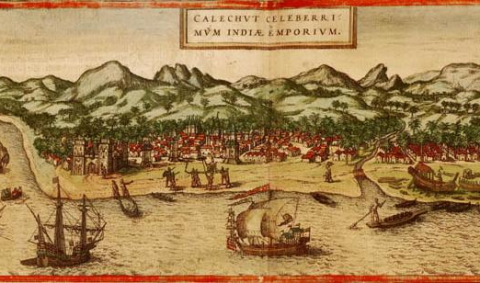
Calicut_1572
(Calicut as seen in 1572)[1]

On May 21, 1498, two Tunisian merchants in Calicut, Kerala, were surprised to see a European from Algarve,  the southernmost region of mainland Portugal, walk into their house. Their conversation went like this

Tunisian: “What the devil brought you here?”
European: “We came in search of Christians and spices.”

The European was a degredado, a felon or an outcast like a converted Jew. As Europeans renewed world exploration once again in the 15th century, degredados, who were considered expendable, were first released onto the shore in strange lands. If this volunteer came back with his body parts intact, the brave sailors would follow.[2]

This particular degredado had landed from a Portuguese ship and people of Calicut who were used to seeing foreigners knew that he was not Chinese or Malay. Suspecting that he was from the Islamic world they threw a few Arabic words at him and seeing no response, they took him to the house of the Tunisian merchants. Since the man was not harmed, the commander of the Portuguese carrack São Gabriel, Vasco da Gama, set foot on the ground in Kerala and became famous for doing what Christopher Columbus set to do five years back — naming random places, India.

If Vasco da Gama and the Tunisian merchants were to land in present day Calicut, they would be amused to see posters opposing globalization and anti-globalization rhetoric in the words of the rulers. The shocked foreigners would have told Malayalees that Kerala was a globalized land much before the time of Buddha till the 17th century and was wealthy too. Even the degredado, who would have known more history, would have rolled in Kapad beach hearing one of those Achyutanandan sing song speeches.

Continue reading “The Spicy History of Malabar”

Indian History Carnival – 2

carnival-2

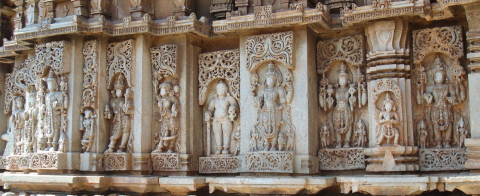
(Image from the Hoysala trail by backpacker)

The Indian History Carnival, published on the 15th of every month, is a collection of posts related to Indian history and archaeology.

  1. Sukumar finds a connection between Gonds and Australian aborgines. He says Gonds are one of the oldest people in India.

  2. Dr. James F. McGrath wrote, “the Aryans were, most probably, well-established in India long before the purported Aryan invasion would allegedly have occurred.” Here at varnam we analyzed The Genetic Distance between Karunanidhi and Mallika Sherawat .

  3. Dr. Arvind Sharma quotes Greek and Latin sources to write how Greeks perceived the Indians, and how the Indians perceived themselves, in or around the fourth century B.C.E. “The point which stands out clearly from these accounts is that the Indians are considered a diverse and polyglot people.”

  4. Rastrakutas are of Kannadiga origin.

  5. Manish Khamesra has Part 1 of his travel to Fatepur Sikri. “This magnificent fortified city, built between 1565-1585, was the capital of Mughal Empire for around 15 yrs during Akbar’s reign.” (via Desi Pundit)

  6. Backpakker has images of the Holy Rosary Church built by French Missionaries around 1860. (via Desi Pundit). She also has images from the Hoysala trail (1,2,3)

  7. Rohit finds a 29th December 1930 speech by Muhammad Iqbal in which he expresses the philosophical basis for Pakistan. Gaurav thinks, “that (dubious) honour goes to speech given in 1888 by Sir Syyed Ahmend Khan to a gathering of Muslim intellectuals”

  8. Ratheesh has a short review of John Keay’s India Discovered. “I think India Discovered is also a must-read for every Indian to understand how our glorious past was discovered, studied and protected by foreigners, who didn’t always have great support from their Governments.”

  9. Rohit also has a post which shows that Gandhi made Nehru India’s first Prime Minister.

  10. Dr. Bhaskar Dasgupta came across a paper on the partition of India written by a famous professional geographer, Oskar Spate who  served on the Punjab Boundary Commission. It explains how various parts of the country were divided between Indian and Pakistan.

  11. Dr. Subrato Roy writes about the lessons from the 1962 war.
  12. Delhi Assembly Deputy Speaker Shoaib Iqbal has demanded that Bharat Ratna be conferred on the last Mughal Emperor Bahadur Shah Zafar. B. Shantanu thinks it is more than a joke.

If you find any posts related to Indian history please send it to jk AT varnam DOT org or use this form. The next carnival will be up on March 15th.

Previous Carnivals: 1

Technorati Tags:

Much About History

Randy Cohen who writes the Ethicist column in New York Times got the following question

I’m a history professor — my period is 1500-1800 — with an M.A. student who wants to pursue a doctorate. While she is smart and capable, she is very religious, subscribing to the “young earth” theory that the world is only 6,000 years old. I am to work with her for a year and then recommend her to Ph.D. programs. Must I do so if I find her views incongruent with those of historians? [Randy Cohen – The Ethicist – New York Times]

It is shocking to see that in the year 2008, there are Ph.D students who believe in fairy tales, then if you have graduated from one of those schools where creationism is taught as science this is not surprising. Mr. Cohen advices the professor to teach her Sumerian history and is confident that the student will have a eureka moment when she discovers that the Sumerians could not have accomplished so much immediately after the earth was formed.

Randy, two words: Max Müller. He had a Ph.D on Spinoza‘s Ethics, was the founder of Indian studies in the western world and the creator of the discipline of comparative religion, but believed that all languages can be traced to the Tower of Babel, Indians were populated by the descendents of Japhet and Christianity was a true historical event. His  biblical beliefs resulted in dating the hymns of Rig-Veda being to 1000 B.C.E., and this 19th century paradigm is still widely held.

If the professor, following Randy’s advice, tried to teach a student who believes that earth was created on the night preceding October 23, 4004 B.C.E, Sumerian history, the most likely outcome is that the student will rewrite history to fit in with the Biblical narrative.

Technorati Tags: , ,

Archaeology and Mythology

Recently an underground cave dedicated to the founders of Rome – Romulus and his brother Remus was found between one of the seven hills of Rome and the Basilica of Santa Anastasia. Does this mean that the story of the two brothers are not myth anymore or can archaeology prove mythology?

“Everyone always wants to think that archaeology has proved the Bible is true, or that there really was a Trojan War, or that King Arthur was a real character,” says historian T.P. Wiseman of England’s University of Exeter. “Archaeology by its nature can’t provide such evidence.” He says that when archaeologists interpret an artifact, their expert perspective is essentially a best guess, because there’s no means of confirmation. Historian Christopher Smith of Scotland’s University of St. Andrews notes that even if artifacts clearly reference the Romulus and Remus story, all they will show is that the cavern is a place where first-century Romans celebrated the legend — not that the story is real. “It is tempting to argue that the finds support historical events,” Smith says, “when in fact they merely support ancient beliefs about events.”[ Does a cave prove Romulus and Remus are no myth? – USATODAY.com]

The Troy was considered a mythological place till German businessman,Heinrich Schliemann found a site in Turkey which is now accepted by historians. German archaeologist Manfred Korfmann who has been excavating in Troy wrote

According to the archaeological and historical findings of the past decade especially, it is now more likely than not that there were several armed conflicts in and around Troy at the end of the Late Bronze Age. At present we do not know whether all or some of these conflicts were distilled in later memory into the “Trojan War” or whether among them there was an especially memorable, single “Trojan War.” However, everything currently suggests that Homer should be taken seriously, that his story of a military conflict between Greeks and the inhabitants of Troy is based on a memory of historical events–whatever these may have been [Was There a Trojan War?]

Archaeology could not prove that the Trojan war happened for sure, but it came up with the answer that it could have happened. 

Technorati Tags: , ,

Don't bet against the Tatas

Osamu Suzuki is a wise man for he did not say that he would eat every Tata Nano that would be manufactured. He just said that it was impossible. He probably learned not to take wild bet against Indians from Sir Frederick Upcott who was the Chief Commissioner of Railways in 1907.

When Sir Upcott was informed that Jamsetji Tata was planning to start an iron and steel mill, he said, ‘Do you mean to say that the Tatas propose to make steel rails to British specifications? Why, I will undertake to eat every pound of rail they succeed in making’. Tata Steel was established in 1907 by Dorabji Tata who later commented, ‘Sir Frederick Upcott would have had a slight bout of indigestion’ since Tata Steel shipped about 1500 miles of steel rails to Mesopotamia during Word WarI[1]

[1] Sharada Srinivasan and S. Ranganathan(2004). India’s Legendary Wootz Steel: An Advanced Material of the Ancient World

Sanskrit in Nevada

Mahatma Gandhi said, “Without the study of Samskrit one cannot become a true Indian and a true learned man.” Nehru, surprisingly said, ““If I was asked what is the greatest treasure which India possesses and what is her finest heritage, I would answer unhesitatingly that it is the Samskrit language and literature and all that it contains” and Dr. S Radhakrishnan was of the opinion that, “Samskrit has moulded the minds of our people to the extent to which they themselves are not conscious.” Now when you hear Washoe County, Nevada has proclaimed Jan 12 as Sanskrit Day, you wonder if it is a scene from a Harold and Kumar movie.

This happened due to the efforts of Rajan Zed, the Hindu priest of Nevada whose prayers in the Senate were disrupted by anti-abortion activists. According to the proclamation by the county, “As Hinduism expands in the West, it is important that to understand Hinduism, one should have a working knowledge of Sanskrit.” The press release also notes correctly that Buddhist and Jain scriptures were also written in Sanskrit.

Another revelation due to this program was the existence of the only Sanskrit Rock Band in America, “Shanti Shanti“, consiting of two sisters, Andrea and Sara Forman.

Technorati Tags: