In 1524, the Moors attacked the Jews of Kerala and burned their houses and synagogues. Due to this incident, the Jews left the place where they had originally settled — Anjuvannam — and moved to Cochin. The Rajah of Cochin gave them a site for a town right next to his palace and temple. The Jew town was created in 1567 and the synagogue in 1568. Even now the palace (now a museum) and the temple exist, right next to the synagogue in Jew town.
[nggallery id=1]
These photographs were taken during a recent visit. It is forbidden to take photographs inside the synagogue, and so the two inside images are from the post cards they sell in the gift shop. They also sell a facsimile of the copper plates by which the Rajah granted them land and one photograph is from my copy of those plates.
Author: जयकृष्णः | ജയകൃഷ്ണൻ
Godesses around the world
The earliest inhabitants of India worshipped a Mother Goddess and a horned fertility god. Godesses are also mentioned in the Rg Veda like Prthvi, Aditi, Usas, Rathri and Aranyani. While godesses are still worshipped in Indic religions, they have largely disappeared from the West after the arrival of the Abrahamic religions.
But this was not the case before; female worship was prevalent all around the world. Recently three such artifacts were found: in Turkey, in Golan and in Scotland.
The one in Golan, dated to 500 CE, was of Aphrodite – the Greek goddess of love. (see pictures)
“Aphrodite was the goddess of love, but also the goddess of fertility and childbirth,” Segal says. “Pregnant woman hoping for a safe birth would sacrifice to her, as would young girls hoping for love. Mainly, flowers, rather than animals, would be sacrificed to Aphrodite. The figurines we found were made in a mold in rather large numbers. They would be offered to the goddess in a temple by supplicants, or kept above one’s bed,” Segal said. [Dig unearths ancient cult figurines of Aphrodite]
According to the person who led the dig, Christians outlawed the Aphrodite cult, but it still survived since women clung to it.
While the Aphrodite figurine is just 1500 years old, the one found in Turkey is ancient, dating to 16,000 years back.
Erek said that the figurine showed that the social status of women was very important 16,000 years ago. Erek noted that the oldest fired clay god or goddess figurines –unearthed in Mesopotamia, Anatolia and Near East– were made in 5,000 BC. He added that experts believed that the clay was used earliest in that period, however, the goddess figurine showed that this method was older than thought. [16,000 Year-Old Mother Goddess Figurine Unearthed]
Finally, a sandstone figurine, 5000 years old, was discovered in Scotland and it is supposed to Scotland’s earliest face.
The carving is flat with a round head on top of a lozenge-shaped body. The face has heavy brows, two dots for eyes and an oblong for a nose. It is thought other scratches on top of the skull could be hair. A pair of circles on the chest are being interpreted as representing breasts, and arms have been etched at either side. It is believed a regular pattern of crossed markings on the reverse could suggest the fabric of the woman’s clothing.[Scotland’s ‘earliest face’ found]
The Man who came to destroy Hinduism – 2
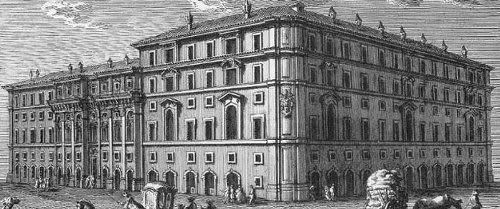 |
| The headquarters of thePropaganda fide in Rome |
(Read Part 1)
It would be wrong to say that at that point in time Indians of the 1830s hated English. At the Hindu college, which was established by Indians, the British themselves admitted that the English education was as good as any school in Europe. When the Government decided to establish a new Sanskrit college in Calcutta, Ram Mohan Roy was disappointed. He wanted Indians to learn European math, science, chemistry instead of “grammatical niceties and metaphysical distinctions”.
After further objections to the “imaginary learning” of Hindu schools, he [Ram Mohan Roy] summarily assures Lord Amherst that “the Sanskrit system of education would be the best calculat- ed to keep this country in darkness.” What he wants to see established is “a more liberal and enlightened system of instruction, embracing mathematics, natural philosophy, chemistry, anatomy, with other useful sciences.” This, he urges “may be accomplished with the sums proposed, by employing a few gentlemen of talent and learning educated in Europe and providing a College furnished with neces- sary books, instruments, and other apparatus.” [The life and letters of Raja Rammohun Roy]
Mohan Roy’s letter to Lord Amherst did not get an answer. By then the fight between the Anglicists and Orientalists had reached a point where a decision had to be made. Macaulay arrived on the scene in 1834 and he had a clear idea about the future direction. Also Duff’s independent efforts had convinced Macaulay that an Anglical education system would succeed.
Macaulay was of the opinion that there was no point in perfecting the vernaculars, since there was nothing intelligent, but falsehood in them. In his Minute, he noted that he had no knowledge of Sanskrit or Arabic, but was convinced that a single shelf of a good European library was worth the whole native literature of India and Arabia. On the other hand, whoever learned English had access to the vast intellectual wealth of the wisest nations of the earth and the literature available in English is valuable that the literature of all languages of the world together.[Macaulay’s Education Part 3: The Minute]
Lord William Bentinck signed Macaulay’s draft into law. While the goal of British Government was to promote European literature and science, the Oriental schools were not to be closed. Instead it was decided not to subsidize the students. The large amount of money spent on printing Oriental books were to be stopped and the money instead was to be used for promoting European literature.
Duff had already done this without any Government support and had solved many problems which the administration would face later. When a medical college was established in Calcutta there seemed to be a problem since Hindu shastras prohibited touching a dead body for anatomical purposes. To find a way out, the education commission visited Duff’s school. The students told the commission that it was a fact that shastras prohibited handling of a dead body, but they did not care. They wanted to take up the medical profession. Later orthodox priests told William Bentinck that there was no prohibition against touching a dead body for learning, but Duff was praised for showing that modern science was compatible with traditionalism.
Continue reading “The Man who came to destroy Hinduism – 2”
The Man who came to destroy Hinduism – 1
On Jan 15, 1823, Jean-Antoine Dubois, a French-Catholic missionary, who spent time in Pondicherry, Madras Presidency and Mysore left India for Paris, never to return again. During his time in India, he dressed like a native and preached the Gospel, but after 30 years in India, he was convinced that it was next to impossible to convert Indians.
But seven years later, on May 27th, 1830, a Scottish missionary arrived in Calcutta and his goal was to “prepare a mine which should one day explode beneath the very citadel of Hinduism.” This 24 year thought that the methods of other missionaries, like directly appealing Hindus to renounce their faith, would do nothing but anger the natives. Instead he claimed to have found a unique way to destroy Hinduism in a peaceful manner.
To understand how Alexander Duff came up with his recipe, we need to understand the India of 1830s.
- The language of the Government was Persian and there were a few educational institutions which taught Arabic and Sanskrit. The learned people spoke these Oriental languages and not English.
- Duff arrived at a time when there was a controversy in British India over the language to be used for Indian higher education. On the one side there were the British Orientalists who wanted to use Sanskrit, Persian and Arabic and on the other side there were the Anglicists who had scorn for Oriental languages and Indian culture and wanted to enforce English
- The missionary activities were not very successful. The missionary technique consisted of standing in the street corner and preaching which fetched an occasional convert or two, but nothing of great significance. Even in South India, where there were more converts, the converts came from the out castes; the Hindu masses remained unaffected.
Duff would take all these three ingredients to come up with a winning formula, which was eventually endorsed by the Lord himself – I mean Lord Macaulay. Looking back, the formula was simple.
- Provide English education for the masses
- Make Bible studies an integral part of this education
- Be non-apologetic about teaching Christianity.
Thus he would teach Western history, philosophy, and natural sciences and as per the plan Hindus seeing irrationality in their religion would discard their faith voluntarily. But this was tricky business. It was possible that a Hindu who had left Hinduism due to Western education could become agnostic. But Duff would fill that spiritual vacuum with the Christian view of life.
Duff was very clear about what Christian education meant: it was not secular education with some Biblical studies thrown in. For him Christianity contained all knowledge and his goal was to teach with Christianity revelation at the center.
 When Duff first proposed this method, veteran missionaries did not find it appealing. Still he went ahead without any government support. Bengalis did not mind an English school, but had reservations about an English school where Bible was an important subject. This reservation made it difficult for Duff to get started; he could not even find a building to start his classes.
One Indian who helped get Duff was Raja Ram Mohan Roy. Mohan Roy who worked with Lord William Bentinck in suppressing sati and who believed that the pure faith of the vedas were corrupted by various cults had founded Brahma Samaj to teach the worship of one God. Ram Mohan Roy provided Duff with a hall as well as his first students. When parents learned that Bible was being taught there, they were reluctant to send their kids, but Ram Mohan Roy helped there as well. On the first day of school, Ram Mohan Roy, who had three more years to live, calmed the students who refused to read the Bible and appeared daily for the Bible class.
Though Duff was a proponent of higher studies in English, he did not hate Bengali. He did not want students to be alien to their culture and hence Bengali studies were an important part of the curriculum. After one year, Duff conducted a public exam – in front of parents and the media – and students demonstrated their knowledge in language, science and Bible. This was a huge success and it convinced both Indians and the British. Soon the number of students started increasing.
Not everyone in Calcutta was his fan. One of the newspapers published an article suggesting that all students who attended Duff’s school be outcasted. This warning had an effect and the attendance dropped briefly, but later picked up.
Soon Duff encountered students —- not from his school, but from the Hindu college — who were enamored by Western thought and had a low opinion of Hinduism. These were the kind of people Duff wanted to seed Christian religion into and he invited them to his home to attend lectures on “God and His Revealing.” Hindus reacted strongly against Duff and asked the Government to stop this. Lord William Bentinck asked Duff to slow down and this crisis too passed.
But soon Duff got his converts — Krishna Mohan Banerjee, Mohesh Chunder Ghosh, Gopinath Nandi and Anando Chand Mazumdar — and as he had expected they came from the higher castes. Some of them were Brahmins who ate beef to show their defiance against Hinduism and whose moral vacuum was happily filled by Duff.
By this time the Orientalist-Anglicist fight had reached critical mass. The East India Company needed a supply of qualified clerks and there were educational institutions like the Mohammedan college in Calcutta and Sanskrit college in Benares which provided the employees. The company even started a new Sanskrit college in Calcutta and Oriental colleges in Delhi and Agra. A large sum of money was spent in publishing books in the Oriental languages and translating European works into these languages. For the amount of money spent on education, there was not enough demand for these books.
In the language fight, the Government, missionaries and Orientalists wanted to use the Oriental languages, while Duff sided along with the Anglicists. If Indians were to learn Western culture and Christian theology, he said, it was not possible to do it in Sanskrit, Arabic or Persian or the vernacular Bengali. This decision on which language to choose for Duff was very critical and in a later speech given in Scotland, he said that it concerned the ultimate evangelization of India.
His arguments against Sanskrit were that (a) it was not perfect for Western education (b) ordinary people did not speak Sanskrit and (c) Western literature was not translated to Sanskrit. Since Sanskrit was tied to Hinduism, even if one were to teach Western literature in Sanskrit, the association formed in the mind of people would of an idolatrous and superstitious religion whereas English, would bring fresh ideas without the burden of association.
(Read Part 2)
Indian History Carnival – 20
The Indian History Carnival, published on the 15th of every month, is a collection of posts related to Indian history and archaeology.
- Where do Nairs come from? Maddy does a literature survey and “To summarize, the Nayars have been considered a derivative of local people with invading Aryans, have been wandering Scythins who settled down, the Nagas and so on. No one theory holds forte, though from all the above, the Scythian link seems to be the near fetched one”
- In a recent article in the Wall Street Journal, Paul Beckett wondered why Indians were not contributing to charity like Americans. He also used the derogatory term “Hindu rate of growth” to which Sarvesh Tiwari responds, “Here we shall share some random thoughts from the historical perspectives on Hindu outlook to economy and charity, and try showing how, there is continuity even today, although latent, of the same outlook prevailing among the more traditional Hindu shreShThins of our age.”
- The effort to set up a Sanskrit University in Karnataka is facing considerable opposition. Sandeep B says, “Sanskrit is what gives identity to the Indian civilisation as we know it. From Valmiki to Kalidas, every major Sanskrit literary work spoke of this identity in its own way.”
- History and Mythology, a blog about Amar Chitra Katha, has a post about Chandragupta II: “He is almost certainly the King Chandra eulogized in the Sanskrit inscription on iron pillar in the Quwat al-Islam mosque in New Delhi’s Qutub Minar campus, which dates back to 4th century.”
- “Located near the city of Jogjakarta on the island of Java, it’s a stunning remnant of the days when the Dharmic religions were politically ascendant in the islands. It was commissioned and built between 800 and 900 CE by the local monarchs so that devotees need not travel all the way to India for spiritual pilgrimage.” Usha Alexander writes about the Borobudur stupa.
- “In 1193 CE, Nalanda was put to a brutal and decisive end by Bakhtiyar Khilji, a Turkish Muslim invader on his way to conquer Bengal. He looted and burned the monastery, and beheaded or burned alive perhaps thousands of monks,” writes Namit Arora on his post on Nalanda.
- Feanor has translated Afanasii Nikitin’s fifteenth century memoirs of his travel to India. Nikitin was a merchant from the Mongol areas of Russia. He had heard that horses were in demand in India and spent few years in Deccan.
- Hari, based on Vaasanthi’s Cut-outs, Caste and Cine Stars, looks at the life of MG Ramachandran (1917-1987), “one of the most important figures of Tamil politics, who, with help from other prominent leaders of the Dravida Munnetra Kazhagam (DMK), including the crafty script writer Karunanidhi, seamlessly moved between cinema and politics as if the two were one.”
f you find any posts related to Indian history published in the past one month, please send it to jk AT varnam DOT org. Please send me links which are similar to the ones posted, in terms of content.The next carnival will be up on Sep 15th.
See Also: Previous Carnivals
The Exile Effect
The Biblical narratives are very clear about certain events like the Exodus, the origin of the Israelites, and Joshua’s military conquest of Caanan. There was a PBS documentary – Bible’s Buried Secrets (1, 2) – which found no evidence of Exodus, no evidence of Joshua’s conquest and that the Israelites were not migrants from outside, but natives of Caanan. Now the focus on the origins of Israel has shifted from the Late Bronze and Iron ages to the Persian period. According to one paper, “The earlier assumption that Israel emerged as a social entity before the 6th century b.c.e. has been labeled a ‘myth’. ”
The earlier assumptions are now being questioned because the biblical narrative was not able to withstand examination by archaeological data.
According to the PBS documentary, the Hebrew Bible was formed during the Babylonian exile.
Israelites were reminded that they had broke the covenant with God and hence were incurring his wrath. Still this was not taken seriously till the time the Babylonians exiled the Caananites. It was during this exile that one of the scribes of that era, known as “P”, took all the previous revisions and created the present version of the Bible. The documentary suggests that the Abraham story was created then, by this scribe, to enforce the concept of the covenant. The scribe lived in
Babylon and Abraham was placed in the nearby Ur; Abraham’s goal was to reach the promised land, so was the dream of the exiles. [Bible’s Buried Secrets (2/2)]
Some people think of this period as the origin of Israel, but a new paper on the Persian origins makes it clear on what exactly happened after the exile.
Yahwism after the Exile experienced discontinuity of iconographic practices and matured as it consolidated its sacred literature.Stern (2001: 29) insists that “upon the return from exile, the Jews purified their worship. Jewish monotheism was at last consolidated.” This assumes that there were no iconographic representations of Yahweh
after the Babylonian deportation. The archaeological and textual evidence supports pentateuchal Yahwism as the official, normative religion that was practiced by the majority, even though there are some iconographic representations from the Persian period that require more detailed discussion. The Persian period seems to be the time when the prohibition on representation of Yahweh was particularly widespread. Pentateuchal Yahwism thrived and became the norm that would be followed by the world’s major religions: Judaism, Christianity, and Islam. [The Persian Period and the Origins of Israel: Beyond the “Myths”]
Smithsonian on Indus Script
Ever since Rao et al. published that the Indus script showed the structure of a formal language, a new debate on the topic was initiated. There were some hostile reactions to this paper. Now, Smithsonian has published an article on the topic which presents the findings in a positive way.
After publishing the paper, Rao got a surprise. The question of which language family the script belongs to, it turns out, is a sensitive one: because of the Indus civilization’s age and significance, many contemporary groups in India would like to claim it as a direct ancestor. For instance, the Tamil-speaking Indians of the south would prefer to learn that the Indus script was a kind of proto-Dravidian, since Tamil is descended from proto-Dravidian. Hindi speakers in the north would rather it be an old form of Sanskrit, an ancestor of Hindi. Rao’s paper doesn’t conclude which language family the script belongs to, though it does note that the conditional entropy is similar to Old Tamil—causing some critics to summarily “accuse us of being Dravidian nationalists,” says Rao. “The ferocity of the accusations and attacks was completely unexpected.” [Can Computers Decipher a 5,000-Year-Old Language?]
Indian History Carnival – 19
The Indian History Carnival, published on the 15th of every month, is a collection of posts related to Indian history and archaeology.
- Ravi Mundoli summarizes the current debate on the Indus script: “Seems like the lay person can’t do much other than remember that everyone has an axe to grind, and while one needn’t reject everything everyone says out of hand as being motivated by extraneous, non-academic/scientific reasons, it’s good to examine the evidence keeping in mind who is doing the analysis.“
- Sandeep scanned through the NCERT history books and found appalling distortions. In his post he goes through four examples.
- Three years back, the Kannada actress Jaimala triggered a major controversy when she said that she had entered the sanctum santorum of Sabarimala. varnam writes aboutMt. Athos in Greece where even female animals are not allowed
- There have been debates on of if Marco Polo visited China, but now Calicut heritage asks if Marco Polo visited Calicut?
- Sarvesh K Tiwari’s series
on Akbar’s U-Turn continues with a look at Sufis. “Their islamization was to however complete soon, and whatever the origins of their real traditions, the later sUfI-s came down to become zealous missionaries of Islam, often displaying no lesser bigotry than the orthodox ulemA” - Nick Balmer continues his investigation into the coffee plantations of Mananthavadi: “Henry Baber was not the first person to grow coffee at Mananthavadi. As far as it is possible to tell, that honour belongs to Captain Henry Bevan, who was appointed in April 1825 to command the Wynaud Rangers, a force set up from the recently disbanded Seringapatam local battalion.”
- Maddy looks at Sardar K M Panikkar’s contributions – in the Tibet issue, creation of a naval doctrine — and his relationship with Nehru and Krishna Menon.
f you find any posts related to Indian history published in the past one month, please send it to jk AT varnam DOT org or use this form. Please send me links which are similar to the ones posted, in terms of content.The next carnival will be up on Aug 15th.
See Also: Previous Carnivals
In Pragati – Book Review: Adventures of Ibn Battuta
The Adventures of Ibn Battuta: A Muslim Traveler of the Fourteenth Century (Paperback), by Ross E. Dunn, 379 pages, University of California Press; 1 edition (December 9, 2004)
The first thing that Prof Matthew Herbst asks students to do in the introductory lecture of the series New Ideas/Clash of Cultures at University of California, San Diego is to draw a map of the world and label as many countries as possible. A minute later they are asked to keep their pens down and name the country at the centre of the map. Some have Italy, a few have North America, and some the Atlantic Ocean.
This instinctive action, which illustrates the cultural bias of historians, is amplified if education starts with the typical Western Civilization till 1600 followed by the Western Civilization since 1600 course. A student could thus specialise in the Ancient Near East with tangential knowledge about India, China, Africa, or the Muslim empires.
Affinity towards one’s homeland is natural, but it should be balanced with knowledge about other civilisations. It is natural that for Indians, the centre of their world is India, but when they read about the Buddha, knowledge of the Axial age — when Socrates, the Jewish prophets, and Confucius revolutionised thinking — gives better perspective. Such perspective provides awareness that the empiricism of John Locke and scepticism of David Hume could be derived from the dialogue between Indra and Prajapathi in Chandogya Upanishad. Proper context for local history will be obtained by taking an introductory course in World Civilisation instead of Western Civilisation, as well as by reading the works of ancient travellers like Ibn Battuta.
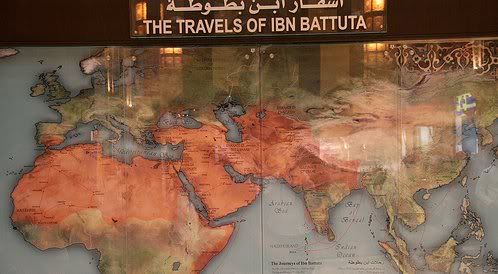
 In 1325, this twenty-one year old Moroccan left home to perform the haj. In fact he visited Mecca four times—first from Morocco via North Africa, Egypt, Palestine and Syria, the second after visiting Iraq and Persia, the third after going down the Swahili coast up to Tanzania and the final one after visiting Anatolia, Delhi, Calicut, Maldives and China. When he returned to Morocco, surviving the Black Plague that devastated Europe, he had visited about forty countries in the modern map covering a distance of 117,000 km.
Settling down in Tangier he collaborated with a young literary scholar, Ibn Juzayy, to compose the rihla—a book of travels in Arabic literature—about his impressions of all the countries and his experience which included working as a judge for Mohammed bin Tughluq, becoming penniless near the Doab, and attempting a coup in Maldives.
Since Ibn Battuta wrote his rihla towards the end of his itinerant career, some details are incorrect and fuzzy; after visiting Constantinople, Ibn Battuta was impressed by the markets, monasteries and the Genoese colony of Galata while in reality, by that time, it was a city on the decline. Also his book is not an encyclopedia; he wrote about things which fascinated him, like saints, life among the upper crust of society, and Muslim culture.
So using the rihla as spine, Ross E Dunn has fleshed out this book by providing the history of each city that Ibn Battuta visited. The chapter on Anatolia provides a brief history of the transformation of a country of Greek and Armenian Christians into Turkey and the sections on Cairo and Delhi provides background information on how they both rose to prominence, thanks to the Mongol empire. Since Ibn Battuta’s objects of fascination were few, Dr Dunn juxtaposes the missing pieces from other history books and writings from other travellers like Simon Semeonis, Ludolph von Suchem, and Ibn Jubayr, making this book comprehensive.
Ibn Battuta’s World
 Some time after the first haj Ibn Battuta heard about India’s riches and wanted to seek employment there. He already had exposure to Indians; some selling drugs and food items in Mecca, some as pages accompanying Princess Bayalun of the Golden Horde, and some scholars in Oman. He knew that Indian ships sailed to Aden regularly. He also knew that the Delhi Sultanate welcomed foreigners and paid well.
It is interesting to contrast some of the places Ibn Battuta visited with their current state. Mogadishu, currently invokes the images of civil war, militias and poverty, but at the time of Ibn Battuta’s visit, it was one of the richest ports owing to the connections with the Horn of Africa and Ethiopia. Ibn Battuta met the ruler, Abu Bakr, who wore a “robe of green Jerusalem stuff” above “fine loose robes of Egypt with a wrapper of silk.” During a meal of chicken, meat, fish, green ginger, mangoes and pickled lemon, he observed that a single resident of Mogadishu ate more than a whole company of visitors.
While the Mongols had reduced Baghdad to a small provincial town, Cairo was prospering under the Mamluk Sultanate—members of a slave dynasty—due to the Red Sea trade. Jerusalem, which was under Mamluk control, was a small town of no great importance; Ibn Battuta spent a week there meeting various scholars and Sufi masters. By the time he arrived in Delhi, Mohammed bin Tughluq, who had succeeded a Slave Dynasty, had finished his experiment in shifting capitals. A seven year drought and the first of the twenty-two rebellions that would bring his downfall was about to start.
On his first visit, the sultan’s mother gave Ibn Battuta 2000 silver dinars. Even before he got the job of the judge, Tughluq ordered him to be paid 5000 silver dinars and the revenue from two villages. On his appointment, he got 12,000 dinars as perquisite with an annual salary of 12,000 dinars. According to Dunn, at that time an average Hindu family lived on 5 dinars per month; a soldier, 20.
Even though he was rich, the cost of living in Delhi was high. The hamster that kept the Delhi’s economic wheel turning, much like the present, was sycophancy. Nobles borrowed money to buy expensive gifts for the sultan and other nobles, who then reciprocated with gifts of higher value. Soon Ibn Battuta amassed debts of more than 55,000 dinars to get out of which, quite interestingly, he composed an ode to the Sultan.
Also he faced first hand the job risks in working with a pixilated Sultan. Tughluq took umbrage at Ibn Battuta’s association with a Sufi ascetic who had fallen out of favour. Tughluq first got the ascetic’s beard plucked hair by hair, then later tortured and beheaded him. Ibn Battuta was put under house arrest for nine days and expected to be executed. Surprisingly he was freed and entrusted with a mission to China.
 Arriving in Calicut and Quilon on his way to China as the Mughal emissary to the Mongol court carrying a gift of 200 Hindu slaves, he found that the entire trade of the Malabar and Coromandel coast was controlled by Muslims. He also found that the Hindu rulers of those provinces allowed Muslims to worship as they pleased and encouraged these trade communities. Also, similar to the frequent battles between the countries on the African coast, battles among small provinces along the Indian west coast was also common and Ibn Battuta participated in the battle by Honavar against Sandapur (Goa).
Ibn Battuta’s travels showcase the importance of Muslim trade networks and the prosperity it bought to the trading communities in India and elsewhere. He travelled during a period of relative calm; the crusades were over, the Mongols were Islamised and the Muslim caravan routes throbbed with activity carrying not just merchants, but scholars, craftsmen, Sufis and converts. Thus a Muslim grandee seized by wanderlust could travel through Dar al-Islam staying in mosques, or with the scholars, kings, and saints receiving gifts of robes, horses and camels.
The relative peace during Ibn Battuta’s time soon changed. In China, Genghis Khan’s heir fled with his entire court unable to halt the advance of the rebels. The Ottoman Turks captured Constantinople and turned the Hagia Sophia into a mosque. Timur invaded Delhi and by his own account killed 10,000 infidels in an hour. The most important event happened, a century later, in the Malabar coast with the arrival of Vasco da Gama’s fleet. This was not just a great navigational feat, but a major geo-political event by which Europeans cut off the Muslim middlemen.
Dr. Dunn’s book presents Ibn Battuta’s world not in isolation, but in a global context helping us better understand the world of 14th century. It is not surprising that this book was required reading in Prof. Herbst’s class.
Image Credits: cgsheldon, lloydi, 
(This review appeared in the June 2009 edition of Pragati)
Vandalism of Tamil-Brahmi sites
Recently on the ancient trade path from Madurai to Kerala, archaeologists discovered pottery with Tamil-Brahmi inscription.
Epigraphists have deciphered the three Tamil-Brahmi letters on the ring-stand as “vayra,” which means diamond. The deep-set cist-burial, which has two compartments made of granite slabs, was found to have skeletal remains. A pair of stirrups lay next to the ring-stand. The symbol that followed the three Tamil-Brahmi letters showed an etched gem and bead, with a thread coming out of the bead. According to Mr. Mahadevan, the script could be dated to the first century A.D. [The Hindu : Front Page : Tamil-Brahmi script found in village]
Finding this inscription has been rather lucky because quarrying and vandalism has been destroying Tamil-Brahmi sites.
Tiruvadavur is now the most disturbed Tamil-Brahmi site in the State, with a huge quarry situated right at the foot of the hill. Quarrying has progressed so deep that the site looks like an open-cast mine. All round the quarry, for several kilometres, granite blocks as big as a truck or a car, are stacked on either side of the village roads. There is a surreal scene too: a nearby hill has been sliced in half, as if it were a cake. An official of the State Archaeology Department admitted that quarrying was under way within the prohibited/regulated area, that is, within 300 m of the protected limits of the monument.[History vandalised]
So why is Tamil-Brahmi so important?
Tamil-Brahmi inscriptions are important not only in the history of Tamil Nadu and the rest of South India but for the whole country. They have many unique distinctions. They are the oldest writings in any Dravidian language. They are also the oldest Jaina inscriptions in India. I believe that the Mankulam Tamil-Brahmi inscription of [Pandyan king] Nedunchezhiyan is older than the Karavela inscription at Udayagiri in Orissa.
Tamil-Brahmi inscriptions are the only record of the old Tamil, the one prior to Sangam poetry. Many Tamil-Brahmi inscriptions are important landmarks in our history. For example, the inscriptions of Nedunchezhiyan at Mankulam, the Irumporai inscriptions at Pugalur near Karur and the Jambai inscription of Adhiyaman Neduman Anji link the Sangam age with the Tamil-Brahmi age. It is the Jambai inscription that prove that the “Satyaputo” mentioned by Asoka was none other than the Adhiyaman dynasty, which ruled from Tagadur, modern Dharmapuri.[‘Tamil-Brahmi inscriptions are the only record of old Tamil’]