Bye Bye Somini

Who thought that Aravind Adiga winning the Booker Prize would have such serious after shocks.? Our beloved New York Times Delhi bureau chief Somini Sengupta is leaving her position. The news of the transition of this South Asian reporter was published on the SAJA forum, a site covering “South Asians”, an imaginary species.

For almost four years Ms. Sengupta worked tirelessly to prove to fellow “South Asians” that “India” was not shining. Her propensity to cover the downtrodden and the ones who were stomped on by upper class members of the Hindu caste system was unparalleled. Sadly that nectar is insufficient for winning awards these days. 

The new man in town is Pulitzer Prize-winner Jim Yardley who comes from the Beijing bureau. A person from any other bureau would have been highly insulting. We hope Mr. Yardley realizes that the cheat sheet has limitations – it cannot even win you a Nehru-Gandhi peace award.

Ms. Sengupta spawned a cottage industry of satirists and social scientists who won’t have, to paraphrase an American President, “Somini to kick around anymore.” The revival of our cottage industry depends on Mr. Yardley’s ingenuity; we will be watching with bated eyelids. Ms. Sengupta meanwhile is moving to Amsterdam, an arcadia, where countless people have found salvation thinking about “social” issues.

Off to the Moon

As the debate continues on if it is prudent to spend money on space missions while there are other needs, it is worth reading how NASA helped invent Silicon Valley.

But if you’d visited the region in 1930, all you’d have seen was a two-lane highway cutting through acres and acres of nothing but farmland and tiny hamlets, and not even a hint of what would someday become arguably the most important commercial technology center in the world.

In December of that year, however, word came that the U.S. Navy was going to open an air station in Sunnyvale, Calif., one that would handle gigantic airships and that would need a mammoth hangar.

The result? The Sunnyvale Naval Air Station, later known as NASA Moffett Field. And today, Moffett is home to NASA’s Ames Research Center, a facility that is at the heart of Silicon Valley, both geographically and figuratively. In 1930 the region didn’t know what was about to arrive, but it soon realized how much change was coming. [How NASA helped invent Silicon Valley – CNET News]

Book Review: Akhenaten

Akhenaten: Dweller in Truth A Novel by Naguib Mahfouz, Anchor (April 4, 2000), 176 pages


In 1989, M T Vasudevan Nair wrote an interesting movie named Uttaram (Answer). In the movie Mammotty played a journalist who is out to find the reason behind the suicide of his friend’s wife. He travels around, gleans various bits of information from acquaintances of the deceased, and reconstructs what happened.

In Akhenaten: Dweller in Truth A Novel(1985), Naguib Mahfouz follows a similar pattern of story telling where a young man, Meriamun, meets contemporaries of Akhenaten (1353 BC-1336 BCE) to find out the truth about the Pharaoh. Akhenaten, known as a heretic for espousing the worship of one god, was an aberration in polytheistic Egypt. While Egypt had a pantheon of gods with Amun being the supreme deity, Akhenaten believed that Aten, the disk of Sun, was the one and only God.

Early in his reign he allowed other deities to continue, but soon execrated them, changed his name from Amenhotep IV to Akhenaten and moved the capital from Thebes to a new city named Akhetaten. During his time Egypt faced attacks from enemies and civil dissent and he faced both of them with same aggressiveness that Shivraj Patil shows while facing the Indian Mujahideen. He remained obstinate in his opinion that unconditional love was the panacea for all evils and his one and only God would take care of the enemies.

When Meriamun starts his investigation of the truth, Akhenaten had died, his queen Nefertiti was a prisoner in her palace, and the city the Pharaoh had built had been deserted.

When the scribe meets Tey, Nefertiti’s step-mother, she tells her version of events and warns him, “Do not believe anyone who says otherwise. You will hear conflicting accounts and every man will claim to have spoken the truth, but they all have their biases.” Thus, clouded by their biases every one — from the high priest of Amun to the Akhenaten’s body guard — tells Meriamun their version of events creating a contradictory image of the Pharaoh.

For the priests of Amun, Aten worship was a political ploy created by Tiye, Akhenaten’s mother to control their power. For people who were close to Akhenaten, like his teacher Ay or friend Bek, Akhenaten really had a divine experience. According to some others, it was Ay, his father-in-law, who brainwashed Akhenaten into the worship of Aten and came up with the idea of the One God.

The women had a different take. According to Tadukhipa, the Mittani princess who was married to Akhenaten’s father and was ignored by Akhenaten, not only did Akhenaten had an incestuous relationship with his mother Tiye, he was driven by shame and stigma to destroy himself and his country. According to Nefertiti’s step-sister Moutnemendjet, who too was ignored by Akhenaten, Nefertiti was a whore who married the heretic king with perverse sexuality.

In the movie Uttaram, the character played by Mammotty finds the truth behind his friend’s wife’s suicide, but we are in no luck here. Armed with all this information, it  becomes the reader’s responsibility to average out the multiple histories and infer what must have happened. Was Akhenaten a stoic, 1300 years ahead of Zeno of Citium, or a mad man or someone who had a divine inspiration? We are not left a definite truth, but a set of individual experiences which for them were the truth.

This illustrates the trouble with relying only on literary sources for historical reconstruction. If major changes can be made, just over a period of few years, history can be altered radically over millenia. Without multiple attestation, it is hard to to say if a source is a polemic, apologia or neutral and hence no historian accepts written sources uncritically.

Akhenaten and his work is of importance in world history for he can be called the father of monotheistic intolerance. In a conversation with the High Priest of Amun, he declares that there is the One and Only God. When the priest brands it nonsense, the Pharaoh calls upon him to believe in him. This belief in the exclusivity of monotheistic God and condescension for other belief systems has resulted in much pain and suffering over the past 3000 years.
Indian History Carnival – 10

The Indian History Carnival, published on the 15th of every month, is a collection of posts related to Indian history and archaeology.

  1. “So when you tie the next rakhi on a boy’s wrist or somebody ties one on yours, remember Alexander, the lovely Roxanne and Porus with his elephants…”, writes Maddy.

  2. In 2003, Kamalesh Dwivedi, CIO of Network Solutions translated Meghadutam since he missed his wife. Venetia Ansell writes a review and observes, “And it is perhaps appropriate that Mr Dwivedi is one of a growing group of NRI success stories – leaving aside his Sanskrit he went from IIT to Harvard to a successful career in the US – who are now returning to interests such as Sanskrit.”

  3. “In the secular annals of Indian history, the chapter on Vijaynagar is hurriedly dismissed. Simply because it is an outstanding testimony of a vigorously renewed Hindu spirit, which perhaps had a parallel only in the age of the Guptas.” writes Sandeep in a post about Madhava Vidyaranya

  4. Criticizing India’s inexplicable reluctance to capture Captain Jack Sparrow and his friends off the Somali coast, Nitin points out that in the 1880s, the Indian government was responsible for protecting the region.

  5. Even though Queen Victoria assumed the title of Empress of India, she never visited the jewel in the crown. The Prince of Wales visited India, but never reached the South. His son, George V reached Travancore in 1911. Murali Ramavarma has a post about it.

  6. Laxmi Panda joined Bose’s Indian National Army when she was 14. Later in her life she had to work as a domestic help to make ends meet. In a post about her, Sumir writes, “One can not deny the place of eminence given to those people who had remained with non-violent Gandhian course of struggle for independence. However, it is wrong to deny the place to those struggles which had been undertaken with the same spirit with which satyagrahis had exerted”

  7. Fëanor writes about Nairs, the military class of Malabar.

If you find any posts related to Indian history published in the past one month, please send it to jk AT varnam DOT org or use this form. Please send me links which are similar to the ones posted, in terms of content.The next carnival will be up on Nov 15th.

See Also: Previous Carnivals

Stop Praying to Hindu

Sen. John McCain’s campaign has been attracting such extreme elements that the candidate himself has been forced to defend his opponent.

In the next clip McCain is speaking up close with a woman in the audience who says she can’t trust Obama and then blurts out that it’s because he’s “Arab”. Some reports have it that she said ‘Arab terrorist’. But at least on this tape only ‘Arab’ is audible.

McCain shakes his head, as though losing his patience and snatches the mic back out of woman’s hands. “No, Ma’am. No, Ma’am. He’s a decent family man, citizen, that I just happen to have disagreements with on fundamental issues.” Again, there’s a lot there when you actually see the video. And I encourage you to watch.[Talking Points Memo | Weird. Sad. Surreal]

Today at a McCain rally at Davenport Pastor Arnold Conrad, who gave the invocation, said:

I would also add, Lord, that your reputation is involved in all that happens between now and November, because there are millions of people around this world praying to their god — whether it’s Hindu, Buddha, Allah — that his opponent wins, for a variety of reasons. And Lord, I pray that you will guard your own reputation, because they’re going to think that their god is bigger than you, if that happens. So I pray that you will step forward and honor your own name with all that happens between now and election day.[Think Progress » Minister delivers divisive invocation at McCain event. (Updated with audio)]

To paraphrase Swami Vivekananda, “What have the people who pray to Hindu done to get such dumb bigots?.” Compared to Pastor Arnold Conrad, the hate mongers who wrote the Satyadarshini pamphlet are Einsteins.

Also, a quick note to Pastor Conrad: Our God, Hindu, is not interested in a sophomoric “mine is bigger than yours” competition. Mostly it is because our God, Hindu, is not a God. He is an It — the unchanging, infinite, immanent, and transcendent reality which is the Divine Ground of all matter, energy, time, space, being, and everything beyond in this Universe.

The Conversion Agenda

“It was Brahma himself who kidnapped Sita. Since Brahma, Vishnu and Shiv were themselves the victims of lust, it is a sin to consider them as gods.” (page 39)
“When Vishnu asked Brahma to commit a sin, he immediately did so. How can such a ‘evil Brahma’ be a Creator of this Universe? How is it possible for both the sinner and the entity which provoked the sin to be gods?” (page 39)
“God, please liberate the sinful people of India who are worshipping ‘f’alse gods’ that believe in the pleasures of illicit ‘vyabhichari’ relationships.” (Page 39)[Seriously Sandeep » Burden of the Cross: My Op-ed in Pioneer]

Those are quotes from a nefarious pamphlet distributed by an evangelist organization called New Life in Karnataka. Their goal – convert people to Christianity by denigrating Hindu gods and goddesses.
Though conversions have been going on for 2000 years since the time of Paul, for Indians one of the biggest challenges happened during the British rule. This was a time when evangelicals openly treated Hinduism with condescension.
In 1792 from Charles Grant, a British politician and Evangelical, proposed English education instead of Indian vernaculars mainly as a way to undermine what he called the Hindu fabric of error. Introduction of English, he reasoned, would show Hindus how absurd their religion was and dispel many of their myths. The spread of English arts, science and philosophy, along with the spread of Christianity, according to Mr. Grant, would enable the Indian people to rise to the level of human beings.
Initially the East India Company maintained a policy of religious neutrality even denying permission to missionaries to work in the country. When the charter of the East India Company came for renewal before the Parliament in 1813, the Evangelicals, including Zachary Macaulay, father of Thomas Macaulay, had become influential as to add a provision allowing missionaries to enter the country legally, as well as provide public funding for Indian education.
Trevelyan, Thomas Macaulay’s brother-in-law, was sure that English education would bring the end of the idolatrous religion of India since Hinduism was not a religion which would bear examination. All that was needed, according to him, was to prove that the world did not rest on the back of a tortoise or is it composed of concentric circles of wine, cake and milk and the religion would be gone. The enlightened natives would need a religion and they would go for Christianity.
One such gentleman, a Professor of Philosophy from Poland named Krezenski came to meet Gandhji on January 2, 1937. Prof. Krezenski told Gandhiji that Catholicism is the only true religion and if he converted he would be as great as St. Francis. Gandhiji had a simple question: why can’t a poor Hindu be St. Francis?
The reason is that both religions are not equal. In the market place of monotheism, there may be tolerance for other religions, but they do not believe that all religions are equal. They sincerely believe, since the days of Akhenaten, that there is only one way — their way — and that is the correct way. It then becomes their moral responsibility to show the heathens the correct way.
The correct way is shown by denigrating what is held sacred by the vast majority of the population following examples set by Saudi Arabian school texts and Taliban madrassas. Fed up with the missionary material, Gandhiji wrote

The outward condition has perhaps changed but the inward mostly remains. Vilification of Hindu religion, though subdued, is there. If there was a radical change in the missionaries’ outlook, would Murdoch’s books be allowed to be sold in mission depots? Are those books prohibited by missionary societies? There is nothing but vilification of Hinduism in those books. [Vol 67]

Swami Vivekananda wrote to the Hindus of Madras from United States

What is meant by those pictures in the school-books for children where the Hindu mother is painted as throwing her children to the crocodiles in the Ganga? The mother is black, but the baby is painted white, to arouse more sympathy and get more money. If all India stands up, and takes all the mud that is at the bottom of the Indian Ocean and throws it up against the Western countries, it will not be doing an infinitesmal part of that which you are doing to us.”[Complete Works]

This caused Swamiji to ask a rhetorical question, “What have the Hindus done to these disciples of Christ that every Christian child is taught to call the Hindus “vile”, and “wretches”, and the most horrible devils on earth?.”
The missionary tactics have not changed since the days of Swami Vivekananda and Mahatma Gandhi. As Maoists mysteriously kill Hindu swamis and rape victims miraculously appear, there is little discussion on the material created and distributed by the missionaries. Their literature needs to be collected and displayed for it will expose them for what they really are: peddlers of hate in the name of a Palestinian Jew who preached love.

Pragati: October 2008 Issue

Issue Contents

PERSPECTIVE
Asian growth in an American vaccuum
A stronger rupee is the path ahead for India
V Anantha Nageswaran

Frontline worry in the war on terror
Washington must learn to do without a friendly Pakistani general
Nikolas Gvosdev

Fewer laws, more efficient enforcement
There are no shortcuts in the battle against terrorists
Ravikiran S Rao

Towards a new anti-terrorism policy
A seven-point programme
Nitin Pai

IN DEPTH

The Vajpayee-Manmohan doctrine
The moorings of contemporary Indian foreign policy
Dhruva Jaishankar

FILTER
Washington’s Pakistan strategy; Pakistan’s westward drift; The next chapter
Vijay Vikram

ROUNDUP
A new millennium in science
India’s scientific output has risen sharply since 2000
Christopher King

An electric imperative
Bringing power sector reforms back onto the national agenda
Gulzar Natarajan

BOOKS
American Indians
A review of Vinay Lal’s The Other Indians
Chandrahas Choudhury

Read excerpts | Download

The Jesus Bowl

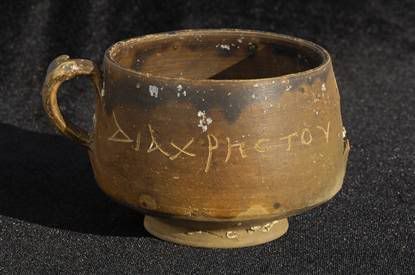
“Was Jesus Christ a magician?,” asks a Times of India headline. In fact this query comes from a recent discovery of a bowl in Alexandria by French marine archaeologists.

The full engraving on the bowl reads, “DIA CHRSTOU O GOISTAIS,” which has been interpreted by French epigrapher and professor emeritus Andre Bernand as meaning either, “by Christ the magician” or “the magician by Christ.”

“It could very well be a reference to Jesus Christ, in that he was once the primary exponent of white magic,” Goddio, co-founder of the Oxford Center of Maritime Archaeology, said.

For a moment assume that this inscription actually reads “by Christ the magician” and the Christ here refers to Yeshua, then it brings up few issues which have been suppressed by the gospel writers.

In the opening scene of The Betrayal: The Lost Life of Jesus: A Novel by Kathleen O’Neal Gear and W. Michael Gear, two Zealots, Dysmas and Gestas, come to meet Yeshua asking him to be their leader in attacking the Romans. During the entire conversation they call him “magician”.

In the footnotes of the book the authors mention that gospel translators took out most references to Yeshua as a magician, but still some remain. When Yeshua is taken to Pilate he is referred to as an evil doer, which in Roman terminology referred to a magician. Suetonius in the Life of Nero writes that Christians were involved in magical practices and sorcery. The magician role of Yeshua is also mentioned in Morton Smith’s Jesus the Magician and John Hull’s Hellenistic Magic and the Synoptic Tradition, but this aspect is seldom seen in modern biblical studies.

The problem with the inscription on the bowl is that it does not refer to either “Christ” or “Magician”

This cup has nothing to do with Christ. The Greek on the cup has CHRESTOU not CHRISTOU (or CHRSTOU as the newsreport has it!). CHRESTOU was a well-known title for one of the Sethian Gnostic archons, ATHOTH. It means “EXCELLENT ONE”. It is found in several Sethian texts, including the Gospel of Judas. I do not yet know what OGOISTAIS is, but I am going to work on it. But it doesn’t mean “magician.” This magical bowl is possibly a GNOSTIC magical bowl with an invocation to ATHOTH on it. So don’t believe the hype for minute. This bowl had absolutely nothing to do with CHRIST or with CHRIST as a magician. BUT it is totally fascinating if this object is actually SETHIAN! [Magical Cup has nothing to do with Christ]

The bowl was dated to the late 2nd century B.C. and the early 1st century A.D which means

it cannot in any case refer to Jesus Christ. The epithet Christ was not added to the name of Jesus of Nazareth until after the crucifixion, in the 30’s of the first century. And Jesus of Nazareth did not exist in the 2nd or 1st century BCE (unless he was an infant in the closing years of the 1st century BCE, as seems probable). [The Jesus Bowl: Another Crock]

Dinosaurs, Humans and Idiots

The Los Angeles Times reports on Sarah Palin’s fundamentalist beliefs.

Palin told him that “dinosaurs and humans walked the Earth at the same time,” Munger said. When he asked her about prehistoric fossils and tracks dating back millions of years, Palin said “she had seen pictures of human footprints inside the tracks,” recalled Munger, who teaches music at the University of Alaska in Anchorage and has regularly criticized Palin in recent years on his liberal political blog, called Progressive Alaska.

The idea of a “young Earth” — that God created the Earth about 6,000 years ago, and dinosaurs and humans coexisted early on — is a popular strain of creationism.[Palin treads carefully between fundamentalist beliefs and public policy – Los Angeles Times]

This Christian practice of taking the Bible literally had serious impact on Indian history as well. Since the world was created on 23rd October 4004 BCE, somehow the Indian scriptures had to be dated to work with that. Max Müller, the German Orientalist who believed that Christianity was a true historical event and 4000 years back was an early period in the history of the world conveniently put the date of Aryan arrival to India at around 1500 BCE.

We are still stuck there even when genetic studies show evidence to the contrary.

Constantine's Dream

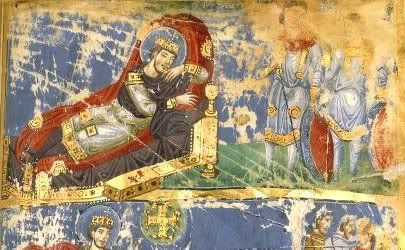
(Constantine’s dream)

The Battle of Milvian Bridge which was fought between Roman Emperors Constantine I and Maxentius on October 28, 312 was important because Constantine won and it resulted in the end of Tetrarchy, a system by which four emperors ruled the Roman empire. It was also important because on one night of the battle, Constantine claimed that he had a vision from God

It is commonly stated that on the evening of October 27, with the armies preparing for battle, Constantine had a vision which lead him to fight under the protection of the Christian God. The details of that vision, however, differ between the sources reporting it. It is believed that the sign of the cross appeared and Constantine heard “In this sign, you shall conquer” in Greek. [Vision of Constantine]

Constantine, besides being the first Christian Roman Emperor also by the Edict of Milan made professing Christianity not a crime.

There is a scene in The Betrayal: The Lost Life of Jesus: A Novel by Kathleen O’Neal Gear and W. Michael Gear where one of the protagonists mentions this battle. The monk Cyrus, who once was a soldier with Constantine, tells Kalay the washer woman that Constantine was sitting in his tent all day drinking wine looking for a way to motivate the troops. Constantine knew he had to come up with a myth; either a cross of light or the letters chi-rho (the first two letters in the Greek spelling of the word Christ)

While that was fiction, the truth is not far away. Eusebius of Caesarea spoke to Constantine and wrote in Life of Constantine

when Constantine “was praying with fervent entreaty, a most marvelous sign appeared to him from heaven” (Eusebius, Life of Constantine,1.28). The famous sign in the sky was a cross of light, with theinscription, “Conquer by this”. Eusebius goes on: “At this sight hehimself was struck with amazement, and his whole army also, which followed him on this expedition, and witnessed the miracle.”[The Resurrection of Jesus as Mass Hallucination]

Another Christian writer Lactantius who was a contemporary of Constantine had a slightly different version.

Lactantius’ early account places the vision of the cross in Constantine’s dream, and on the night before. So, Constantine’s vision is not shared by his army and it is a nighttime dream rather than a vision. [The Resurrection of Jesus as Mass Hallucination]

Thus in Constantine’s time itself one version of the story had the sign as a dream; another as a sign seen by the whole army. Thus a myth was created.