The End of Socialism

In Night at the Museum Ben Stiller plays a watchman at the Museum of Natural History where exhibits come to life after being animated by an Egyptian artifact. You can think of Jyothi Basu as the watchman of the Museum of Dead Ideologies where various exhibits like Lenin, Stalin, Mao, Pol Pot and Che Guevera come to life after being animated by the chanting of a few passages from The Communist Manifesto. It turns out that this geriatric curator has finally seen the light and has has revealed certain truths which were self-evident for rest of the world.

We want capital, both foreign and domestic. After all we are working in a capitalist system. Socialism is not possible now,” he said in response to a question after a meeting of the party’s state secretariat.“We had spoken about building up a classless society, but that was a long time ago,” he said. [We are expire !]

Various revolutionaries are shocked and cannot figure out why Jyothi Basu had to quit sticking his head in the sand. RSP national secretary K.Pankajakshan annouced that their revolutionaries, at least those who are alive, will continue with the head-in-the-sand policy and if the sand is not deep enough, they were willing to walk till the Gobi desert.

Kerala Chief Minister V S Achyutanandan argued that it is not a good idea to tell public that Santa Claus des not exist and chanted the Communist Gayatri mantra, “the innate strength of the working class would inevitably wipe away capitalism.”  Since the entire working class of Kerala is in “Gulf”, there was no one to hear his speech, but there are reports that Fidel Castro got up from his coffin and laughed at VS’ speech.

Jyothi Basu and the Bengali comrades should be congratulated for finally telling the truth, but the Kerala comrades are still following the Mother Teresa Design Pattern. The Mother doubted the existence of God, heaven and the soul and came to the conclusion that Jesus was not true, but still kept on saving souls for the church. The Kerala comrades too have become rich through capitalism and know very well that socialism is dead, but still keep on peddling that failed ideology.

In Night at the Museum, Ben Stiller gets help from President Teddy Roosevelt (played by Robin Williams) and he is able to control the chaos. Probably Achyutanandan needs help from President Bush (played by Will Ferell).

Nanotechnology in Ancient India

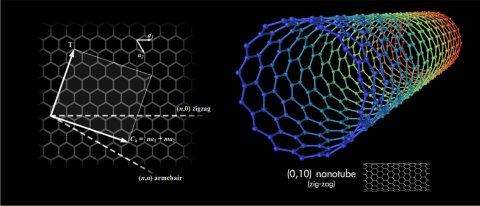
carbon-nano-tube
Carbon nanotube

Sir Walter Scott in his book Talisman mentions, through a recreation of the scene of October 1192 AD when Richard Lionheart of England met Saladin the Saracen to end the Third Crusade, that Richard wielded a good English broadsword while Saladin had a scimitar of Damascus steel, ‘a curved and narrow blade, which glittered not like the swords… but was, on the contrary, of a dull blue colour, marked with ten millions of meandering lines…'[Nanotechnology was used by ancient Indians’ ]

The Damascus steel is actually Indian steel. Wootz steel as it is known is formed by adding large quantities of carbon to iron and this steel industry was based in the southern peninsula. The name Wootz is the westernized version of Kannada ukku and Sangam Tamil ekku, meaning crucible steel.

According to Robert Floyd Curl, Jr., Nobel Prize Winner in Chemistry in 1996, Indian craftsmen used nanotechnology in Wootz steel as well as in paintings. More specifically carbon nanotubes, first announced by Russian scientists in 1952, was found in the sword of Tipu Sultan as well as in Ajanta paintings. Carbon nanotubes which are cylidrical fullerenes have extraordinary strength in terms of tensile strength and elastic modulus

“Our ancestors have been unwittingly using the technology for over 2,000 years and carbon nano for about 500 years. Carbon nanotechnology is much older than carbon nanoscience,” Curl said at the ongoing 95th Indian Science Congress here.

Indian craftsmen used unique smelting techniques to manufacture the Damascus blades which led to nanotisation giving them a unique long-lasting edge. Wootz also had a high percentage of carbon, which was introduced by incorporating wood and other organic matter during fabrication. India, for ages, was a leading exporter of this steel which was used to make Persian daggers which were quite popular in Europe centuries ago. [Indian craftsmen, artisans used nanotech 2000 yrs ago]

See Also: The nanotechnological wonders of Damascene steel, The Wootz File, Wootz Figures, The Legendary Wootz Steel

Lessons from the Renaissance

In 1503, the much awaited clash of the titans was to take place in the Salone dei Cinquecento, the imposing chamber of Palazzo Vecchio in Italy. Piero Soderini, an Italian statesman commissioned Leonardo da Vinci to paint Battle of Anghiari on one wall and Michelangelo Buonarotti, the Battle of Cascina, in the opposite wall. Even though the artists were contemporaries, they had never competed directly before. Both of them lived in Florence and had a strong dislike for each other and thus this contest was eagerly awaited for the people expected  this contest would push each artist to produce his best.

They worked on the initial drawings, but  both did not complete the task. Leonardo was known for not completing most of his projects and he turned his attention elsewhere. Pope Julius II summoned Michelangelo   to Rome for an even more prestigious project – to paint the ceiling of the Sistine Chapel.

Thanks to the work of artists like Leonardo da Vinci, Michelangelo, Giotto, Brunellesci, Donatello, and Rapahel and writers like Erasmus, Francois Rabelais, and Shakespeare, there was a resurgence in art, philosophy and literature from the late 13th century, which we  know as Renaissance.

Renaissance fostered an atmosphere in which value was placed on human excellence, demonstrated with real examples that  have set the standards for the modern age. While sitting through a lecture on Renaissance, the question in my mind was: Are there lessons we can learn from the 14th century Italians? Can we also achieve that level of greatness?

Continue reading “Lessons from the Renaissance”

Infinity Foundation: January Events

We are pleased to invite you to the following events in Delhi in early January:

  1. The World Congress 2008 on Spirituality & Psychology has over 450 registered delegates from 40 countries.
  2. Here is a pdf flier giving an overviewof Infinity Foundation, designed specifically for this World Congress.
  3. The first 3 volumes of our Series of 20-volumes on the History of Indian Contributions to Science & Technology will be launched on January 7th.

(From an e-mail from Rajiv Malhotra)

New Benazir Theories

On July 8, 1988, Bangalore-Trivandrum Island Express derailed and plunged into Ashtamudi lake near Kollam, Kerala, killing 107 people.There was an investigation and the accident was blamed on a localized tornado. This was probably the first and last tornado in the history of Kerala which surprisingly did not affect anything else in the neighborhood. On Feb 27, 2002 kar sevaks were burned to death in Godhra, Gujarat and the reason was found to be self-combustion.

Looks like investigators from Kollam and Godhra are now in Pakistan. According to some theories Benazir died because she had struck her head on a metal lever on the sun-roof of her
armoured Toyota Land Cruiser, resulting in a fatal skull fracture. Another theory is that she was killed by a laser gun. If the plan is to come up with an outrageous theory, they should go with the indigestion one.

Keep Those Resolutions

4000 years back Babylonians started the New Year by paying off debts and bringing back borrowed goods. In Rome, the New Year was considered a time to expunge old ills and set a pattern for the next twelve months. Every Jan 1st, we make a bunch of resolutions which we promise to keep for the year only to find that by Jan 31st, we can’t even remember most of them. If you are such a person, you are in the majority for statistics show that only about 15% of New Years resolutions are kept.

There are three simple ways by which you can keep your resolutions

  • One by One: Instead of starting a whole bunch of tasks on Jan 1, space it out and start a new one each month

    Each month of this
    year develop one new habit. Make it simple and doable. At the end of
    each month decide on a new “habit” for the next month and continue
    doing the existing habit. At the end of the year 12 habits will be
    developed.

  • Be specific: Instead of saying I will write every day, set a measurable target like, “I will write 300 words every day”. Instead of saying I will read more books, be precise by saying, I will read at least 5 pages daily. Once these resolutions are quantified they can be tracked.

    My first habit was to drink at least 2 quarts of water per day
    This is a pretty simple habit but it did take some planning to accomplish. I had to make sure I had a way to measure the water I was drinking and that I had a good source of water that I could take with me in the car and to work. I decided that 1 liter bottles of drinking water would do the trick. I bought a case of them from Costco and took some to work with me. It’s real easy to see if the goal has been accomplished as I will have 2 empty bottles at the end of the day.

  • Track the resolutions:Once Brad Isaac asked Jerry Seinfeld how to write better jokes and Seinfeld replied that for that you have to write every day.

    He told me to get a big wall calendar that has a whole year on one page and hang it on a prominent wall. The next step was to get a big
    red magic marker.

    He said for each day that I do my task of writing, I get to put a
    big red X over that day. “After a few days you’ll have a chain. Just
    keep at it and the chain will grow longer every day. You’ll like seeing
    that chain, especially when you get a few weeks under your belt. Your
    only job next is to not break the chain.”

Have a happy and productive new year!

The Karna Design Pattern

Numitor and his brother Amulius were descendants of fugitives from Troy and upon their father’s death, they received the throne of an ancient city near Rome. Numitor became the king and Amulius in charge of the royal treasury. Soon Amulius dethroned Numitor and fearful that Numitor’s daughter would produce children, she was sworn to abstinence. Well, we all know how well abstinence works, and before the daughter realized that she was pregnant and gave birth to twins. Amulius ordered that the daughter and both her children be killed.

The servant who had to kill the twins did not do it and instead put them in a basket on the banks of the Tiber river. The basket was carried downstream and the twins were  found by a shepherd Amulius who raised them as his own children. One of them grew up to be a dacoit and the other a software engineer. No, they grew up to be Romulus and Remus, known as the founders of Rome.

If this story has an uncanny similarity to the story of Karna don’t be surprised. The seventh century BCE  biography of Sargon says

My city is Azupiranu, which is situated on the banks of the Euphrates. My high priestess mother conceived me, in secret she bore me. She set me in a basket of rushes, with bitumen she sealed my lid. She cast me into the river which rose over me. The river bore me up and carried me to Akki, the drawer of water. Akki, the drawer of water, took me as his son and reared me. Akki, the drawer of water, appointed me as his gardener. While I was a gardener, Ishtar granted me her love, and for four and […] years I exercised kingship

Besides Moses, and Karna, others who have undergone this ordeal include Perseus who was cast into the open sea, but was saved by the fisherman Dictys, and King Nyatri Tsanpo, regarded as Tibet’s first recorded monarch, who was sent floating in a casket down the Ganges. Like the story of the great deluge, this is also one of the recurring themes across cultures. Also, without this pattern the Hindi movie industry would have folded in the early 70s.

Whose mother?

caral
The Pyramids of Caral

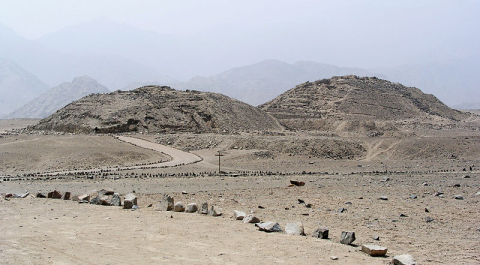
Caral, in Barranca province, Peru, is one of the oldest cities of the Americas. The site was inhabited between 2627 BCE and 2020 BCE and had  an elaborate complex of temples, an amphitheatre and ordinary houses.The official web site of the project lists all those societies which created civilization: Mesopotamia, Egypt, India, Peru, China and Mesoamerica. The web site calls Caral,the oldest civilization of America.

Writing in the Times of India, Shobhan Saxena decided to be more Peruvian than the Peruvians themselves, According to him, Caral is the mother of all civilisations. He also writes, “the earliest known civilisation in South
Americas—at 2,627 BC–was much older than the Harappa Valley towns
and the pyramids of Egypt.” Shobhan needs to know something: Google is your friend. The Indus valley civilization had its roots in Mehrgarh and reached the Mature phase by 2600 BCE. Ancient Egyptian civilization began around 3150 BC and they were building pyramids by the time of Caral.

One more thing. Even Tom Friedman does not use metaphors like “mother of all something” these days.

Top 10 Archaeological Discoveries

toba

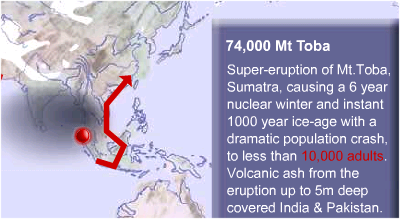
The Archaeology Magazine has published their Top 10 discoveries of 2007. Among the top 10 are the Solar Observatory at Chankillo, Peru, Nebo-Sarsekim Cuneiform Tablet, Greater Angkor, Cambodia, and Urbanization at Tell Brak, Syria. While nothing from India made it to the top 10, there is one story among the nine which did not make it to the final cut – Toba Survivors in Andhra Pradesh

Dec 25, 326 CE

Lupercal_grotto
The Lupercal

That was probably the date when Christmas was celebrated on Dec 25th for the first time and now we have a theory on the location where Christmas was first celebrated on the “official day.” The place is Basilica of St. Anastasia and the basis for the theory is the discovery of a pagan shrine, the Lupercal, dedicated to the founders of Rome – Romulus and his brother Remus. The Basilica of St. Anastasia was built around 326 CE near the Lupercal shrine  and the location was chosen to link pagan practices to Christian celebrations.

According to Roman mythology, the brothers were abandoned by their parents and was bought up by a wolf. They were discovered by shepherd, Faustulus who raised them as his own children. In January of this year, archaeologists found the Lupercal believed to be the one where the brothers were bought up by the wolf, and in November, the first photos were released. This cave is located between one of the seven hills of Rome and the Basilica of Santa Anastasia.

In the early days of Christianity, the practice was to appropriate pagan practices and celebrations.  The Roman emperor Constantine presided over the First Council of Nicaea and it was there that Dec 25 was picked as the birth date of Yeshua. During those times, two important pagan festivals were celebrated – the first one starting on Dec. 17 honored Saturn, a major Roman deity of agriculture and harvest and the second one starting on Dec 25, celebrated the birth of Mithras, the Persian god of light. Constantine combined both and we now have Christmas.

See Also: Merry Christmas!