Indian History Carnival–72: Linguistics, Yaadhum,Soubise, Ahmed Khan, Robert Smith

  1. Geo Currents has a post on the Vexatious History of Indo-European Studies. Part II of this post looks at how Indo-European linguistics was misused by various ideologues

    As “race science” gained strength in late 19th century Europe, it faced a major obstacle in Indo-European philology. European racial theorists maintained a stark separation between the so-called Caucasian[1] peoples of Europe and environs and the darker-skinned inhabitants of South Asia, yet the philologists argued that Europeans and northern Indians stemmed from the same stock. Some of the early efforts to mesh the new racial ideas with linguistic findings were rather strained. The popular American writer Charles Morris, for example, argued in 1888 that races are divided on the basis of both language and physical type, which generally but not always coincide; he further contended that “the Aryan is one of these linguistic races” (p. 5) that had lost its original physical essence. The general tendency was to emphasize ever more strongly this supposed loss of “purity,” and thus for physical type to trump linguistic commonality

  2. Baradwaj Rangan writes about Yaadhum, a documentary on the identity of Tamil Muslims.

    Yaadhum is some sort of road movie, and Anwar’s stops along the way illuminate various aspects of Islam in the South and even Goa. He goes to Chola country, establishing the presences of Muslims through an inscription that refers to “Ahmed the Turk.” He goes to Kayalpattinam, which belonged to the Pandyas, and finds an almost 1000-year-old mosque to which additions have been made at different times. He narrates the history of the Tamil Muslims of Pulicat, most of whom are boat builders. He goes to Calicut, home of the Mapilla Muslims. Prof. MGS Narayanan, Director General, Centre for Heritage Studies, Dept. of Cultural Affairs, Govt. of Kerala, talks about a law which is supposed to have been passed by the Zamorin that at least one member of the fishermen families in Calicut must get converted to Islam so that there will be enough people to support naval warfare against the Portuguese who wanted to conquer Malabar in the 16th century. (Hindus were generally reluctant to go to sea.)

  3. How does a slave from West Indies end up in West Bengal in 1777?  Carnival contributor Fëanor has that story

    He racked up large debts which the Duchess continued to pay off. He maintained a house in town, was a favourite of Garrick, and appeared at theatre vastly perfumed. ‘I smell Soubise!’ would go the cry amongst the punters when he appeared. He was caricatured in the popular press (one print by Austin showed him squaring off against the Duchess in a public fencing match), and even had portraits sketched by Gainsborough. In 1777, following an accusation of rape, he either escaped or was exiled to Bengal. As a skilled equestrian, he was able to found a riding school in Old Calcutta. He also taught fencing, and for a time sold books, possibly the first reported African British bookseller.

  4. Blake Smith writes about Ahmed Khan who was stuck in Marseilles on his way to London in 1792. He was off to London to sue British traders in Bombay for not paying back the loans.

    Ahmed did not speak French—yet—but he did speak Persian, then the language of diplomacy, poetry, and prestige throughout the Subcontinent. So did Pierre Ruffin, the French government’s official translator of ‘Oriental’ languages, which, at the time, meant Arabic and Persian. Ruffin, who had survived the fall of his former employers, had been in office for over a decade. His moment of glory had come in 1788, when an embassy from Tipu Sultan, ruler of the southern Indian state of Mysore, arrived in Paris to seal an alliance against Britain.

  5. Malini Roy has a post on Robert Smith, who was one of the British soldier artists who lived in India in the 19th century

    Smith’s view of Allahabad, for instance, focuses on a strange looking hybrid of a building, which is referred to by Lord Moira in his journal entry for 27 September 1814: ‘A mosque of rather elegant structure stands on the esplanade beyond the glacis. When we obtained possession of Allahabad, the proprietary right in the mosque was considered as transferred by the former Government to ours; and from some temporary exigency, the building was filled with stores. These being subsequently removed, much injury, through wantonness or neglect, was suffered by the edifice; and upon some crude suggestion, our Government had directed it to be pulled down. … The Moslems now implored that the building might be regarded as a monument of piety, and be spared. I have ordered that it shall be cleansed and repaired, and then delivered over to the petitioners’

The next carnival will be up on Jan 15th. Please leave your links as comments to this post or via e-mail.

The Yogi who met Socrates

Death of Socrates by Jacques-Louis David (1748–1825)

In the 5th century BCE, the contacts between India and Greece became sporadic. The reason for this was the defeat of the Persian army in two wars.  In 490 BCE, the Persian army, which included Indian cavalry, was defeated by the Athenians at the Battle of Marathon. The Persians were also defeated in 480 BCE at the Battle of Plataea which followed the Battle of Thermopylae (remember 300?).  Since the relation between the Persians and Greeks broke down, it in turn affected the Indo-Greek relations.
That said, there is evidence that Indian ascetics  traveled to Greece along a trade route that went through Oxus river, Caspian Sea, Kyros river and  Black Sea.  These ascetics influenced Diogenes of Sinope (412 – 323 BCE) who then introduced Indian ascetic practices into Greek traditions. But much before Diogenes, there is a mention of an Indian yogi who met Socrates and had a conversation.
According to Aristoxenus, a disciple of Aristotle, this Indian met Socrates in Athens and asked him what he studying. Socrates replied that he was studying human life. The Indian at this point laughed and asked him how could he study human life without studying the divine.  The quote is as follows

‘Now Aristoxenus the Musician says that this argument comes from the Indians: for a certain man of that nation fell in with Socrates at Athens, and presently asked him, what he was doing in philosophy: and when he said, that he was studying human life, the Indian laughed at him, and said that no one could comprehend things human, if he were ignorant of things divine [Eusebius of Caesarea: Praeparatio Evangelica (Preparation for the Gospel). Tr. E.H. Gifford (1903) — Book 11]

It is not sure if Socrates changed his mind, but his student Plato was influenced. Plato who previously argued that human and divine affairs were the same, started distinguishing between the two. According to Plato there was one kind of study concerning nature, another concerning humans and a third concerning dialectic.

‘But he maintained that we could not take a clear view of human affairs, unless the divine were previously discerned: for just as physicians, when treating any parts of the body, attend first to the state of the whole, so the man who is to take a clear view of things here on earth must first know the nature of the universe; and man, he said, was a part of the world; and good was of two kinds, our own good and that of the whole, and the good of the whole was the more important, because the other was for its sake.[Eusebius of Caesarea: Praeparatio Evangelica (Preparation for the Gospel). Tr. E.H. Gifford (1903) — Book 11]

Unfortunately, we don’t know the name of this Indian teacher and to what tradition he belongs to or any other detail.

Reference

    1. Mcevilley, Thomas C. The Shape of Ancient Thought: Comparative Studies in Greek and Indian Philosophies. 1st ed. Allworth Press, 2001.
    2. Caesarea, Eusebius of. Eusebius of Caesarea: Praeparatio Evangelica, 2010.

Preserving Vedic Chanting

(Photo via Ujjwol Lamichhane)

If you have played the party game called “Pass the Secret”, you will know that by the time the message reaches back to you, it would have been distorted beyond recognition.  But for many millennia, the Vedic hymns were memorized and handed down by word of mouth and the contents were preserved intact. The actual wording, intonation and pronounciation had to be perfect and for this the Vedic seers created a system to prevent alteration.
At Huffington Post, Suhag Shukla explains this system

To ensure that the Vedas remained unchanged in content, intonation, and inflection, a number of techniques of recitation with increasing complexity and difficulty were developed, including Jatapata.
The first is Samhita, the simplest form of recitation that approaches the mantra as it is, for example,”the sky is blue” (abcd). Next is Padha, where each word is broken down, as in, “the/sky/is/blue” (a/b/c/d). Krama, the third technique, adds the first real level of difficulty into the recitation through a pattern of “the sky/sky is/is blue” (ab/bc/cd). Jatapata, the first of the more challenging, alternates between a repetitious interposing and transposing of words to create a pattern of “the sky sky the the sky/sky is is sky sky is/is blue blue is is blue” (abbaab/bccbbc/cddccd). Between Jatapata and the last technique are six other techniques (called Mala, Shikha, Rekha, Dvaja, Danda and Ratha) that again are built-in combinations and permutations that have ensured that the order and words of the Vedas remain unchanged. The ultimate and most complex technique is called Ghanam. Its mind-boggling backwards and forwards pattern is, “the sky sky the the sky is is sky the the sky is/sky is is sky sky is blue blue is sky is blue” (abbaabccbaabc/bccbbcddcbcd).[Peeling Back the Layers of Sanskrit and Vedic Chanting]

Post-Rapture News

(via Wikipedia)

On October 30, 1938, Orson Welles made his famous War of the Worlds broadcast. Since it was presented as a series of news bulletins, listeners thought that an actual alien invasion was in progress. People panicked. According to Annie Jacobsen, author of the new book Area 51: An Uncensored History of America’s Top Secret Military Base, this panic was observed with amusement by Stalin and Hitler.

Ms. JACOBSEN: When the Orson Welles radio broadcast “The War of the Worlds” aired in 1938, people on the East Coast actually took actions based on their belief that Martians had landed in New Jersey and were attacking. And this fascinated the American military – I source all this in my book – and led to a lot of behind-the-scenes thinking about what it meant that American citizens could be so moved by something that was fictional – that was science fiction. And across the pond, Hitler also paid attention to “The War of the Worlds.” He referenced it in a speech. And according to my source, Stalin also paid attention to “The War of the Worlds” and was fascinated by American susceptibility toward science fiction. And so his plan, according to my source, was to create panic in the United States with this belief that a UFO had landed with aliens inside of it.[Transcript: Area 51 ‘Uncensored’: Was It UFOs Or The USSR?]

Replace Science Fiction with religion and things are no different in 2011. Some nut job in Oakland, CA announced that today would be the end of the world and there are thousands who are taking it seriously. A biblical event 19th century invention known as rapture, when Jesus Christ returns to take his saints and leave us bloggers and idolators to live peacefully on earth, was to happen, but apparently did not. But in United States –

Thousands of people around the country have spent the last few days taking to the streets and saying final goodbyes before Saturday, Judgment Day, when they expect to be absorbed into heaven in a process known as the rapture. Nonbelievers, they hold, will be left behind to perish along with the world over the next five months. With their doomsday T-shirts, placards and leaflets, followers — often clutching Bibles — are typically viewed as harmless proselytizers from outside mainstream religion. But their convictions have frequently created the most tension within their own families, particularly with relatives whose main concern about the weekend is whether it will rain.[Make My Bed? But You Say the World’s Ending]

So who started this hoax, which is the top news on Google right now?

Ms. Douglas and other believers subscribe to the prophecy of Harold Camping, a civil engineer turned self-taught biblical scholar whose doomsday scenario — broadcast on his Family Radio network — predicts a May 21, 2011, Judgment Day. On that day, arrived at through a series of Bible-based calculations that assume the world will end exactly 7,000 years after Noah’s flood, believers are to be transported up to heaven as a worldwide earthquake strikes. Nonbelievers will endure five months of plagues, quakes, wars, famine and general torment before the planet’s total destruction in October[Make My Bed? But You Say the World’s Ending]

Even Oprah was using the term in her final speech

Oprah gave her “ugly-cry” face and said “I’ve never experienced anything like this and I say once again thank you for taking me to a place that’s beyond joyous. I’m going to have to process it and look at it on tape to see what actually happened here. It feels like the rapture, so thank you all for that!”[Everybody Was at the Final Taping of Oprah]

Is this the first time such rapture craziness has happened? No, apparently rapture was supposed to happen in 1831, 1844, 1914, 1918, 1925, 1942, 1981, 1988, 1989, 1992, 1993, 1994, and now finally 2011. Now lets say for some reason, like for example, I don’t know, there is no movie called Return of Jesus Christ, rapture does not happen today, it can happen in 2060. The 2060 date cannot be absolutely, postively wrong because it was calculated by none other than Sir Isaac Newton based on the book of Daniel.

Threatened rock art of Pakistan

(via dawn.com)

At this point in time, survival of some ancient rock art may not be the most important item in Pakistan, but here it is anyway. Due to the construction of the Diamer-Basha Dam, some 30,000 carvings and inscriptions will vanish forever.

The Shatial, Thor, Hodur, Thalpan, Naupura, Chaghdo and other sites of northern Pakistan having clusters of carvings but the Basha-Diamer area holds thousands of very important rock carvings.
Hauptmann told Dawn.com that a total of 37,051 carvings on 5,928 boulders or rock faces will be inundated after the construction of the Diamer-Basha Dam.
The site represents hundreds of inscriptions in Brahmi, Sogdian, middle Persian, Chinese, Tibetan and even ancient Hebrew languages. Some 80 per cent of the writings are in Brahmi language.
These writings not only provide insights into the religious and political situation but also show the name of the rulers and a rough date of the time. These details of the inscriptions helped the experts arrange them chronologically.
One of the interesting Brahmi inscriptions can be read as; Martavyam Smartavyam, which means: “(Always) remember that (one day) you must die.[Threatened rock carvings of Pakistan]

Maybe Werner Herzog should visit the place with this 3-D camera before this happens.

The First Buildings

We know that agriculture was invented about 12,000 years back in various places around the world, starting with the Fertile Cresent. Many models have been proposed to explain why humans left a foraging for farming. With the discovery of the 11,500 year old temple at Göbekli Tepe in Turkey, we also know that religion played an important role quite early in the settled life.
Now we have new evidence of how people lived during that transitory period. The earliest permanent buildings found during this period were not individual homes, but places for communal living or gathering.

Finlayson, Mithen, and their colleagues conclude that the evidence from WF16, combined with evidence from other sites, suggests that the earliest villages were not made up of houses, but rather communal structures where people came together to process their wild harvests and possibly also to engage in community performances. “These settlements appear to be all about community and not about emerging households,” the team writes, adding that this “ritualized community activity” might have helped to bring together the work force necessary to harvest the wild crops.
The authors don’t speculate on where the farmers lived, and there is no way to be sure. Researchers working at similar sites have surmised that they lived in small camps near the central site, but such open air habitations are very difficult to find and often leave little or no archaeological traces.
Archaeologist Trevor Watkins, emeritus at the University of Edinburgh in the United Kingdom, says he “agrees strongly” with the authors’ conclusion that the social changes that took place during the transition from hunting and gathering to farming were at least as important as the later economic changes that led to full-blown domestication of plants and animals. But he thinks that it’s still possible that some of the other buildings at WF16 were used as domestic dwellings. Nevertheless, Watkins says, the communal activities at WF16 and other Neolithic sites probably created “powerful bonds of collective identity” in the earliest farmers that kept them together in stable societies “over many generations.”[First Buildings May Have Been Community Centers]

Calabashes or Plastic Pots?

(Photograph by author)

Many winter solstices back, a study compared certain parameters like life expectancy, infant mortality etc. of Kerala and United States and found they were equal. Thus it was concluded that Kerala is equal to United States. So the state assembly stopped debating mundane roti, kapda, hartaal issues and engaged in discussions of historical importance like if the final destruction of the library of Alexandria happened during the Muslim invasion in 642 CE.
A new study, done exclusively based on news reports, suggests that Kerala is not United States, but Nigeria. Few years back helmets were made mandatory in Kerala and as usual we Malayalees protested. No words can express what high literacy combined with anger can do to a society than this picture or this.
Recently Nigeria enforced helmet laws on motorcyclists and they protested in a way which would have made every Malayalee proud.

Motorcyclists in Nigeria have been wearing dried pumpkin shells on their heads to dodge a new law forcing them to wear helmets, authorities say. Road safety officials said calabash-wearers would be prosecuted. Calabashes are dried pumpkin shells more commonly used to carry liquid. [Nigeria bikers’ vegetable helmets]

In Kerala, everything is attributed to “western conspiracy”; in Nigeria, fear of voodoo.

Stories have also appeared in the local papers highlighting passengers’ fears that the helmets could be used by motorcyclists to cast spells on their clients, making it easy for them to be robbed. “Some people can put juju inside the helmets and when they are worn the victim can either lose consciousness or be struck dumb,” passenger Kolawole Aremu told the Daily Trust newspaper. [Nigeria bikers’ vegetable helmets]

The similarities do not seem to end. Prof. Amartya Sen should factor this into his studies of “Kerala’s experience of development.”

James Ossuary Not a Fake

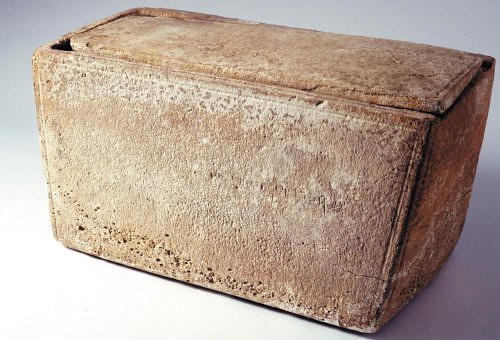
JamesOssuary

The story of the James ossuary continues. This limestone box carried an inscription “James son of Joseph, Brother of Jesus” and if it was proved to be true, could be historical evidence for one man named Yeshua (who may or may not be the one called Jesus of Nazareth).

One school held that the man who announced the existence of the ossuary had faked it. Biblical Archaeological Review held the position that  most scholars claim the ossuary is a fake, based on a hunch and not reason.

After three years in court, the case collapsed.

In the most recent embarrassment for the Israel Antiquities Authority (IAA), the government’s star witness, Yuval Goren, former chairman of Tel Aviv University’s institute of archaeology, was forced to admit on cross-examination that there is original ancient patina in the word “Jesus,” the last word in the inscription that reads “James, son of Joseph, brother of Jesus.”[Supporters of James Ossuary Inscription’s Authenticity Vindicated | Daily Bible and Archaeology News]

The battle is not over yet, but probably will be after 6 months depending on if the case against Tel Aviv antiquities collector Oded Golan is dropped or amended.

Technorati Tags: ,

Off to the Moon

As the debate continues on if it is prudent to spend money on space missions while there are other needs, it is worth reading how NASA helped invent Silicon Valley.

But if you’d visited the region in 1930, all you’d have seen was a two-lane highway cutting through acres and acres of nothing but farmland and tiny hamlets, and not even a hint of what would someday become arguably the most important commercial technology center in the world.

In December of that year, however, word came that the U.S. Navy was going to open an air station in Sunnyvale, Calif., one that would handle gigantic airships and that would need a mammoth hangar.

The result? The Sunnyvale Naval Air Station, later known as NASA Moffett Field. And today, Moffett is home to NASA’s Ames Research Center, a facility that is at the heart of Silicon Valley, both geographically and figuratively. In 1930 the region didn’t know what was about to arrive, but it soon realized how much change was coming. [How NASA helped invent Silicon Valley – CNET News]

Stop Praying to Hindu

Sen. John McCain’s campaign has been attracting such extreme elements that the candidate himself has been forced to defend his opponent.

In the next clip McCain is speaking up close with a woman in the audience who says she can’t trust Obama and then blurts out that it’s because he’s “Arab”. Some reports have it that she said ‘Arab terrorist’. But at least on this tape only ‘Arab’ is audible.

McCain shakes his head, as though losing his patience and snatches the mic back out of woman’s hands. “No, Ma’am. No, Ma’am. He’s a decent family man, citizen, that I just happen to have disagreements with on fundamental issues.” Again, there’s a lot there when you actually see the video. And I encourage you to watch.[Talking Points Memo | Weird. Sad. Surreal]

Today at a McCain rally at Davenport Pastor Arnold Conrad, who gave the invocation, said:

I would also add, Lord, that your reputation is involved in all that happens between now and November, because there are millions of people around this world praying to their god — whether it’s Hindu, Buddha, Allah — that his opponent wins, for a variety of reasons. And Lord, I pray that you will guard your own reputation, because they’re going to think that their god is bigger than you, if that happens. So I pray that you will step forward and honor your own name with all that happens between now and election day.[Think Progress » Minister delivers divisive invocation at McCain event. (Updated with audio)]

To paraphrase Swami Vivekananda, “What have the people who pray to Hindu done to get such dumb bigots?.” Compared to Pastor Arnold Conrad, the hate mongers who wrote the Satyadarshini pamphlet are Einsteins.

Also, a quick note to Pastor Conrad: Our God, Hindu, is not interested in a sophomoric “mine is bigger than yours” competition. Mostly it is because our God, Hindu, is not a God. He is an It — the unchanging, infinite, immanent, and transcendent reality which is the Divine Ground of all matter, energy, time, space, being, and everything beyond in this Universe.