Iraq Museum Reopens

Stuff Happens“, that was Donald Rumsfeld’s response when asked about the looting that happened in Baghdad following the US invasion of Iraq. One of the places that got looted was the Iraq Museum which carries artifacts from as far back as 9000 B.C.E. There was the usual mango man (aam aadmi) style looting where people ran into the museum and grabbed random millenia old artifacts, but there was also professional work where they broke through concrete walls.

Initially it was thought that 170,000 pieces had disappeared; soon the number was reduced to 15,000. Eventually it turned out that only 33 pieces were missing. An important object that disappeared was the Warka Vase, which is dated to 3200 – 3000 B.C.E. Then one day a red Toyota stopped by:

“The red Toyota spluttered to a halt in front of the Iraq Museum and three men in their early twenties jumped out. As they struggled to lift a large object wrapped in a blanket out of the boot, the American guards on the gate raised their weapons. For a moment, a priceless 5,000-year-old vase thought to have been lost in looting after the fall of Baghdad seemed about to meet its end. But one of the men peeled back the blanket to reveal carved alabaster pieces that were clearly something extraordinary. Three feet high and weighing 600lb intact, this was the Sacred Vase of Warka, regarded by experts as one of the most precious of all the treasures taken during looting that shocked the world in the chaos following the fall of Baghdad. [The Iraq War & Archaeology]

Finally after 6 years the museum opened, in February. Well, sort of. You can visit if your name is Nuri Kamal al-Maliki. It will take much longer before an Iraqi mango man can stand before the exhibits, look at the cuneiform inscriptions of ancient Sumer, and wonder about the Meluhhans who could read that tablet. Till then even we Meluhhans have to visit it virtually.

Pavlopetri, Dwaraka etc.

That is the video of a 5000 year old submerged town —- almost a complete town with separate buildings, courtyards, streets and graves — in Greece. Pavlopetri was a harbor town which dates to between the Minoan civilization and the Mycenaean Greek culture, which coincides with the de-urbanization of Harappa.

“This site is unique in that we have almost the complete town plan, the main streets and domestic buildings, courtyards, rock-cut tombs and what appear to be religious buildings, clearly visible on the seabed. Equally as a harbour settlement, the study of the archaeological material we have recovered will be extremely important in terms of revealing how maritime trade was conducted and managed in the Bronze Age.” [World’s Oldest Submerged Town Dates Back 5,000 Years]

Recently The Archaeology Magazine had a feature on 12 great underwater discoveries — of submerged sites, Bronze Age ship wrecks and European ships —- and they left out underwater archaeology in India.

In 2002, in Mahabalipuram, “underwater investigations showed the presence of the remains of walls as well as large stone blocks, which seemed to correspond to the time period of the surviving shore temple. Excavations carried out by ASI in 2005 also revealed the remains of two structural temples, found near the shore temple.” Also after 2004, the “naval diving team, assisting the Archaeological Society of India, also discovered another structure perhaps a temple 100 metres north-east.”

Similarly the ASI conducted excavations near the Dwarkadheesh temple and Gomti Ghat in Dwaraka.They found “a structure of stone blocks with post holes to fit wood”, and “coins, pottery, pieces of bangles and toys”

Previous under water excavations revealed about 120 anchors. These anchors often had three holes of which the upper one was used for tying a rope and the other two holes for holding wooden flukes. The Underwater Archaeology Wing recently found what they call fragments of ancient structures. It is not known of it is part of a wall or temple and so it is classified as part of some structure. One of the structures consists of stone blocks with holes to fit wood and the age of that is unknown.[Dwaraka Update (2)]

Also, a circular wooden structure made of stone and wood was found. Murli Manohar Joshi claimed that finds in Dwaraka were 9500 years old, but science disagreed: some of the finds were dated to 2280 B.C.E.

The Aryan Debate: Horse

In 1974, archaeologists J. P. Joshi and A. K. Sharma found horse bones in Surkotada, a Harappan site in Gujarat. This was a sensational discovery: first, it was the bones of a horse and second, it was dated to the period 2265 B.C.E. to 1480 B.C.E, which corresponds to the Mature Harappan period[1].

Finding horse remains, especially from India, are always controversial. For example, one of the earliest claims of horse is dated to 4500 B.C.E in the Aravalli range in Rajasthan – the same place from where the Harappans got their copper. This period is the same time when horse was first domesticated in the world. So there are questions: was the artifact obtained from a Bronze Age level even though the site was Neolithic? Was it really a horse — the Equus Caballus —rather than a donkey or onager.?

Due to the large size of bones and teeth of an onager, it is hard to distinguish it from a horse. Also sometimes the reports that come with excavations have insufficient measurements, drawings, and photographs required for independent assessment[1]. Due to this the findings are always suspect; it is always concluded that the horse arrived quite late to India.

Such questions arise because in the Indo-Aryan debate — if Vedic civilization pre-dated, co-existed or followed the Harappan civilization — a key factor is the horse. In this debate the main argument against Harappa being Indo-Aryan can be summarized as follows.

  1. According to the popular version of Indian pre-history, horse — an animal not native to India — was bought to India by the Indo-Aryans when they came in 1500 B.C.E. There is no evidence of horse in India before 1500 B.C.E.
  2. Among the numerous seals found in Harappa there is none which represent a horse, while other animals like the bull, buffalo, and goat are represented.
  3. In Rg Veda, the horse (asva) has cultural and religious significance. Since there is absence of horse in Harappa, it can only mean that the Vedic people arrived after the decline of the Harappan civilization.

The find at Surkotada upset this narrative because it crossed a lakshman rekha into Mature Harappan and also violated the threshold for the Indo-Aryan arrival. Hence the findings themselves became suspect – at least till 1991.

The eminent archaeozoologist, Sandor Bokonyi, was in Pune to attend a workshop on ‘Prehistoric contacts between South Asia and Africa’ at the Deccan College. Following the conference he spent some time in Delhi where the Excavation Branch of the ASI showed him the finds from Surkotada which consisted of six samples, mostly teeth. After examining the artifacts, he concluded that they were not of a half-ass, but a real domesticated horse[7].
Continue reading “The Aryan Debate: Horse”

Historical News (1): Pazhassi Raja, MMW, Neolothic Axe

  • From Newspapers
    1. Karur coins of Greeks, Romans and Phoenicians
    2. According to Dr. Nagaswamy, Tamil scholar Francois Gros of the Ecole Francais Extreme Orient, Pondicherry, suggested the study of all the Karur finds and assessment of their archaeological significance, along with the role of Karur in the history of Tamil civilisation. The studies clearly proved that the presence of these foreigners had left a far deeper impact on the economy, defence, arts and architecture than imagined earlier.

    3. Recently Edakkal Caves in Kerala has been a hub of discoveries: A Neolithic axe was found in  Ambukuthy hills and one of the caves had an Indus Valley sign.
    4. Of the identified 429 signs, “a man with jar cup”, a symbol unique to the Indus civilisation and other compound letters testified to remnants of the Harappan culture, spanning from 2300 BC to 1700 BC, in South India, Mr. Varier, who led the excavation at the caves told PTI.The “man-with-the-jar” symbol, an integral remnant commonly traced in parts where the Indus Valley civilisation existed, has even more similarities than those traced in Karnataka and Tamil Nadu, he said.

    5. Kesavan Veluthat has a review of Thomas Trautmann’s The Clash of Chronologies
    6. In the 18th century, when prehistory had not been known and the western intellect was struggling under the burden of biblical chronology, either the world outside Christendom had to be fitted within the scheme or the scheme itself had to be thrown overboard. Sir William Jones was trying to vindicate the “short chronology” of the Bible, with creation located some four millennia before Christ, in opposition to the Enlightenment tirade against the Bible and what it represented. Thus, an ethnology deriving the peoples of the world from the children of Noah, a philology starting with the tower of Babel and a cartography derived from Ptolemaic notions tried to fit the new information into its mould — however hard that was.

  • Movies
    1. One historical movie which is currently in theatres is Pazhassi Raja, based on the true story of a Malayali prince who fought a guerilla war against the British in 1795.

    2. One historical movie which looks to be good is Agora, which is based on the life of Hypatia, the female astronomer and mathematician, who lived from 370 CE – 415 CE.

  • Podcasts
    1. If you have been fascinated by Ardi, Out of Africa theory and the like, one course worth listening is  the MMW1 (Prehistory and the birth of civilization) from UC San Diego. This time they are offering three tracks online, which is the same course taught by three different professors. I have been listening to the one by Prof. Tara D. Carter.
    2. This term Prof. Matthew Herbst is teaching MMW4 (New Ideas and the clash of cultures). Prof. Herbst is one of the best teachers of history as we have noted before and his lectures are highly recommended.

Indian History Carnival – 22

The Indian History Carnival, published on the 15th of every month, is a collection of posts related to Indian history and archaeology.

  1. In February 2009, a conference was held in Los Angeles titled, “The Sindhu-Sarasvati Valley Civilization: A Reappraisal“. This title was the cause of grief in some circles due to the association of Sarasvati with the Harappan civilization. Few of those lectures have been posted in their blog
  2. Did Islam spread in India through violence? Were Hindu kings more violent than Islamic conquerers? Sandeep takes a look
  3. I hate to disappoint him but this particular morsel of history dates farther back than Ghaznis and Ghoris. As early as CE 664, Abdur Rahman, an Arab invader took Kabul (then part of India). However, it took at least two centuries for Mohammad Bin Qasiman Arab againto successfully occupy parts of Sindh around CE 711-712. Subuktgin and his prodigious son, Mohammad of Ghazni, and then Mohammad Ghori were all Turks. I leave it to the readers intelligence to deduce from this piece of historical evidence that Qasim, Subuktigin, and the two Mohammads were merchants.

  4. Based on Prithviraj Vijay, a 12th century account of the Kingdom of Ajmer, Airavat writes about the political and militrary details.
  5. The pages following this eyewitness account are missing but this seems to have occurred in 1178 when Muhammad Ghori invaded Gujarat, sacking Nadol and Kiradu on the way. The manuscript continues, “When these fiends in the shape of men took possession of Nadol, the warriors of Prithviraja took up their bows and the emperor became angry and resolved to lay Ghori’s glory to dust.”

  6. While Hampi is a well known destination, Pattadakkal which is about 90 miles is masked by Hampi’s shadow, says Arundhati.
  7. After all, was Pattadakkal not considered so auspicious that Chalukya kings made it a point to be crowned on its soil? Did its literature not include some of the earliest work in the nascent Kannada language? And did not its architecture set the standard for future temple building? Even Vijayanagar for all its confidence could not resist incorporating Chalukya architectural styles.

  8. Visiting Mahabalipuram after many decades, Kamini writes about the journey, how this place captured Western imagination and different versions of Arjuna’s penance.
  9. Marco Polo is said to have visited Santhome (now in modern-day Madras) where he was regaled with tales of the lost temples of Mahabalipuram. His descriptions found their way, in part, to the Catalan Atlas of 1375. The Catalan Atlas is one of the most important atlases of the medieval era, and was put together by a Catalan Jew (from Spain) called Abraham Cresques. It shows India in peninsular form, and Mahabalipuram is mentioned there as “Setemelti”, which is assumed to be an erroneous version of “Sette Templi” – or seven temples.

  10. Another place which Marco Polo visited was Tanjavur, the Chola capital. Hari was there recently and writes about how Dravidian politics has caused a surge in faith.
  11. Being pious and following certain customs are ways of projecting one’s elevated caste status. This has resulted in a resurgence of local gods and goddesses — Adi Parasakthi for example. And feature stories in Tamil weeklies are often about film stars and prominent personages visiting their villages to worship their family deities.

  12. Arby explores the similarities between Roman religion and Hinduism
  13. It is more likely that the over the last three millennia, Hindutva evolved across the Indian subcontinent integrating itself with local beliefs, much like the Roman religion as mentioned earlier. However, without a central point of authority, the evolution has been chaotic and inconsistent. Also, the evolution was slow and time consuming. But in the end, Hindutva is a religion similar in character to the Roman one, with respect to religious belief, though not theology.

f you find any posts related to Indian history published in the past one month, please send it to jk AT varnam DOT org. Please send me links which are similar to the ones posted, in terms of content.The next carnival will be up on Nov 15th.

See Also: Previous Carnivals

Indic influence in ancient Syria and Egypt

Mention ancient Egypt and the names we remember are Tutankhamen, Nefertiti and Cleopatra. For an Indic connection there is Ramesses II – the Pharaoh who had peppercorns stuffed into his nose. Though he was dismissed as a rebel and heretic, one Pharaoh who deserves attention is Nefertiti’s husband and Tutankhamen’s father Akhenaten (1353 – 1336 BCE) – the first known monotheist and probably the founder of monotheist intolerance.
Recently BBC Radio 4’s In Our Time (via Anne) had an episode on Akhenaten and one of the issues they discussed was why did Akhenaten, in a polytheistic Egypt, insist on the worship of only the Sun disk Aten? Was that a shift in theological thinking or a political move to divest the powerful priests of Amun of their power?
There is no clear answer for why in the third year of his reign Akhenaten started the construction of the new temple dedicated to his Sun god. In some incomplete inscriptions Akhenaten mentioned that things were bad during the reign of his father and grandfather, but it is not clear what was bad. This is also a bit surprising since the reign of his father — Amenhotep III — was  one of those prosperous times in Egyptian history[1].
But another possibility — one which is rarely mentioned — is that Akhenaten’s father-in-law, one Tusharatta, was a Mittani king in North Syria. His wife Kiya was a Mittani and his mother Tiye was half-Mittani. The Mittanis were a warrior elite who ruled over a Hurrian population. But what’s special about them is that they spoke an Indo-Aryan language.

In a treaty between the Hittites and the Mitanni, Indic deities Mitra, Varun. a, Indra, and N¹asatya (Asvins) are invoked. A text by a Mitannian named Kikkuli uses words such as aika (eka, one), tera (tri, three), panza (panca, ¯ve), satta (sapta, seven), na (nava, nine), vartana (vartana, round). Another text has babru (babhru, brown), parita (palita, grey), and pinkara (pi _ ngala, red). Their chief festival was the celebration of visuva (solstice) very much like in India. It is not only the kings who had Sanskrit names; a large number of other Sanskrit names have been unearthed in the records from the area.[Akhenaten, Surya, and the R. gveda2]

But is this language Indo-Iranian, Iranian or Indo-Aryan or to rephrase: did the Mittanis speak the PIE branch of India.? That matter was settled in 1960 by Paul Thime[3].

There are several reasons, but to be brief, I shall only give three: 1. the deities Indra,Mitra, Varun.a, and Nasatya are Indian deities and not Iranian ones, because in Iran Varun.a is unknown and Indra and Nasatya appear as demons; 2. the name Vasukhani makes sense in Sanskrit as a “mine of wealth” whereas in Iranian it means “good mine” which is much less likely; 3. satta, or sapta, for seven, rather than the Iranian word hapta, where the initial `s’ has been changed to `h’.[Akhenaten, Surya, and the R. gveda2]

How did this Indo-Aryan speaking population reach Syria and Palestine in the 14th century B.C.E? There are four possibilities[3].

  1. This group split away from the Iranians, colonized the Mittani kingdom and then reached India.
  2. One group split away from Iranians and moved to India, while another group went to the Near East.
  3. The Indo-Aryans reached India and then went back to Near East.
  4. Indo-Aryans, a Vedic speaking tribe from India left for the Near East taking their gods with them.

Among these (1) is not considered as serious possibility while (2) is the most commonly accepted one. Sten Konov argued for (3) while Frederick Eden Pargiter supported (4). According to H. Jacobi (who believed that the Mittanis came from India), since the worship of Vedic deities was happening in 14th century Mittani kingdom, it would have happened in India much earlier. Jamna Das Akhtar and P.E.Dumont thought that the dates were even earlier[3].
In fact there are many arguments in support of (4). Archaeologists have not found Central Asian, Eastern European or Caucasian culture in the Mittani kingdom. At the time same time they found the peacock motif – something which could have come from India. Based on this Burchard Brentjes argued that Indo-Aryans were settled in the Near East much before 1600 B.C.E[3].With all the trading relations between various parts of India and the Near East, dating as far back as 4000 BCE with the find of cotton in Dhuwelia and carnelian bead in  Mesopotamia in the third millennium BCE, the migration of Indo-Aryans is not a fantasy tale.
Thus with all the Indo-Aryan culture around him, is it possible that Akhenaten got the idea of “One Truth” and the worship of the disk of the sun from it?[2]
There is another related mystery: how this concept of the worship of one God, which disappeared from Egypt, surface in Judaism much later.? The most common explanation is that probably Moses, who according to the Hebrew Bible led an exodus, took the idea to Israel. But archaeology has revealed that the Exodus as mentioned in the Bible never happened. One theory is that they adopted it from a desert people called Shasu? Is there any other explanation?
Postscript: Finally it would take Tutankhamen, the boy king who is currently in San Francisco, to restore the old Egyptian culture back.
References
========

  1. In Our Time, BBC Radio 4
  2. Subhash Kak, Akhenaten, Surya, and the Rg veda,July 17, 2003
  3. Edwin Bryant, The Quest for the Origins of Vedic Culture: The Indo-Aryan Migration Debate (Oxford University Press, USA, 2004).

BC or BCE?

While we were editing the June 2009 History special issue of Pragati, one of the questions that came up was the notation to represent dates: should it be BC or BCE.? Since Pragati follows the Economist style guide, BC was chosen. Though you see BCE a lot more than BC, I have listened to a lecture series from UC Berkeley where the instructor justified using BCE whereas another instructor from UC San Diego justified the use of BC.

The issue with terminology like BC and AD is that it is connected to the birth of Jesus of Nazareth. Robert Cargill of UCLA argues that Christians should switch to BCE/CE system since it would actually help them

Insisting that the world use a calendar based upon the birth of Jesus only exacerbates the internal biblical inconsistencies of dating the birth of Jesus. Therefore, it would be better for all people — Christians and non-Christians alike — to adopt the BCE/CE system of dating. While it was originally supposedly based upon the date of Jesus ‘birth, it in fact was not, but is rather loosely tied to events in the Roman Empire during that time that we can arbitrarily refer to as the beginning of a modern, common era. The BC/AD system no more accurately reflects the reality of Jesus’ life than does Monty Python’s The Life of Brian [Why Christians Should Adopt the BCE/CE Dating System]

The BC/AD system is wrong when it is connected to the birth of Jesus because he was not born in the year 0, or 1 BC or 1 AD; he was born either 4 or 6 or 7 years before 0. But does writing BCE instead of BC remove Jesus? Even though the words Before Common Era may not be as explicit as Before Christ, he is still lurking around in those dates. It is also not clear how switching to BCE will remove the internal biblical inconsistencies like if he was born during the reign of Herod the Great or Quirinius. One thing is sure: it is better to say Jesus was born in 6 BCE rather than 6 years Before Christ.

Though there are some academics who still use BC, the BCE/CE system is gaining acceptance.

The Smithsonian Institution prefers Common Era usage, though individual museums are not required to use it. Furthermore, several style guides now prefer or mandate its usage.Even some style guides for Christian churches prefer its use: for example, the Episcopal Diocese Maryland Church News. In the United States, the usage of the BCE/CE notation in textbooks is growing. Some publications have moved over to using it exclusively. For example, the 2007 World Almanac was the first edition to switch over to the BCE/CE usage, ending a 138-year usage of the traditional BC/AD dating notation. It is used by the College Board in its history tests, by the Norton Anthology of English Literature, and by the United States Naval Observatory. Others have taken a different approach. The US-based History Channel uses BCE/CE notation in articles on non-Christian religious topics such as Jerusalem and Judaism. [Common Era]

If that doesn’t convince you, even Jehovah’s Witnesses – the folks who don’t believe in evolution– have switched. Shouldn’t you?

The Lost-Wax Method

During the third millennium BCE that trade relations between India and Mesopotamia prospered: Burial sites in Mesopotamia had shell-made lamps and cups produced from a conch shell found only in India; Early Dynastic Mesopotamians were consumers of the Harappan carnelian bead. Also the Gujaratis were exporting hardwood and there are even unverified reports of spices from the Malabar coast reaching Mesopotamia. But now there is a debate over if a colony of Indians lived in Mesopotamia —  in a Meluhhan village — at that time[Trading Hubs of the Old World – Part 2]

During this period, texts from Uruk in Mesopotamia mention copper, mainly copper from Dilmun (Bahrain), which originally came from Magan (Oman). In return the Mesopotamians exported barley[1]. The Harappans too used copper extensively. While one copper source was Oman, the other was the Jodhpura-Ganeshwar culture of Rajasthan[2].
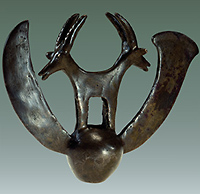
Skipping a few millennia, a 10th century BCE copper production center was discovered in the Negev desert and was claimed to be King Solomon’s mines, though there is debate over if there was a King Solomon. One of the artifact from that era is the twin-headed ibex and swords, found in Israel’s Cave of the Treasure.
Ancient artisans — in Mesopotamia, Greece, China — used a technique called the Lost-Wax method to produce works of art, but that technique is not used much any more. One place where this technique still survives is in Tanjavur district – the realm of the Chola empire. It was here, as Vilayannur Ramachandran explains, that Hindu artistes exaggerated feminine beauty to jolt the aesthetic sense of the viewers.
When a picture of the twin-headed ibex and swords was given to the sthapathi in Swamimalai he was able to create the same using a process which has been around for millennia.


References:

  1. Nicole Boivin and Dorian Fuller, “Shell Middens, Ships and Seeds: Exploring Coastal Subsistence, Maritime Trade and the Dispersal of Domesticates in and Around the Ancient Arabian Peninsula,” Journal of World Prehistory 22, no. 2 (June 1, 2009): 180, 113.
  2. Jane R. McIntosh, The Ancient Indus Valley: New Perspectives, 1st ed. (ABC-CLIO, 2007).

Cretaceous Park, Tamil Nadu

The most important science news the past week has been Ardi: Science had a special issue; there was extensive media coverage both in print and radio; Discovery channel is telecasting a documentary next week. At the same time news of the the 4.4 million year old hominid species that lived in the Afar Rift region of northeastern Ethiopia came out, there was news from India, of a 65 million year old find – of Dinosaur eggs.

On a sultry afternoon on September 12 this year, Ramkumar and his research students went to Ariyalur to scour the rocks and sediments as part of a study funded by Indian and German scientific institutions. As they paused by a stream on a grazing land at Sendurai, they found spherical-shaped fossils peeping out of the sand beds. “We got really excited. As I have seen a dinosaur egg, I was sure these were dinosaur eggs,” said Ramkumar.
A quick digging revealed clusters of eggs beneath seven layers of sand spread over two sqkm. The eggs may not have hatched due to the Deccan volcanic eruptions or seasonal flooding, surmise the team. “We suspect the extinction of dinosaurs was triggered by the Deccan volcano. Volcanic ashes cap the eggs,” said one researcher. [India’s Jurassic nest dug up in Tamil Nadu]

National Geographic has a photo of the egg. Dr. Nitish Priyadarshi has the analysis of the eggs belonging to the Cretaceous period.


Trading Hubs of the Old World – Part 2

Photobucket
(The Arabian Sea Network)

(Read Part 1)
In 1881, the Theosophist Henry Steel Olcott, said, “We Europeans..have a right to more than suspect that India 8,000 years ago sent out a colony of emigrants[6].” New evidence suggests that Olcott was right about the time, but wrong about Indians emigrating in the Old World.
During the third millennium BCE that trade relations between India and Mesopotamia prospered: Burial sites in Mesopotamia had shell-made lamps and cups produced from a conch shell found only in India; Early Dynastic Mesopotamians were consumers of the Harappan carnelian bead. Also the Gujaratis were exporting hardwood  and there are even unverified reports of spices from the Malabar coast reaching Mesopotamia. But now there is a debate over if a colony of Indians lived in Mesopotamia — in a Meluhhan village — at that time[7].
The interesting news is that these trade relations happened much earlier than was previously believed. The important question is: did Harappans have knowledge of the monsoon winds to travel to Mesopotamia?
Soon trade with Mesopotamia declined because Oman developed as a trading hub; the Harappans did not have to travel as far as Mesopotamia for trading. Oman imported both luxury goods and basic commodities: wood, carnelian, combs, shell, metal objects, seals, weights and possibly large volume storage jars. What was considered luxury – copper, cereals — became common goods with coastal communities playing a major part.
The bitumen coated reed boats of the third millennium BCE were replaced by the plank-built wooden boats by the second millennium BCE. Instead of a few major players, there were many minor players creating a distributed network.
While there is evidence for sea-faring Harappans traveling to the Persian Gulf, there is no archaeological evidence of Mesopotamians reaching India during that period. Since no large ports, warehouses have been found in Harappa, it is assumed that the trade involved small-scale ports belonging to local communities; the Lothal dock and warehouse is of late Harappan period.

The other interesting development is the trade with East Africa. The Arabians and their neighbors in Levant and Mesopotamia used wheat and one species – the bread wheat – came from the Indus and the other – emmer wheat – from Africa. The pearl millet which was domesticated in Mali and Mauritania around 2500 BCE was found in Gujarat  by 2000 – 1700 BCE. African crops like sorghum and Ragi started appearing in South India after this period, possibly via Gujarat. There was a Western transmission of crops too: moong dal (third mil BCE), urad dal (2500 BCE), pigeon pea (1400 BCE), sesame (2500 BCE), and cotton (5000 BCE) made their way to both Africa and Arabia.

(Zebu)

By 2000 BCE, the the Harappan maritime activity shifted to Gujarat. Around that time the trade between Africa and India intensified. While crops moved from Africa to India, genetic studies have shown that the zebu cattle went from India via Arabia to Africa.  These Bos Indicus, who reached Africa, met some Bos taurines and before you knew, sparks were flying, setting the African Savannah on fire. There is also evidence of the migration of zebus from Indus to Near East via Iran in the late third millennium BCE. Some of this zebu movement involved travel by boats along the Arabian coast and points to a trade on a much larger scale. Thus the transportation of a giraffe in 1405 by Zheng He’s fleet from Africa to China does not look that far fetched.

The Omanis developed wooden boat technology and deep-sea fishing around the time the African crops reached India. If they had knowledge of monsoons, the Omanis could reach India directly, else they had to travel around the Makran coast and reach India via Iran. It is also possible that the Omanis got their wooden craft technology from Indians; after all they imported wood from India.

(Ramses II)

An interesting development happens in 1200 BCE. Among the dried fruits kept in the nostrils of the mummy of Ramses II was pepper and there was only one place in the world where pepper was produced. While this points to the first contact between the Malabar coast and Egypt and the origins of the spice trade, what is not known is how the pepper reached Egypt.
The Harappan trade meanwhile shifted from Oman to Bahrain — Mesopotamian textual sources start mentioning more of Dilmun than Magan — and so Dilumn became the transit point for goods to Mesopotamia from India, but this change in the transit point did not affect the goods. Many millennia later when When Ibn Battuta visited Calicut, the chief merchant was an Ibrahim from Bahrain with the title shah bandar (the port master or chief of harbor)[5].
This is the point we see the rise of an early capitalism with private Mesopotamian citizens funding seafaring merchants who operated in a complex exchange system. Business was risky, but Dilmun communities thrived on the profit.
Then slowly we see the merchants in Dilmun adopting Harappan administrative standards. Thus goods were sealed with the Harappan style stamp seals and not the cylindrical Mesopotamian ones. The Indus weight system was also used and it was known as the standard of Dilmun. Meanwhile certain seals found also in Mohenjo-daro and Harappa, which were inspired by the Sumerian seals
By Iron age, there was a technological break through with the mastery over monsoons. The Arabians were already using monsoon winds to reach India. At the same time the Egyptians too started doing the same — with boats with sharp bows and triangular sails — skipping the middlemen in Arabia due to which South Indian ports gain prominence over Gujarati ones.
Finally
Since our minds are locked in to the “Aryan migration/trickle down” 1500 BCE time frame, we rarely look into the interactions before that period. A recent paper in Nature, on the origins of Indian population, showed that the rise of Ancestral North Indians and South Indians was connected to human. Between these two events, Indians had extensive trade contacts with the Old World and hence the door was not closed after the ANI and ASI established themselves. There was movement of people, animals and plants, both into India and out of India for many generations. It is worth investigating what impact this interaction had in the cultural transformation of the subcontinent.
A painful lesson India and Africa learned is that trade usually ends up in colonization. But looking at the trade network of this period, there is no such evidence, even in a place like Bahrain which was central to the global trade. Trade, free of colonization, would take place even during the medieval period till the Portuguese showed up in Calicut in 1498 looking for “Christians and spices.”

References:

  1. Himanshu Prabha Ray, The Archaeology of Seafaring in Ancient South Asia (Cambridge University Press, 2003).
  2. Nicole Boivin and Dorian Fuller, Shell Middens, Ships and Seeds: Exploring Coastal Subsistence, Maritime Trade and the Dispersal of Domesticates in and Around the Ancient Arabian Peninsula, Journal of World Prehistory 22, no. 2 (June 1, 2009): 180, 113.
  3. Jack Turner, Spice: The History of a Temptation (Vintage, 2005).
  4. Jacques Connan, “A comparative geochemical study of bituminous boat remains from H3, As-Sabiyah (Kuwait), and RJ-2, Ra’s al-Jinz (Oman),”Arabian Archaeology and Epigraphy 16, no. 1 (2005): 21-66.
  5. Mehrda Shokoohy, Muslim Architecture of South India: The Sultanate of Ma’bar and the Traditions of Maritime Settlers on the Malabar and Coromandel Coasts, 1st ed. (RoutledgeCurzon, 2003).
  6. Edwin Bryant, The Quest for the Origins of Vedic Culture: The Indo-Aryan Migration Debate (Oxford University Press, USA, 2004).
  7. C. C. Lamberg-Karlovsky,Archaeological Thought in America (Cambridge University Press, 1991).

Notes:

  1. Most of this article is based of Reference [2].
  2. From Wikipedia: “In 1974, Egyptologists visiting his tomb noticed that the mummy’s condition was rapidly deteriorating. They decided to fly Ramesses II’s mummy to Paris for examination. Ramesses II was issued an Egyptian passport that listed his occupation
    as “King (deceased)”. The mummy was received at Le Bourget airport,
    just outside Paris, with the full military honours befitting a king”

Images: (via Wikipedia)